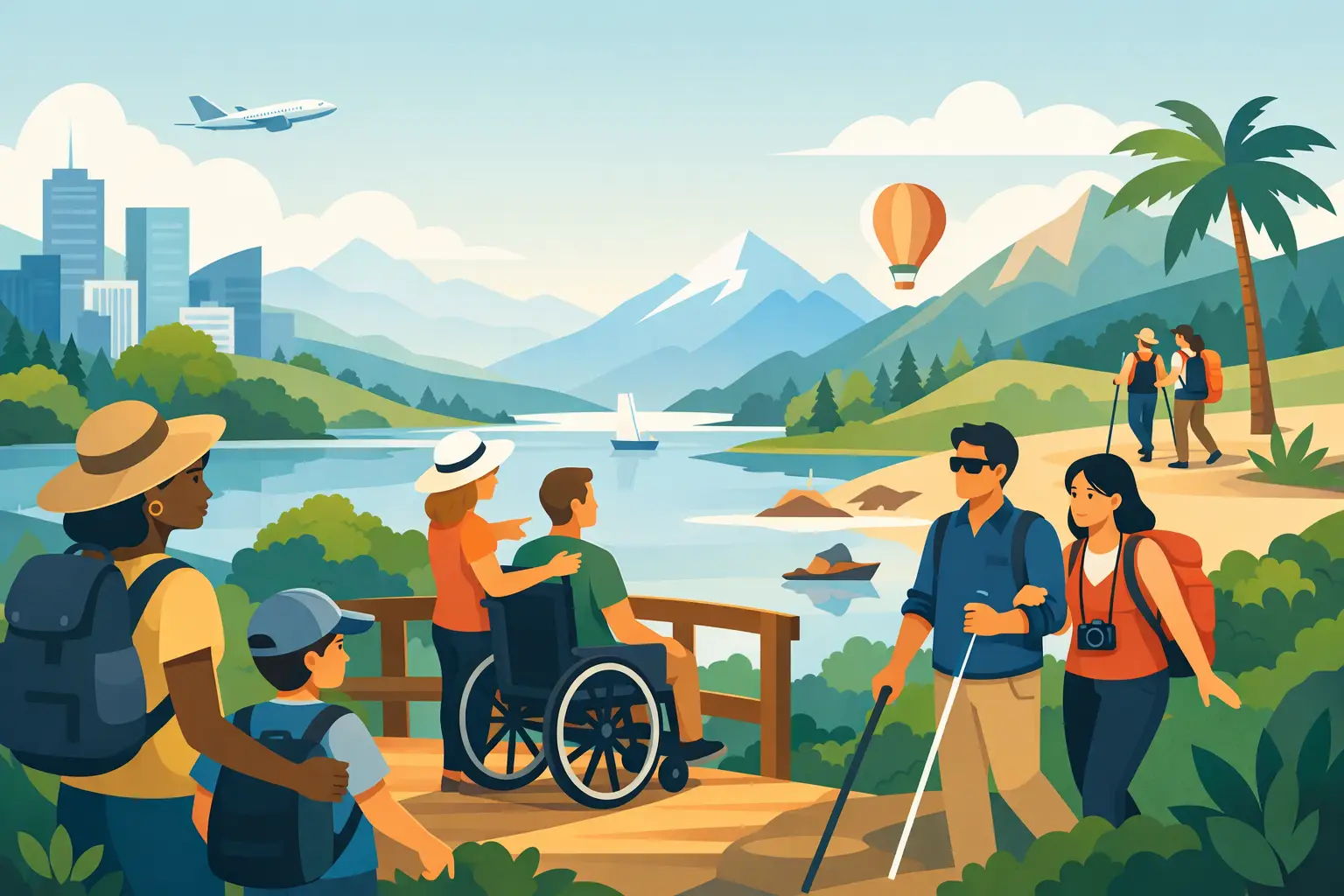
A staircase with no alternative, a ticket office that is difficult to understand, a written label that is too small or audio that is inaccessible without a network can be enough to exclude a visitor. Inclusive tourism is therefore not just about adding a pictogram or a dedicated page to a website. It consists of allowing as many people as possible to prepare, understand and experience a visit in good conditions, with autonomy and dignity.
For museums, heritage sites, tourist offices and communities, the issue is both cultural and operational. Making a route more accessible improves the reception of people with disabilities, but also that of families, foreign visitors, elderly people, people who are uncomfortable with digital technology or those facing temporary fatigue. It is a quality of use approach, much more than an obligation to be treated separately.
Inclusive tourism starts before the visit
An inclusive experience often happens before you walk through the door. The visitor must be able to know if the place is suitable for their situation, anticipate possible difficulties and choose their route without unpleasant surprises. Imprecise information on accessibility can be more discouraging than a clearly explained constraint.
It is preferable to describe the realities of the site precisely: number of steps, presence of an elevator, width of passages, availability of suitable toilets, seating, quiet areas, parking conditions or possible support. For an ancient monument, total accessibility is not always achievable. On the other hand, the honesty of the information and the existence of alternatives really change the experience.
This preparation also concerns the contents. A family with a young child, a deaf person, a non-French-speaking visitor or a person with reading difficulties do not expect the same mediation. Providing several entry points in the same route helps avoid a two-speed visit, where certain audiences receive an impoverished version of the story told.
Think about obstacles rather than categories of audiences
Accessibility is often discussed by categories: motor, visual, hearing, cognitive disabilities. This grid is necessary, in particular to comply with regulatory requirements and guide investments. But, on the ground, it is more effective to start from the obstacles encountered along the way.
An obstacle can be physical, such as a step or an unstable path. It can be sensory, when information is only available in text or audio. It can be cognitive, faced with complex signage, overly specialized vocabulary or difficult to read instructions. Finally, it can be digital: a poorly placed QR code, an overloaded interface, content that requires a continuous connection or a recent smartphone.
This approach leads to more useful solutions for everyone. Well-organized text helps dyslexic people as well as busy visitors. Subtitles make a film accessible to deaf people, but are also useful in a noisy room. An offline mode is valuable in a crypt, on a heritage trail or in an area with low network coverage, without being reserved for a particular audience.
Mediation must offer several ways of understanding
The same heritage story benefits from being offered in complementary forms: listening, reading, images, transcription, plain language content, visual cues or quizzes. The objective is not to multiply functionalities indiscriminately. This is about giving the visitor the opportunity to choose the mode that suits them, according to their current needs.
Audio is particularly relevant to free the gaze and accompany the discovery of a space. However, it must be associated with a readable transcription for people who are deaf or hard of hearing, as well as for those who prefer to read. Descriptive images, sufficient contrast and predictable navigation also enhance autonomy.
Content that is easy to read and understand can be decisive in certain contexts, particularly for people with comprehension difficulties, non-speaking visitors or audiences unfamiliar with museum codes. They require real editorial work. Simplifying does not mean impoverishing: we must preserve meaning, historical rigor and the pleasure of discovery.
Guideius addresses every digital cultural mediation challenge
Create a multilingual smartphone audio guide that is easy to deploy, accessible and tailored to your museum, heritage site or destination.
Make digital a support, not a barrier
Digital tools can reduce mediation obstacles, provided they are designed for real uses. A solution that is very rich but difficult to administer often ends up producing dated content, incomplete journeys or unverified information. For small and medium-sized structures, simplicity of management is therefore a condition for long-term inclusion.
The personal smartphone principle has concrete advantages: no fleet of audio guides to clean, refill, distribute or replace. The visitor accesses the route using a QR code or GPS trigger, at their own pace. But this organization should not exclude those who do not have a compatible phone, have run out of battery or do not wish to use their equipment. A reception solution, a one-off loan or human mediation remain necessary depending on the profile of the place and its audiences.
The quality of the connection is another point of vigilance. On an outdoor route, in an underground site or behind thick walls, the network is never acquired. Pre-download and offline operation make the experience secure. They also prevent access to knowledge from depending on the visitor's mobile plan.
Guideius is part of this logic by allowing teams to deploy multilingual, audio and multimedia courses, without dedicated hardware, with access by QR code or GPS and offline availability. The interest does not lie only in the technology: it is in the ability of the teams to adapt and maintain content without permanently depending on external technical expertise.
Design with the people involved
No audit grid replaces the observation of a real visit. The best decisions are made when a site involves relevant people in designing, testing and evaluating courses. Local associations, residents, companions, mediators, regular visitors and audiences far from the cultural offering provide feedback that an internal team cannot always anticipate.
It is useful to organize tests along the entire journey, from searching for information to leaving the site. Ask participants what they understood, where they hesitated, what they couldn't do alone and what made them want to continue. Attention must be paid as much to the reception, signage and break areas as to the application or audio content.
This approach requires time and fair compensation for those contacted when their contribution goes beyond a simple return visit. It can also reveal problems that are more complex than expected. This is precisely its value: it is better to identify a difficulty before deployment than to hide it behind a promise of general accessibility.
Prioritize the perfect project without waiting
Not all establishments have the same budget or the same margins for architectural transformation. A listed site, a medieval tower or a natural route sometimes impose strong constraints. Inclusive tourism does not mean solving everything in one season. It requires prioritizing, planning and making visible what is progressing.
A pragmatic method consists of first dealing with the most frequent and most detrimental obstacles: access to information, orientation, readability of content, alternatives to exclusively audio or visual information, rest, and digital continuity. Low-cost improvements can already have a noticeable effect, provided they are consistent. A more readable font doesn't make up for an impossible-to-understand path, just as an accessible app doesn't correct a poorly marked entry.
Usage data can help adjust choices. The statistics of a digital journey show, for example, the most consulted steps, abandonments or preferred languages. They do not say everything about accessibility and should never replace the words of visitors. Used with sobriety and with respect for personal data, they nevertheless provide valuable clues to improve mediation and allocate resources where they will be useful.
Making inclusion a promise kept
The risk is to communicate about inclusion as an abstract quality, without being able to demonstrate what is really proposed. Visitors need reliable information, the teams need manageable tools and public partners need a credible trajectory. A modest, precise and verifiable promise is better than a speech that claims to suit everyone.
Inclusion becomes sustainable when it enters into ordinary practices: writing content, choosing service providers, reception training, updating information and evaluating courses. It is not an additional comfort. She affirms that common heritage must be able to be encountered by people with very diverse abilities, languages and habits.
Each improvement should be able to answer a simple question: which visitor will now be able to live this experience with more autonomy, understanding or pleasure? It is from this concrete question that cultural places can build, step by step, a hospitality that is felt as much as it is declared.
Would you like to apply these ideas to your site?
Guideius helps deploy multilingual audio tours with QR codes, GPS, offline mode, multimedia content and privacy-friendly analytics.