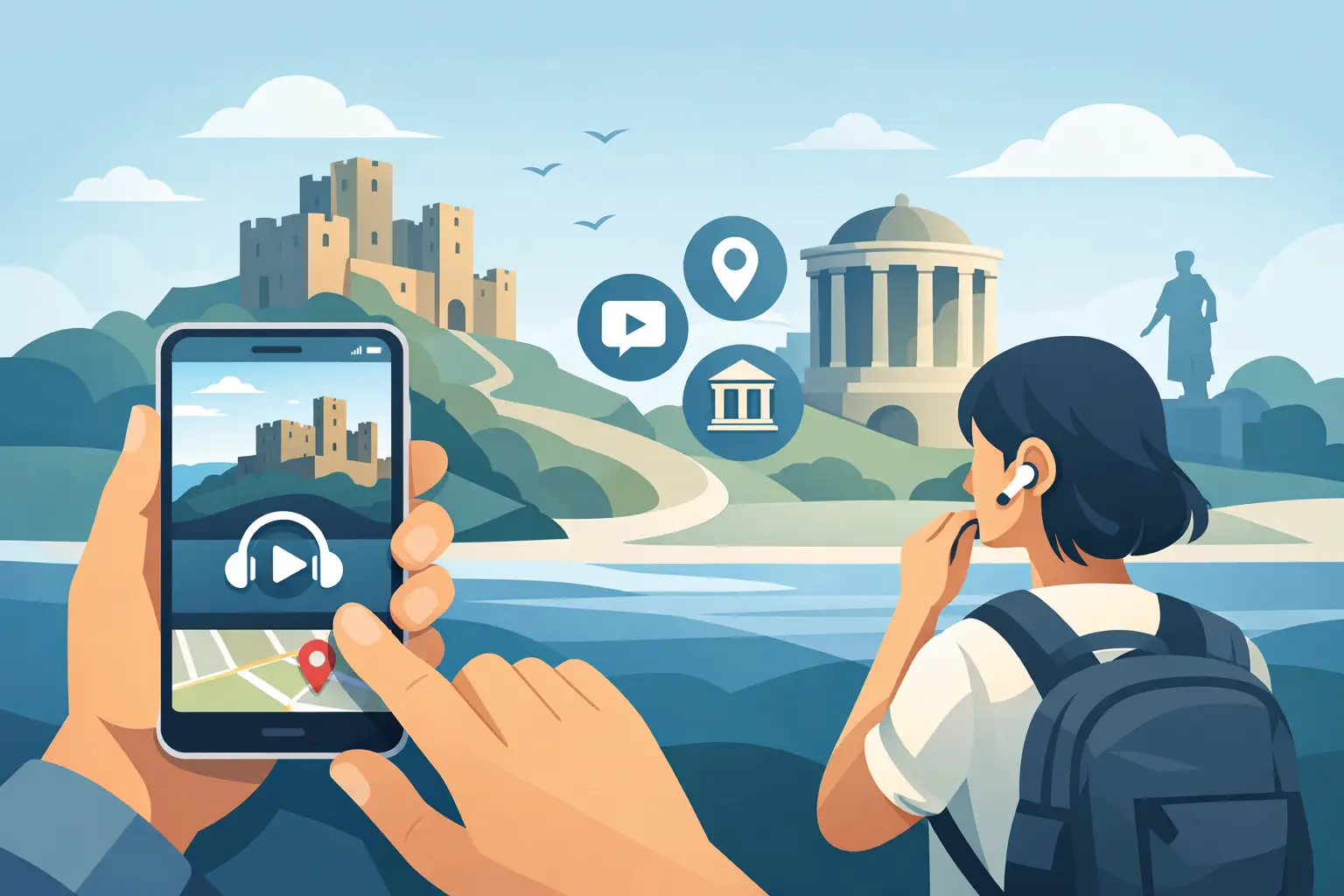
At the entrance to a monument, the same scenario is often repeated: some visitors want to follow an in-depth tour, others have twenty minutes, still others do not master the language offered. An independent visit to a historic site on mobile allows you to respond to these varied paces without making the welcome more burdensome or multiplying the equipment to be loaned.
For a site manager, the subject is not limited to replacing a traditional audio guide with a smartphone. This involves designing mediation that is reliable on the ground, clear for all audiences and realistic to administer. The mobile then becomes a transmission medium, serving the place, its stories and its visitors.
Why mobile is changing the independent visit to a historic site
The first benefit is concrete: visitors use a device they already know. They can start a journey at their own pace, return to content, choose a language or stop at a detail that catches their attention. This autonomy is particularly suitable for sites with irregular attendance, places with free access, heritage villages and monumental complexes.
For teams, the change is just as significant. Without audio guide park to reload, disinfect, distribute, recover and replace, daily operations become simpler. The budget can be devoted to what really gives value to the visit: writing, voice recording, translations, accessibility and improving the route.
Mobile doesn't solve everything by itself. A visitor may be low on battery, lack headphones, or encounter an area with poor network coverage. This is why a successful independent tour must provide simple alternatives: content accessible offline, text associated with audio, readable signage and, depending on the context, some loan or orientation solutions at reception.
A more flexible experience, not a less demanding visit
Autonomy does not mean the absence of a framework. A good guide route without imposing. It indicates a starting point, gives an estimated duration, suggests a recommended order, then leaves the visitor free to listen further or skip a step.
This flexibility is valuable in a historic site. Expectations differ between a family, a school group, a curious resident and an enlightened amateur. Rather than producing a single and overly dense discourse, it is often more relevant to create several levels of reading: the essentials to understand the place, then in-depth details on the architecture, uses, characters or transformations of the territory.
Design a self-guided tour of a historic site on mobile
Technology should not dictate the journey. Before choosing functions, you must identify what the visitor must understand, feel or observe. In a fortress, the common thread could be defense and daily life. In an old center, it will be able to connect facades, businesses and urban developments. In an archaeological site, he will often have to help imagine what is no longer visible.
Starting from the real constraints of the place
Each site has its own visiting conditions. An outdoor route involves questions of geolocation, weather, safety and readability in direct sunlight. An indoor monument may have thick walls, narrow spaces, or areas where the GPS signal becomes inaccurate. Triggering by QR code is then particularly suitable for identified stages, while GPS provides fluidity on a urban route or landscaped.
The most effective is often to combine the two approaches. The GPS invites the visitor to progress through a territory; QR codes secure access to specific content in complex areas or inside buildings. This complementarity avoids promising total automation where the technical context does not allow it.
It is also necessary to test the route in real visit conditions, and not from an office. The quality of listening near a road, the visibility of a sign, the walking time between two stages or the difficulty in finding an architectural detail can profoundly modify the experience. These field observations avoid courses that are theoretically elegant but frustrating once open to the public.
Writing for listening and for place
Audio content is not a cartel read aloud. He must set up a scene, guide the eye and use sentences short enough to remain understandable during the walk. From the first seconds, the audio can invite the visitor to look at a door, look up at a frame or face a perspective.
Duration matters. A well-constructed two-minute sequence will generally be listened to more than an eight-minute commentary, even a well-researched one. Long content has its place when it is offered as voluntary in-depth study. This organization respects everyone's time without renouncing historical rigor.
The media usefully complement audio when they provide information that is impossible to perceive on site: old plan, restitution, archive photography, enlarged detail or before-and-after comparison. They should not distract attention from the site. The priority always remains the monument, the landscape or the real object.
Plan for multilingualism and accessibility from the start
Adding language or accessibility options at the end of a project costs more and often produces an uneven experience. It is better to integrate these needs when writing: clear sentences, absence of overly implicit references, useful descriptions of visual elements, synchronized texts or transcriptions, sufficient contrasts and understandable navigation.
Multilingual is not reduced to a literal translation. Local references, units of measurement, puns and certain dates sometimes require editorial adaptation. A foreign visitor must be able to grasp the essential issues of the place without knowing the regional history beforehand.
Accessibility also concerns uses. A simple interface, well-sized buttons, a route that does not require reading a complex map and the possibility of consulting content without a continuous connection improve the experience of many audiences, including those who do not identify as having a disability.
Guideius addresses every digital cultural mediation challenge
Create a multilingual smartphone audio guide that is easy to deploy, accessible and tailored to your museum, heritage site or destination.
Deploy without creating a new burden for teams
A mobile visit only makes sense if it can be managed by a small team. The site manager must be able to correct a schedule, update information, add a temporary step or consult usage without systematically depending on a technical service provider.
Signage plays a decisive role here. A QR code alone is not enough: the visitor must understand in a few seconds what they are going to get, how to start the visit and whether installation is necessary. Clear wording, a consistent visual and an indication of duration reduce hesitation at entry.
Access via web app is particularly relevant when the objective is to limit obstacles. The public can open the course immediately in their browser, without downloading a heavy application. A dedicated application may nevertheless be justified for projects requiring very in-depth customization, recurring use or a strong brand identity. The right choice depends on the attendance, the type of public and the means of communication available.
Measure to improve, without monitoring
Usage data can inform editorial and operational decisions. The number of starts, the languages chosen, the most viewed steps or course abandonments reveal what attracts attention and what deserves to be adjusted.
These indicators must remain at the service of mediation, with a proportionate and respectful approach to visitors. It is not a question of following individuals, but of understanding the life of a journey: is a little-heard stage difficult to find? Is its content too long? Is the course too ambitious for the time actually available?
This reading also helps to objectify the value of the project to a community, a financier or management. Beyond the number of visitors, it shows how the public uses the content and what improvements are made over the seasons.
Making digital an extension of heritage
The risk of a smartphone visit would be to create an additional screen between the visitor and the place. This risk exists when the tool accumulates effects, information and requests. Conversely, well-designed mobile mediation restores observation time: it explains just enough to make visible what would have remained silent.
It is in this logic that Guideius supports heritage sites: offering a solution without dedicated hardware, capable of operating in the field, with multilingual content, accessibility options and administration accessible to non-technical teams. The challenge is not to add digital technology for its own sake, but to make heritage speech available where it counts.
A project can start modestly, with a short course on the most significant points, then evolve based on feedback from visitors and teams. This progression avoids oversized devices and allows the essential to be preserved: a historic site deserves a visit that makes you want to look, understand and come back.
Would you like to apply these ideas to your site?
Guideius helps deploy multilingual audio tours with QR codes, GPS, offline mode, multimedia content and privacy-friendly analytics.