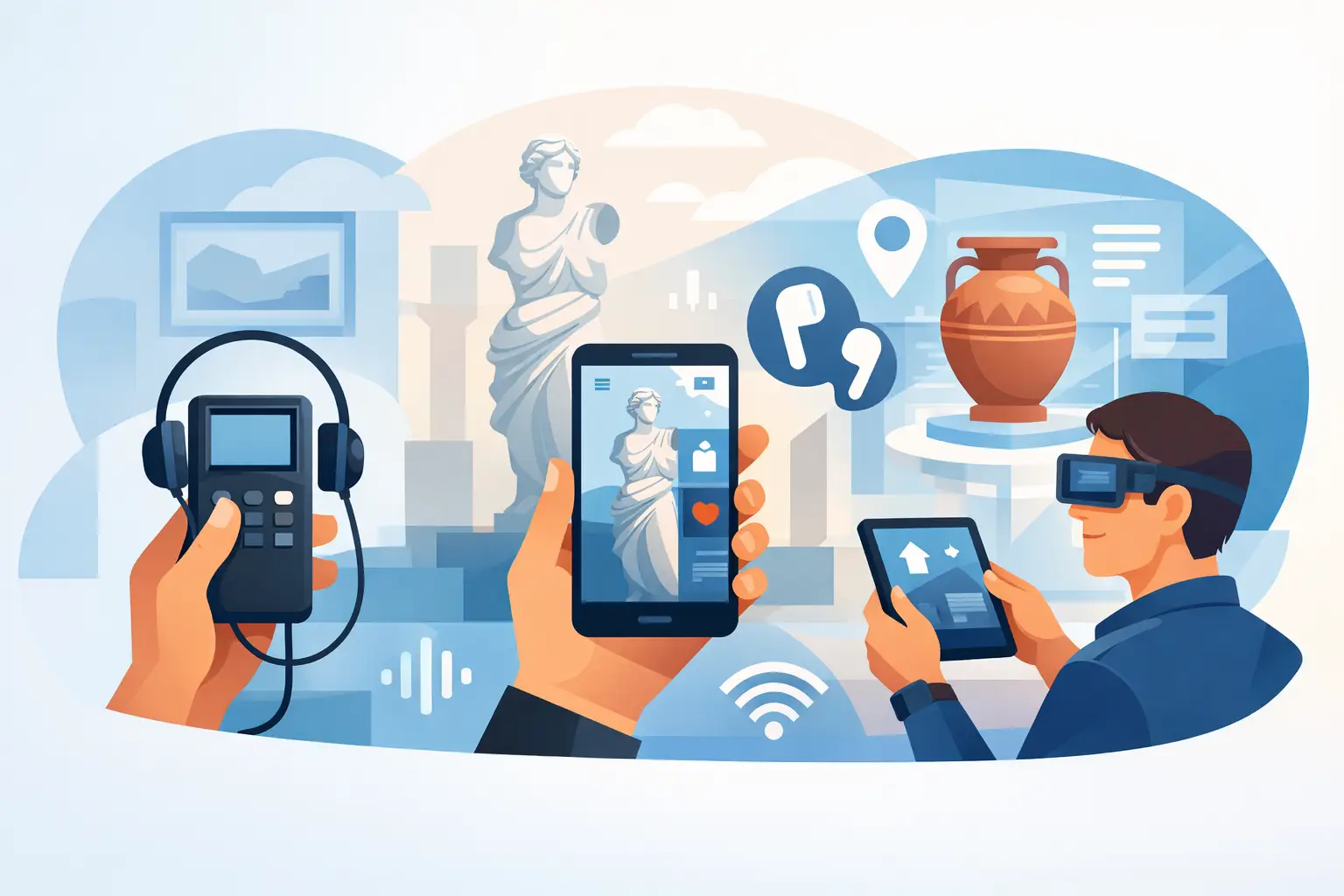
The stock of audio guides which must be loaded, distributed, disinfected and then collected at the end of the day takes up time that the cultural teams would prefer to devote to visitors. Faced with this reality, an alternative to the classic audio guide does not only consist of replacing a box with a screen. It must preserve the quality of mediation, simplify operation and remain accessible to all audiences.
For a museum, a monument, a tourist office or an outdoor trail, the visitor's smartphone today offers a relevant basis. It is still necessary to choose a system adapted to the constraints of the field, the diversity of the public and the real resources of the structure.
Why the traditional audio guide shows its limits
The dedicated audio guide meets a clear need: to offer an autonomous commentary, often multilingual, without depending on the visitor's personal equipment. Its operation is known to the public and the teams. In certain busy contexts or with visitors who are not comfortable with digital technology, it can retain its place.
But this model is based on continuous logistics. You have to buy the devices, manage the headsets, anticipate breakdowns, ensure charging, track losses and organize cleaning. Added to this is the renewal of equipment, which is rarely neutral for the budget or the environmental footprint.
The content itself can become difficult to scale. Modifying a track, adding a language or creating a temporary route sometimes requires the intervention of a service provider and the physical updating of the entire park. For small and medium-sized structures, this rigidity often slows down mediation projects.
The most flexible classic audio guide alternative: the smartphone tour
A audio tour on smartphone solution allows the public to access content from their own device, via a web app or an application. A QR code placed at reception, on a panel or near a work gives access to the route. GPS can trigger content based on the visitor's position on an external circuit.
This approach removes much of the material burden without sacrificing editorial quality. Visitors listen at their own pace, with their headphones or directly on their phone. The teams no longer devote their day to handling a fleet of devices and can concentrate their attention on reception, human mediation and observation of uses.
A visit that is no longer limited to audio
The interest of digital does not lie in adding superfluous effects. Above all, it allows you to choose the right media for each subject. An archive can be enlarged, a map can locate a missing building, an old photograph can dialogue with the current landscape. A quiz can keep families focused, while content in sign language or a transcription makes the journey more inclusive.
Audio remains central when it gives voice, rhythm and context to the visit. It benefits from being completed with sobriety, in the service of understanding. A good tour does not ask the visitor to look at their phone constantly: it invites them to look up at the works, places and details that tell the story of the territory.
Offline mode is not a detail
In a church with thick walls, an isolated archaeological site or a rural circuit, network coverage can be uneven. A credible digital alternative must therefore allow the prior downloading of content. The visitor keeps his route even when he loses the connection.
This requirement avoids a frustrating experience and limits reliance on public Wi-Fi. It is particularly decisive for outdoor routes, large sites and areas where the quality of the network varies greatly from one point to another.
Guideius addresses every digital cultural mediation challenge
Create a multilingual smartphone audio guide that is easy to deploy, accessible and tailored to your museum, heritage site or destination.
The criteria that really matter for your structure
The choice of a solution should not be reduced to the price displayed or the aesthetics of an interface. The first question is operational: can your team create, edit and publish content without advanced technical skills? Clear administration allows the route to come alive throughout the seasons, exhibitions and visitor feedback.
The second question concerns access. A QR code is simple and economical, but it must be clearly visible, accompanied by understandable instructions and ideally offered upon reception. GPS is useful on an outdoor route, provided the trigger zones are field tested. In a museum, triggering by QR code or step number often remains more precise.
Accessibility must be thought of from the design stage. Providing a transcription of audio tracks, readable contrasts, navigation compatible with assistive technologies, content adapted to deaf or hard of hearing people and several languages improves the experience of many visitors, not only that of the public concerned. Ease of navigation is also essential for people unfamiliar with digital uses.
Finally, data control deserves particular attention, especially for communities and public establishments. Usage statistics are useful to understand which journeys are launched, which steps retain attention or when visitors abandon. However, they must be collected in a proportionate, transparent and privacy-friendly manner.
Prepare for the transition to digital without weakening reception
The replacement of the dedicated hardware must not leave out visitors without a smartphone, without a battery or without a mobile plan. The fairest principle is to make the smartphone the main option, while organizing a backup solution adapted to your attendance: a few devices on loan, synthetic paper support, or reinforced human mediation in certain slots.
Before launching, it helps to follow five concrete steps:
- map the stops and actual network conditions on the route;
- define an editorial line, listening time and audience priorities;
- produce short, embodied and scientifically verified content;
- test the route with visitors, reception staff and people with accessibility needs;
- train the team in support, the dashboard and routine adjustments.
This preparation work avoids the pitfall of a tool that is technically functional but little adopted. Clear signage, a well-worded greeting and headphones or earphones available for sale or loan can make an immediate difference in the rate of use.
Measuring usage to improve mediation
With a traditional audio guide, it's difficult to know if visitors are actually listening to the commentary, at which points they stop, or which languages are most in demand. Usage data from a digital journey provides useful information, provided they are interpreted with caution.
A little-consulted stage does not necessarily reflect a lack of interest. It may be poorly signalled, located after a fatigue zone, too far from the main flow or simply less suited to the audio format. Cross-referencing statistics with field observations and team discussions makes it possible to identify relevant improvements.
This ability to adjust transforms the course into a living tool. A temporary exhibition, a new point of view, a school visit or a simplified version can be added without replacing an entire fleet of equipment. It is also a more sober way of investing over time.
Choose a solution that respects the reality on the ground
The right device is one that integrates into your reception rather than adding a difficulty to it. For a small museum, the priority will often be rapid implementation, self-management and predictable cost. For a territory, GPS, offline and multilingualism could become decisive. For a very busy monument, it will also be necessary to think about flows, signage and solutions intended for unequipped visitors.
Guideius follows this logic with audio tours accessible by QR code or GPS, administered by non-technical teams and enriched with functionalities useful in the field. The challenge is not to digitize the visit at all costs, but to give cultural places the means to transmit better, with fewer material constraints.
Before comparing features, start with your visitors and your team: the moments when an explanation is missing, the most requested languages, the areas without a network, the content that deserves to be heard. It is from these concrete situations that a digital alternative becomes a real mediation tool.
Would you like to apply these ideas to your site?
Guideius helps deploy multilingual audio tours with QR codes, GPS, offline mode, multimedia content and privacy-friendly analytics.