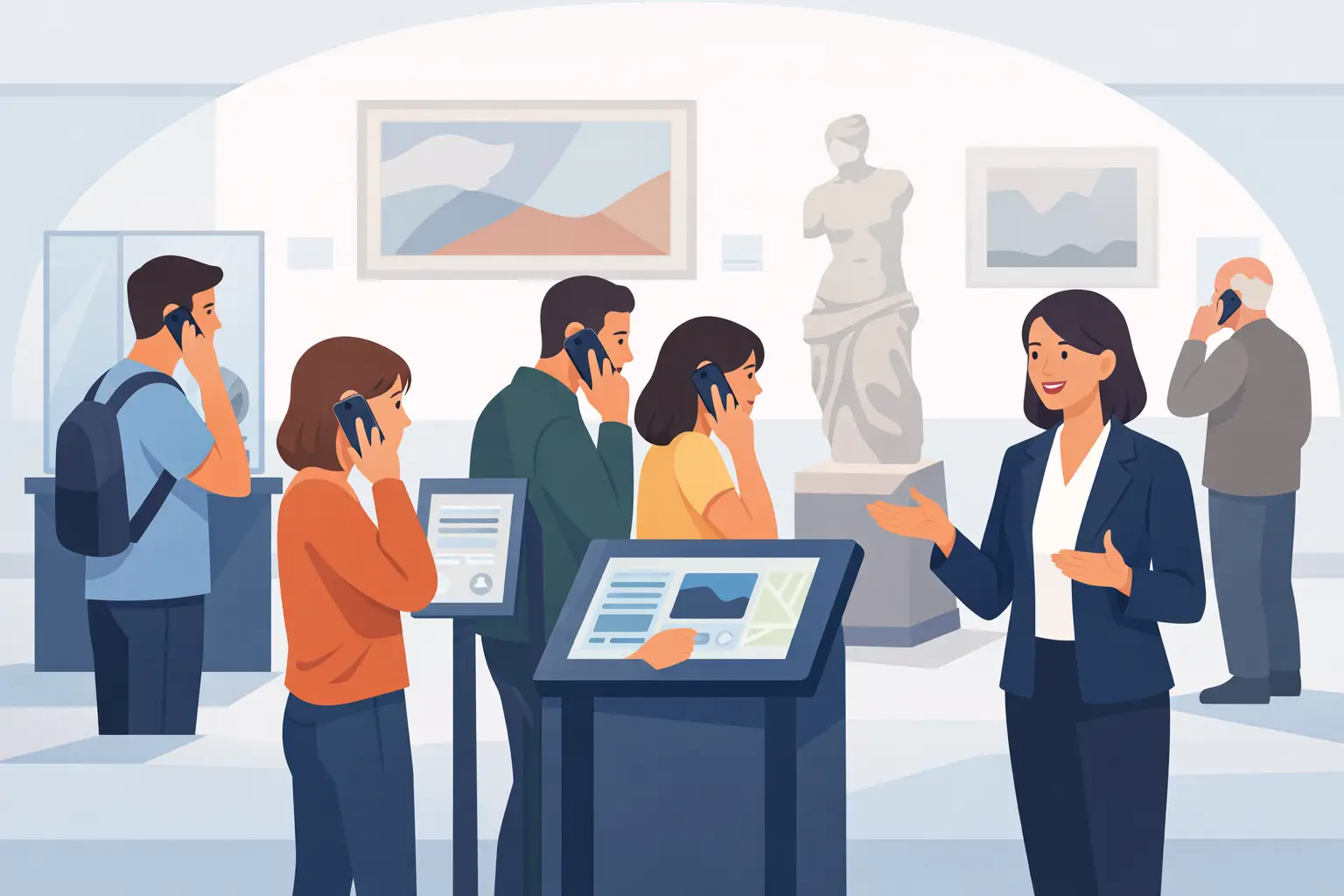
In many establishments, the question is no longer whether to offer a smartphone museum audio guide, but how to set it up without burdening the teams' daily lives. Between visitor expectations, budgetary constraints and accessibility requirements, the smartphone often emerges as a pragmatic response. It is still necessary to distinguish the fashion effect from a real mediation tool.
Why the smartphone museum audio guide is essential
The switch to the smartphone first responds to a reality on the ground. Visitors arrive already equipped, familiar with their device, and expecting experiences that are easy to launch. For cultural structures, this profoundly changes the operational equation: less material to purchase, fewer objects to load, distribute, recover, clean and renew.
This logistical gain is particularly decisive for small or medium-sized museums and heritage sites. When a team is small, every task counts. Removing the management of a fleet of dedicated audio guides frees up time for reception, human mediation and maintenance of the route itself.
There is also an economic issue. A smartphone device often allows you to reallocate the budget: less equipment-related expenses, more resources for content quality, translation, accessibility or updating the route. For cultural equipment, this is not a detail. A good audio guide is judged less by its content than by its ability to transmit a clear, fair and lively story.
A mediation tool, not just technical support
Reducing the audio guide on smartphones to a simple hardware alternative would be a mistake. Its real interest lies in its ability to enrich the visiting experience without complicating it.
A visitor can listen to an audio track, display an archive image, follow a route, consult a version in their language or access content adapted to their needs. The smartphone then becomes an access point to more flexible, more customizable and often more inclusive mediation.
That said, it all depends on how the course is designed. If the tool imposes too many steps, requires multiple downloads, or assumes constant connection, the experience quickly deteriorates. Conversely, a quick launch via QR code, a clear route and an offline mode transform the smartphone into a discreet companion for the visit, not an obstacle.
Concrete benefits for teams
For professionals, the interest of the smartphone is first measured in daily use. A well-thought-out solution reduces friction at every level.
The first benefit is the simplicity of deployment. Once the content has been integrated, access can be done via a web app or an application, without distributing terminals. Reception staff do not have to manage inventory or explain an unknown device. A few clear instructions are enough.
The second benefit is scalability. Modifying a comment, adding a language, correcting a date or enriching a point of interest becomes much simpler than with old hardware or closed systems. For heritage sites, where the routes can evolve with exhibitions, the seasons or scientific news, this flexibility is precious.
The third benefit concerns the usage measurement. With a digital audio guide, it becomes possible to better understand visitor behavior: what content is listened to, where visitors drop off, what languages are most used. These data do not replace field observation, but they help to manage mediation choices in a more refined manner.
What visitors really expect
The most common mistake is to think that visitors necessarily want more technology. In reality, what they want most is less friction.
A good smartphone museum audio guide must be immediate, readable and reassuring. The visitor wants to understand in a few seconds how to get started. He wants a clear interface, quality sound, well-paced content and navigation that does not distract from the works or the location.
The question of comfort is central. Holding your phone throughout the visit can be tiring. Read long texts on screen too. This is why audio remains a particularly relevant format: it accompanies the gaze instead of monopolizing it. Multimedia content has its place, but as a complement, not as overload.
Multilingual has also become a standard rather than a supplement. For many tourist sites, offering multiple languages on smartphones is easier and more sustainable than with dedicated devices. Here again, the interest is concrete: better reception without making operations more complex.
Guideius addresses every digital cultural mediation challenge
Create a multilingual smartphone audio guide that is easy to deploy, accessible and tailored to your museum, heritage site or destination.
Limits not to be minimized
The smartphone is not a magic solution. It brings clear advantages, but also points for vigilance.
The first concerns the actual equipment of the public. Yes, the majority of visitors have a smartphone. But not all, and not in the same conditions. Low battery, old device, refusal to scan a QR code, lack of digital comfort: these situations exist. An establishment must therefore plan a fallback response, even slight, so as not to exclude part of its public.
The second point is connectivity. In an old building, an underground site or a nature trail, the network can be unstable. A solution without offline mode exposes you to very visible disruptions in experience. In the field, this is often a more important criterion than the sophistication of the functionalities.
The third point concerns attention. The smartphone can enrich the visit, but it can also fragment it. If the course multiplies manipulations, notifications or screens, it creates a screen instead of a link. Digital mediation must remain at the service of the place, not the other way around.
What criteria to choose a solution
Comparing audio guide offers on smartphones is not about adding features. You have to start from the uses, the constraints of your site and the reality of your team.
Administration and autonomy
A relevant solution must be able to be administered without advanced technical skills. If each modification requires an external service provider, the real cost quickly rises and autonomy disappears. For cultural structures with limited resources, this editorial autonomy is a major issue.
Accessibility and inclusion
Accessibility should not come at the end of the project. Size of texts, readability of interfaces, transcription, adaptation of content, simple navigation: these elements determine the quality of reception. On this subject, you have to look at the real functions, not just the commercial promises.
Triggering and fluidity
QR code, GPS, manual entry, free or guided route: the right choice depends on your site. In a museum, the QR code can be very effective. On an outdoor circuit, GPS often becomes more relevant. The main thing is to avoid unnecessary manipulations.
Economic model
A low entry price can mask high recurring costs, separate maintenance fees, or quickly needed options. You have to think in terms of overall operating costs, not just the launch budget.
Data Mastery
For public and parapublic actors, this question is far from being secondary. Who hosts the data? What statistics are collected? With what level of transparency? Digital mediation consistent with the values of the cultural sector requires a sober and ethical approach.
The smartphone museum audio guide in a broader strategy
The smartphone does not replace scenography, signage, or human mediation. It works best when it fits into a coherent whole.
In certain places, it will mainly be used to offer several languages and some in-depth information. In others, it will carry the essence of the visit story. It all depends on the route, the audiences and the cultural project. This is why a good device rarely starts with technology. It begins with a simple question: what do we want to convey, to whom, and under what conditions of visit?
When this basis is clear, digital becomes a very useful lever. It makes it possible to update content, better accommodate varied audiences, extend the visit without material burden and equip teams with concrete indicators. It is also in this logic that solutions like Guideius find their relevance: not by adding complexity, but by making digital mediation more accessible to structures which have neither a dedicated IT department nor an expandable budget.
The real subject is therefore not to choose between tradition and modernity. It is to build a fair, sustainable and practicable visitor experience on a daily basis. If the smartphone allows this, then it is not a trend effect. It becomes a transmission tool in its own right.
When making a choice, the most reliable criterion often remains the most concrete: will your team be able to maintain this system over the long term, and will your visitors use it effortlessly? If the answer is yes, you probably care about more than just audio. You hold a mediation which finds its place on the ground.
Would you like to apply these ideas to your site?
Guideius helps deploy multilingual audio tours with QR codes, GPS, offline mode, multimedia content and privacy-friendly analytics.