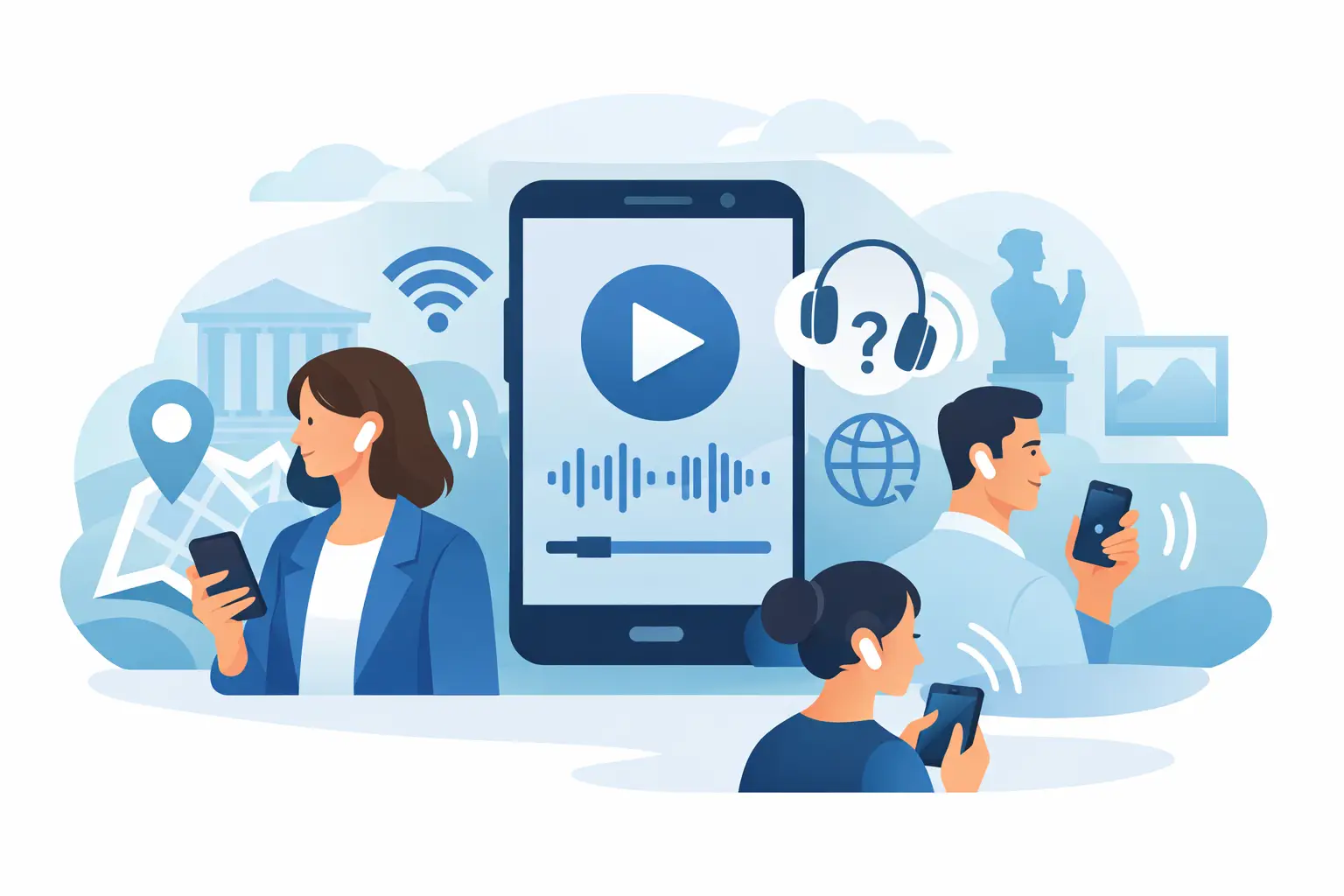
A visitor scans a QR code at the entrance, plugs in their headphones, selects their language and begins their visit in a few seconds. For a museum or heritage site team, this scene changes a lot of things. A hardware-free audio guide solution not only replaces a device with a smartphone: it transforms logistics, budget, maintenance and the way mediation is designed.
However, the subject deserves more than a simple modern effect. Between marketing promises and realities on the ground, the right choice depends on your attendance, your internal organization, your audiences and your technical constraints. For a small or medium-sized cultural structure, the challenge is not to have the greatest number of functionalities, but a solution that can really be used on a daily basis.
Why a hardware-free audio guide solution changes operations
The first benefit is very concrete: you eliminate the purchase, storage, recharging, cleaning and renewal of a fleet of devices. On paper, this seems obvious. In the field, this is often what frees up the most time for reception teams, who can concentrate on guiding visitors rather than distributing and retrieving equipment.
This development also reduces hidden costs. A dedicated audio guide is never just about its purchase price. You have to count losses, breakage, batteries, updates, accessories and sometimes even the space needed to manage all of this. Conversely, a smartphone device relies on equipment already present in the visitor's pocket.
There is also an image issue. Many establishments are seeking mediation that is more fluid, more autonomous and more consistent with current uses. The visitor easily agrees to scan a code and use their own phone. On the other hand, it tolerates queues, complex procedures or aging devices less and less.
A good solution is not just a QR code
Many offers present themselves as hardware-free audio guides because they open an audio page after a scan. This is sometimes enough for a very simple route. But as soon as a site wants to offer a real visitor experience, the needs become more demanding.
A solid solution must first guarantee immediate handling. The visitor does not have to create an account, download a complicated route or search for a long time where to click. Each additional step reduces usage.
It must then operate in the real conditions of the location. In an ancient center, a stone monument, an extensive heritage garden or a semi-underground space, connectivity is not always stable. Offline mode is therefore not a secondary convenience. This is often a condition for success.
Another point often underestimated: triggering. The QR code is effective at the entrance or in front of a work. GPS becomes useful on outdoor routes, urban circuits and tourist routes. The two approaches are not opposed. They complement each other depending on the nature of the site and the degree of autonomy sought.
The criteria that really matter for cultural teams
Simplicity of administration
A platform can be very complete and still difficult to operate. For a structure that does not have a dedicated digital team, the administration interface is decisive. Adding audio, correcting text, publishing a translation or modifying a visual must be feasible without depending on a service provider at each step.
This editorial autonomy has a direct impact on the quality of content. A temporary exhibition changes, a panel is moved, a school course must be adjusted, a foreign version must be added. If the update is heavy, it will be postponed. If it is simple, mediation remains alive.
Accessibility and inclusion
In the cultural sector, accessibility cannot be treated as an option. A hardware-free audio guide solution must make it possible to adapt the experience to various audiences: non-speaking visitors, disabled audiences, people with specific reading, listening or navigation needs.
This involves several elements: multilingual content, subtitles, readable contrasts, clear navigation, compatibility with ordinary mobile uses, and sometimes visual or textual enrichments to complement the audio. The goal is not just to check a regulatory box. It’s about making mediation truly shareable.
Useful usage data
Knowing how many visitors have launched a journey, which steps are most viewed or when listening stops helps to manage content. These statistics do not replace field observation, but they provide valuable benchmarks to improve the experience and justify choices to funders or communities.
Caution remains necessary. Not all data is good to collect. In a public or parapublic setting, digital sobriety and data control are matters of trust. Better a clear dashboard, useful and respectful, than an accumulation of indicators that are difficult to use.
Guideius addresses every digital cultural mediation challenge
Create a multilingual smartphone audio guide that is easy to deploy, accessible and tailored to your museum, heritage site or destination.
Limits to anticipate before getting started
Choosing a smartphone solution does not mean that everything becomes simple by nature. There are real operational questions, and they are best addressed up front.
The first concerns visitor equipment. The majority use their phone, but not all. Depending on your audience, it may be necessary to provide an alternative solution for people who are not equipped, are uncomfortable with digital technology or have insufficient battery power. Without equipment on the structure side must not produce exclusion on the visitor side.
The second concerns the audio uses themselves. Not all visitors have headphones with them. Some will listen through loudspeaker, which is not always suitable for sensitive or quiet places. We must therefore think about the signage, the recommendations for use, or even occasionally offer low-cost headphones depending on the context.
Finally, there is the question of content. Bad mediation is still bad, even on an elegant interface. If the audios are too long, monotonous, too erudite or poorly structured, the medium will not compensate. Digital is only as good as the editorial quality it serves.
In which cases is this approach most relevant?
Small and medium-sized museums
For establishments that want to offer multilingual mediation without investing in a fleet of devices, the model is particularly relevant. It allows you to offer a professional experience with a limited level of internal load, provided that the tool is well thought out.
Heritage sites and outdoor trails
On a diffuse site, a historic center, an interpretive trail or an independent tour, the visitor's smartphone becomes a natural support. GPS, simple maps and contextual triggering then provide real use value.
Tourist offices and visit networks
When several points of interest must be linked in the same experience, a hardware-free audio guide solution makes it possible to harmonize content, pool administration and quickly update routes. It is often more flexible than a heavy physical installation, especially when the offer changes according to the seasons.
How to compare offers without making a mistake
The most common reflex is to compare features one by one. It is useful, but insufficient. Instead, we must look at the overall operating cost, the level of support offered and the ability of the solution to last over time.
An initially inexpensive offer can become restrictive if each modification requires external intervention. Conversely, a more complete solution can be more economical if it reduces maintenance tasks, improves the usage rate and avoids the purchase of equipment. Good calculation is never just technical. It is organizational.
It is also necessary to examine the quality of the support. The success of a project often depends on very concrete details: structuring the route, prioritizing content, setting the trigger, on-site tests, clarity of visitor instructions. A service provider who knows the realities of cultural places will save time and avoid classic errors.
It is in this area that specialized players like Guideius find their place: not by adding complexity, but by offering digital mediation designed for cultural teams who need autonomy, reliability and a sustainable economic framework.
What to aim for: less management, more transmission
Ultimately, choosing an audio guide solution without hardware is not a gadget choice. It is a decision of mediation and exploitation. You win if technique is replaced by content, if the team saves time, and if the visitor has easier access to the story of the place.
The best device is not the one that impresses in demonstration. It’s the one that works on a busy Saturday, in an imperfect network area, with varied audiences and a team that already has ten topics to manage. When technology remains sober, inclusive and simple to administer, it finally serves what it should serve: the encounter between heritage and those who come to discover it.
Would you like to apply these ideas to your site?
Guideius helps deploy multilingual audio tours with QR codes, GPS, offline mode, multimedia content and privacy-friendly analytics.