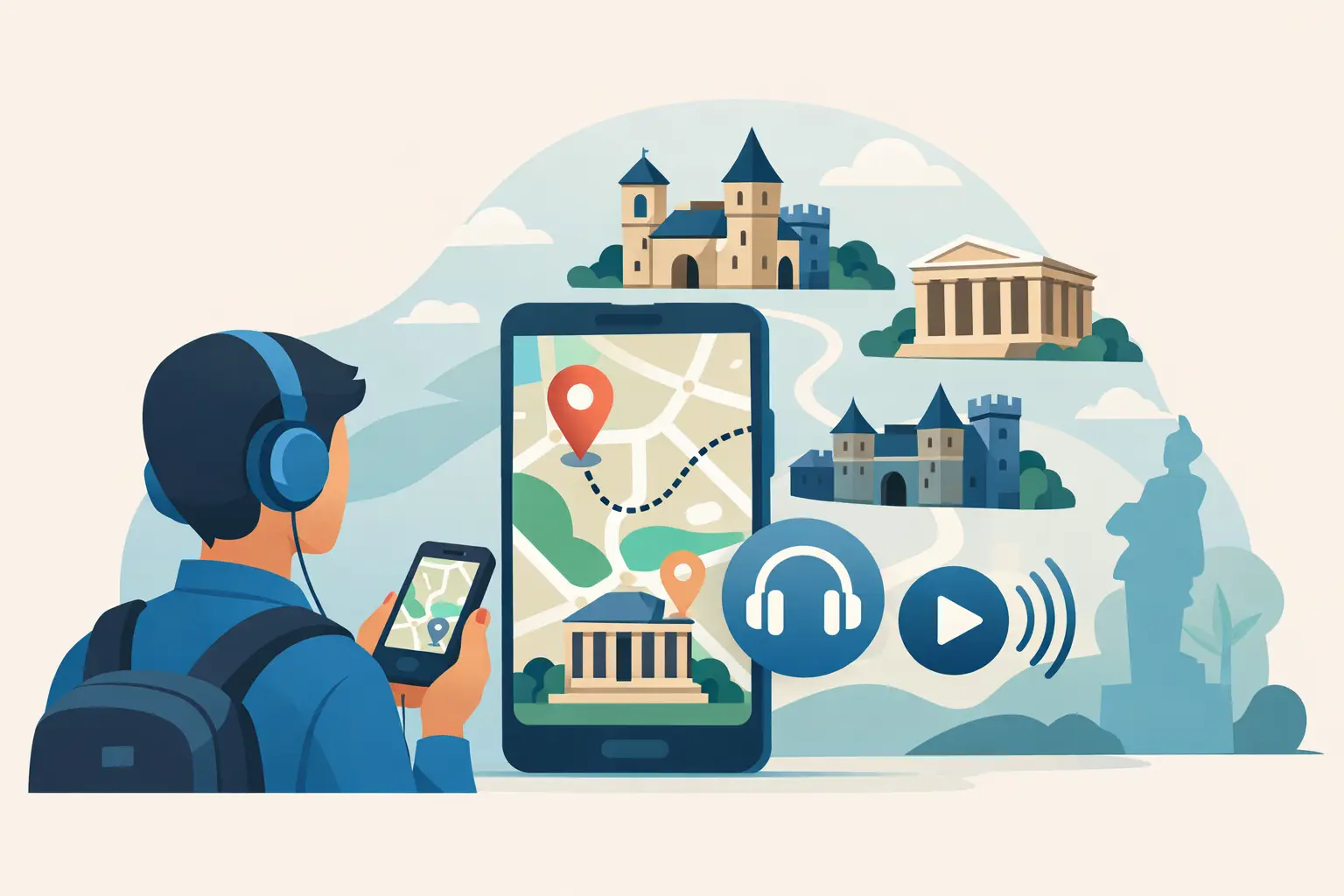
A visitor arrives in front of an old abbey, takes out his phone, scans a QR code and begins to listen to a story that is triggered in the right place, at the right time. On the pitch, that’s often where everything plays out. A heritage GPS audio tour is not only a more modern tour format. It is a choice of mediation which involves reception, accessibility, the autonomy of the public and the daily organization of the teams.
For an off-site museum, an interpretation center, a municipality or a tourist office, the challenge is not to “go digital” to follow a trend. It’s about offering a consistent experience with the site, simple to deploy and sustainable over time. And on this point, not all solutions are equal.
Why the GPS heritage audio tour meets a concrete need
The main interest of this format lies in its ability to accompany the visit in real space. Where a traditional audio guide often follows a fixed numbering, GPS allows the content to be linked to the visitor's movement. This logic works particularly well on open sites, old centers, landscaped routes, villages of character or heritage complexes spread over several points of interest.
For visitors, the benefit is immediate. They advance at their own pace, without equipment to borrow or a route that is too directed. The experience becomes more fluid, especially when it is based on their own smartphone. For the teams, the interest is just as concrete. There is no fleet of devices to purchase, no daily maintenance, no disinfection, no returns management, no hardware renewal to plan every few years.
This model also meets a strong expectation of small and medium-sized cultural structures. Many want to enrich mediation without increasing operations. A well-designed system then makes it possible to reconcile quality of visit, budgetary control and administrative autonomy.
What a good heritage GPS audio tour should really provide
The promise is not only held in geolocated triggering. A good system must first remain understandable to everyone. This requires a simple interface, clear instructions, quick handling and content adapted to different reading levels.
Accessibility should not be treated as a secondary option. Subtitles, transcription, compatibility with various uses, readable, multilingual navigation and alternative consultation modes improve not only inclusion, but also general comfort of visit. In fact, what is useful to an restricted audience is often also useful to a family, to international visitors or to audiences unfamiliar with digital tools.
Editorial quality matters just as much as technique. A heritage tour is not just a matter of juxtaposing audio notes. You need writing designed for walking, sequences that are neither too long nor too poor, a good rhythm, real orientation work and a clear articulation between story, place and context. Without this, GPS becomes a simple trigger with no mediation value.
GPS, QR code, offline - field logic more than a technical effect
On paper, GPS seems to be enough. In reality, the field requires a more nuanced approach. Geolocation can be very effective in a park, a town or a clear outdoor route. It may be more uncertain in narrow streets, wooded areas, interiors or sites with thick walls. This is why a reliable course often relies on a combination of triggers.
The QR code remains an excellent entry point. It facilitates access, reassures the user and allows the correct route to be quickly launched. The GPS then takes over to support progress. This hybrid operation limits friction and improves the real experience, far from theoretical demonstrations.
Offline mode also deserves special attention. In many territories, network coverage remains patchy. An audio tour that depends entirely on a mobile connection creates frustration and penalizes precisely the most interesting sites, often located outside of well-covered centers. Planning an offline consultation is therefore not a technical refinement. This is a condition of use.
Guideius addresses every digital cultural mediation challenge
Create a multilingual smartphone audio guide that is easy to deploy, accessible and tailored to your museum, heritage site or destination.
Operational benefits for heritage teams
A mediation project rarely succeeds solely on the quality of its concept. It succeeds because it lasts over time. For teams, this requires simple administration, rapid updates and the ability to evolve content without depending on a service provider for each minor modification.
On this point, the simplicity of management makes a real difference. Adding a language, correcting an audio cartel, adjusting a GPS point or consulting usage statistics should not require advanced technical skills. In many structures, the teams already combine reception, programming, communication, partnerships and site management. A mediation tool only has value if it fits into this reality.
Usage data are also useful, provided they are readable and respectful. Knowing how many visitors launch the journey, which steps are most popular, where the dropouts are or which languages are most requested helps to manage the system. This information can feed into editorial, budgetary or tourist decisions. They do not replace field observation, but they shed light on it.
Limits to anticipate before getting started
It would be misleading to present GPS audio tracking as a universal answer. Some contexts lend themselves to this better than others. On a very small indoor site with few stopping points, triggering by QR code alone may be sufficient. Conversely, over a large territory, overly automatic guidance can become imprecise if the trigger zones are poorly calibrated.
The public does not behave uniformly either. Some visitors want to be accompanied step by step. Others prefer free discovery. Some people easily use their phone with headphones. Others hesitate, share a device with several people or have a low battery. Designing a route therefore means planning for usage margins and not imagining an ideal visitor.
You also have to be careful not to overload the experience. Heritage does not cope well with content inflation. Too many steps, too many audios, too many interactions or too many multimedia effects end up distracting from the place itself. The right question is not “what can we add?” ", but "what really helps to look at, understand and feel the site? »
How to choose a solution adapted to your structure
The first criterion is adequacy with your operational reality. A relevant solution must be simple to deploy, even without a dedicated digital team. This involves a clear administration interface, concrete support and a clear economic model. Many structures have neither the time nor the means to manage a technically heavy project.
The second criterion concerns inclusiveness. If your mission is to transmit heritage to as many people as possible, the chosen solution must integrate this requirement from the start. Multilingual, accessibility, simplicity of use, compatibility with different visitor profiles and respect for data are not peripheral additions. These are foundations.
The third criterion relates to the flexibility of the system. Your journey will probably need to evolve. A temporary event, a new circuit, a territorial extension, a school version or a seasonal adaptation can appear quickly. It is better to choose a framework capable of absorbing these developments without calling into question the entire project.
Finally, look at the solution from the visitor's perspective. Is it quick to launch? Understandable in seconds? Pleasant to use without constant assistance? In this area, the most effective devices are not always the most loaded with features. They are often the clearest, most sober and most reliable.
Making digital a place-based service
A relevant heritage GPS audio tour does not replace signage, human welcome, or scientific work. He comes to extend them. When it is well thought out, it helps visitors to find their way, to understand the layers of a site, to hear several voices, to access content in their language and to experience a more independent visit, without taking the attention away from the heritage itself.
This is where the real challenge lies for professionals. Adopting such a device does not mean adding a technological layer. It means choosing a more flexible, more accessible and often more sustainable form of mediation, provided that you remain demanding in terms of actual use. Solutions like Guideius are precisely in line with this logic of simplicity, inclusion and operational control.
The best course is not the one that shows the most technology. It is the one that allows the visitor to listen to a place with more attention, while giving the teams the freedom to bring it to life sustainably.
Would you like to apply these ideas to your site?
Guideius helps deploy multilingual audio tours with QR codes, GPS, offline mode, multimedia content and privacy-friendly analytics.