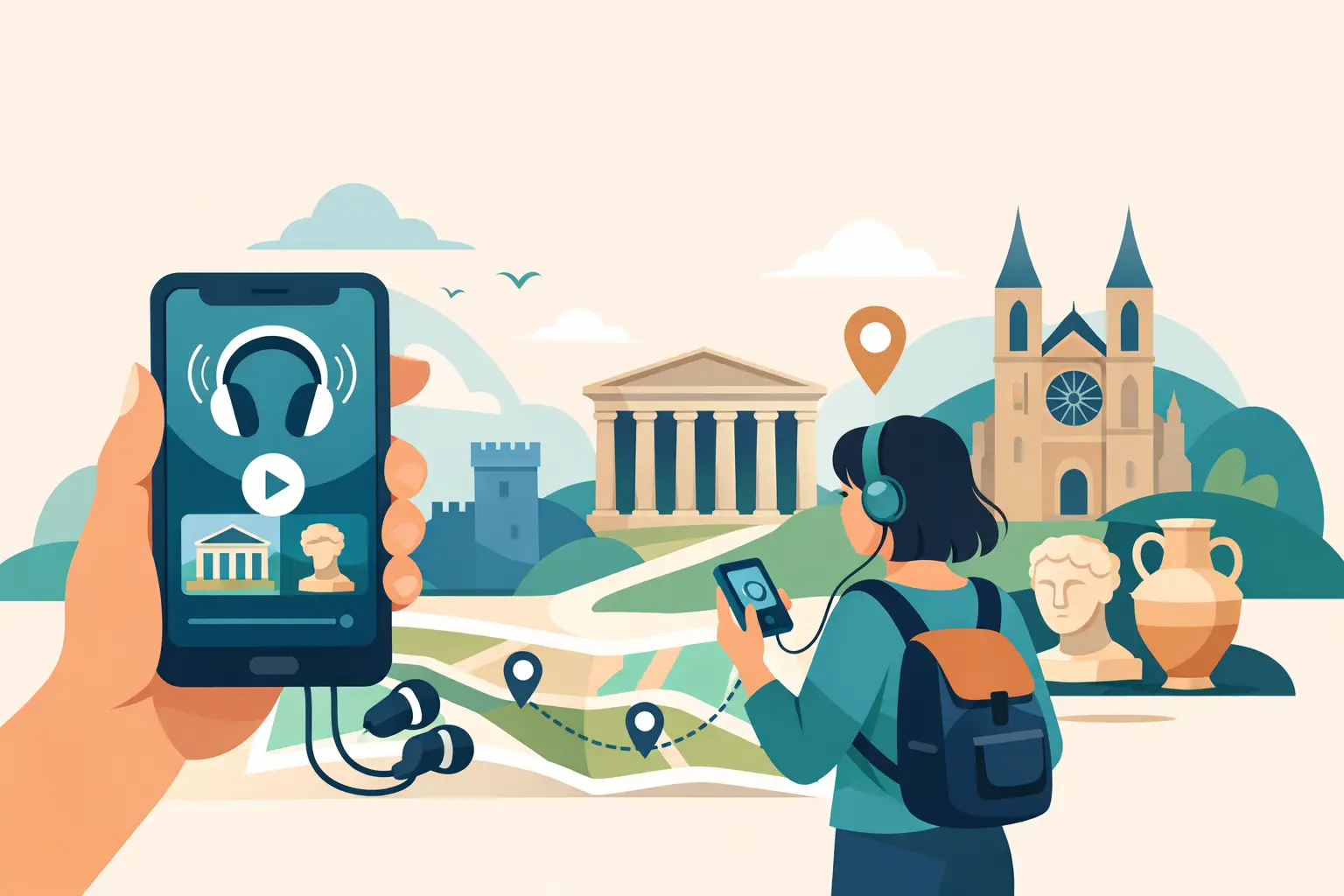
A visitor scans a QR code at the entrance to a site, puts on their headphones and begins their visit on their own phone. For the team, no boxes to distribute, no stock to refill, no queue to manage. This is precisely what makes a heritage audio guide application interesting today: it meets public expectations while significantly reducing the operational burden on cultural structures.
For a territorial museum, a monument, an interpretation center or a tourist office, the subject is not limited to replacing one support with another. An audio guidance solution involves choices of mediation, accessibility, internal organization and budget. Choosing well therefore requires looking beyond the effect of modernity.
Why the heritage audio guide application is essential in the field
The success of this format is primarily due to a simple evolution of uses. Visitors are used to viewing content on smartphones, listening to podcasts, activating a card or scanning a code to access information. In this context, offering an audio tour on their personal device becomes a natural extension of the visit experience.
For teams, the gain is often immediate. Dedicated equipment involves purchases, maintenance, cleaning, losses, breakages and sometimes heavy daily management. Conversely, an application or web app significantly reduces these constraints. This does not mean that there is nothing more to organize, but the logistics are changing in scale.
Another decisive point: editorial flexibility. Modifying a track, adding a language, correcting historical information or enriching a temporary route becomes much simpler than with fixed devices. This agility is particularly important for small and medium-sized structures, which must reconcile scientific requirements, responsiveness and limited resources.
What a good solution should really provide
A heritage audio guide application cannot be judged only by its interface. It must first serve a clear cultural project. The right question is not just “is it modern?” ", but "is it useful for our visitors and realistic for our team? ".
Simple handling for the public
Access to content must be immediate. If the visitor has to download several elements, create an account or follow a complex technical path, part of the audience will drop out. On site, every friction counts. Triggering by QR code, web access without installation when relevant, or GPS guidance for outdoor routes can make a real difference.
Simplicity also concerns visitor profiles. A busy family, an international group, a senior not very comfortable with digital technology and a passionate individual visitor do not have the same expectations. The more fluid the entry into the experience, the more the tool fulfills its mediation mission.
An administration designed for non-technical teams
In many heritage structures, digital mediation is not supported by a dedicated IT department. It is often site managers, mediation officers, tourist offices or multi-skilled teams who manage the project. The administration interface must therefore be clear, stable and understandable without advanced technical expertise.
This includes the management of audio tracks, visuals, translations, points of interest, but also the possibility of developing content without systematically depending on an external service provider. A solution that is too complex can seem rich on paper and become little used in reality.
An experiment that works in real conditions
Heritage is not always visited in a connected and comfortable environment. Rural sites, routes through old centers, buildings with thick walls, underground areas or large outdoor spaces pose very concrete constraints. Offline mode is therefore not a detail. In some cases it is essential.
The same goes for trigger modes. GPS can be very relevant for an outdoor heritage walk. The QR code is often more reliable in a museum or a site with precise steps. The right choice depends on the location, visitor flow and network quality.
Guideius addresses every digital cultural mediation challenge
Create a multilingual smartphone audio guide that is easy to deploy, accessible and tailored to your museum, heritage site or destination.
The selection criteria to examine before getting started
Comparing solutions requires careful reading of needs. Many offers display similar functionalities, but their relevance varies depending on the context.
Multilingual and quality of mediation
Multilingual has become a common expectation, not just in large equipment. A local site can welcome foreign visitors, bilingual school groups or seasonal tourists. The question is not simply to offer several languages, but to be able to administer them easily and maintain their quality over time.
We must also look at the form of mediation. A good heritage audio guide app doesn’t just pile on commentary. It allows you to structure a story, prioritize the levels of information and, if necessary, add additional media, soundscapes or quizzes. Again, it all depends on the objective. Too much content can harm the visit as much as too poor a device.
Accessibility and inclusion
For public and parapublic actors, accessibility is not an extra. This is a central requirement. Subtitling, transcription, adaptation of contrasts, compatibility with mobile uses, readability of interfaces, alternatives to audio-only content: these elements must be integrated from the start.
A serious solution must make it possible to broaden access to heritage, not to create a new barrier. It is a point of cultural coherence as much as a regulatory and operational issue.
Usage data and management
An audio course also needs to be evaluated. How many visitors use it? Which stages are the most listened to? When does attention drop? Usage statistics help to adjust a route, to argue an activity report or to prepare a financing request.
However, we must maintain an ethical course. Not all data is necessary. For structures committed to digital sobriety and control of the information collected, a useful and transparent measure is better than an accumulation of poorly usable indicators.
Common errors in a heritage audio guidance project
The first is to treat the tool as a simple technical purchase. In reality, it is a mediation project. If the content is not adapted to the route, the audience and the actual visit time, even the best interface will not compensate for this gap.
The second mistake is to underestimate deployment support. You have to think about the signage, the welcome message, the instructions for use, the on-site tests and the way in which the teams present the tool to visitors. A powerful but poorly introduced solution remains underused.
The third is the budget. The cost of entry matters, of course, but you have to look at the overall cost of operation. A cheaper offer at the start can become more cumbersome if each development, correction or update generates a strong dependency. Conversely, a well-designed solution with maintenance included often provides more visibility.
Native application, web app, white label: what to choose?
There is no universal answer. A native application can offer a very controlled experience, particularly for recurring uses or strong customization. A web app often facilitates quick access, without downloading, which is valuable for occasional visitors. Some structures need an identity entirely in their colors, others favor speed of commissioning.
The right choice depends on several factors: frequency of visit, notoriety of the place, importance of the brand, budget, editorial autonomy and expected level of personalization. For many establishments, the best solution is one that balances ease of access for the public and ease of administration for the team.
It is in this area that a solution like Guideius finds its relevance: offering a complete framework, easy to deploy, with useful functions in the field rather than a sophistication that is difficult to maintain.
What the visitor is really looking for
The visitor does not come looking for a technological demonstration. He wants to understand a place, find his way, choose his pace and live a richer experience without complications. A good heritage audio guide application therefore knows how to stay in its place. It accompanies discovery, it does not replace it.
This requires a fine balance. Too much automation can make the journey impersonal. Too much freedom can lose certain audiences. Too much content can be tiring. Not enough information can be frustrating. The best systems are often those which respect the visit time, the diversity of uses and the identity of the site.
Basically, choosing an audio guidance solution means choosing a way of transmitting. When the tool is simple, inclusive and well thought out, it eases the daily lives of teams while reinforcing what really matters: the encounter between a place, a story and its audiences.
Would you like to apply these ideas to your site?
Guideius helps deploy multilingual audio tours with QR codes, GPS, offline mode, multimedia content and privacy-friendly analytics.