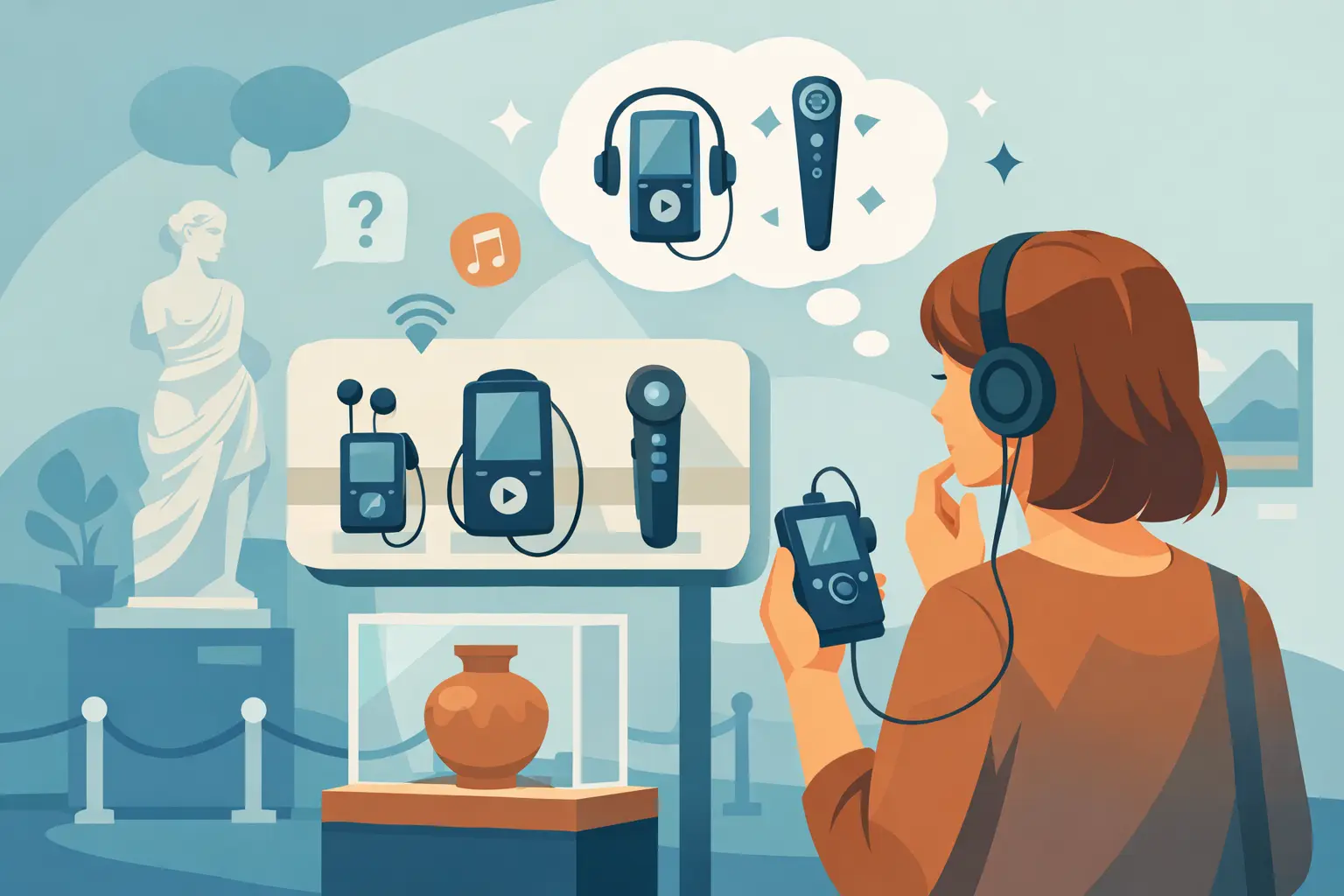
A small museum does not need a complex system to enrich the visit. He needs a reliable tool, adapted to his means and simple enough for the team to be able to maintain it over the long term. The question “which audio guide for a small museum” therefore does not come down to the choice of technology: it involves the quality of mediation, the autonomy of the teams and the accessibility offered to all audiences.
In a structure with limited human resources, an audio guide should lighten daily life rather than create new tasks. It must make it possible to tell the collections precisely, without requiring the purchase, loan, recharging or disinfection of a fleet of boxes. Digital solutions on smartphones respond particularly well to this reality, provided they are chosen according to the actual uses of the place.
Which audio guide for a small museum really meets your needs?
The right choice begins with a very concrete question: what should the visitor be able to do, and what is the team really able to administer? A municipal museum with a few rooms, an artist's house, an eco-museum or an associative site have neither the same flows, nor the same network constraints, nor the same editorial ambitions.
For most small structures, a solution accessible from the visitor's phone is more relevant than a traditional hardware audio guide. The visitor scans a QR code at reception, on a menu or at the start of the tour, then listens to the content in their browser or an application. The establishment thus avoids the initial investment in dedicated devices, losses, breakdowns, storage and daily maintenance.
However, this model is not synonymous with imposed all-digital. Some visitors do not have a smartphone, do not wish to use it or need special support. Inclusive mediation therefore provides for clear signage, content also available in written form when relevant, and a reception solution for people who need it. The audio guide completes the visit, it should not become a barrier.
Prioritize simplicity of deployment and administration
A useful project is one that the team can update without systematically depending on a technical service provider. The chosen system must allow you to modify a text, replace an audio file, add a translation or consult usage data from an interface understandable by non-specialists.
This autonomy is decisive. A temporary exhibition, the moving of a work, a new acquisition or a change of schedule may require rapid adaptation of the route. If each correction involves development, a good tool quickly becomes too restrictive. Conversely, guided administration helps teams keep content alive and accurate.
The triggering must also remain proportionate to the location. In an indoor museum with well-identified rooms, the QR code is often the most direct solution: it is economical, visible and easy to integrate into the scenography. For an outdoor trail, a heritage village or a sculpture garden, the GPS trigger can provide greater comfort. In mixed spaces, combining the two avoids asking the visitor to constantly search for the right content.
Don't underestimate offline mode
Connection quality is often uneven in old buildings, rural sites, cellars, open reserves or outdoor routes. Offering an audio guide dependent on a stable mobile network can produce the opposite effect to that sought: frustration, long loading times and abandonment of visits.
Pre-downloading content or a true offline mode is therefore worth checking from the start. This function secures the experience once the course has started. It is particularly useful for foreign visitors, who do not want to use their mobile data, and for sites located in areas with poor coverage.
The team must also test the route in real conditions, with several phone models and without a Wi-Fi connection. A successful demonstration on a computer does not guarantee a smooth visit in the middle of a building with thick walls. This field test makes it possible to adjust the location of the QR codes, the signage and the weight of the media before opening to the public.
Guideius addresses every digital cultural mediation challenge
Create a multilingual smartphone audio guide that is easy to deploy, accessible and tailored to your museum, heritage site or destination.
Building an audio mediation to the right extent
The most complete audio guide is not always the most effective. In a small museum, each sequence must justify the attention it demands. Better eight well-written steps, with an embodied voice and useful information, than a systematic commentary on each object on display.
A duration of around one to two minutes per listen is often a good benchmark, but it depends on the nature of the collections. Faced with a complex work or a rare sound testimony, the visitor can accept a longer time. In a dense room or a family course, brief and rhythmic formats will be more appropriate. The main thing is to leave the choice: a quick visit, an in-depth tour, or additional content for those who wish to go further.
Images, archives, short videos and quizzes can enrich the story, particularly to contextualize an object that is difficult to interpret alone. They must nevertheless serve the purpose. A cluttered interface distracts from collections and makes production heavier. Digital sobriety is also a cultural requirement: favoring useful, compressed and accessible media makes the journey more comfortable for everyone.
Make accessibility a criterion of choice
Audio improves access to content, but it is not enough to make a visit accessible. A relevant mediation tool provides transcriptions, comfortable reading, appropriate contrasts, simple navigation and, depending on the project, content in sign language or easy to read and understand.
Multilingualism is just as strategic. For a museum located in a tourist area, offering at least one French and one English version can immediately broaden the audience. Other languages will be determined based on the audiences observed, rather than automatically. The quality of translation and cultural adaptation are more important than the multiplication of poorly followed versions.
Finally, accessibility concerns the use of sound itself. Please remember to use headphones, provide readable volume settings and ensure that the visit remains possible without sound. A respectful audio tour does not transform the rooms into noisy spaces and leaves each person free to visit.
Evaluate the cost over time, not just at launch
The price of a solution must be compared to its overall operating cost. Hardware audio guides may sound familiar, but they involve purchasing or renting devices, renewing them, cleaning them, recharging them, taking inventory, and additional docking time. These costs are sometimes difficult to absorb for a small team.
A solution on smartphone greatly reduces these logistics, but the budget must include subscription, content creation, possible translations and launch support. The healthiest model is one whose pricing evolves with the project, without charging for unnecessary functions or volumes from the start.
It is also relevant to check what is included: maintenance, media hosting, support, updates, statistics and editorial support. An inexpensive but difficult to maintain plan can cost more over the years. Guideius is part of this logic by offering a complete solution, designed for cultural teams who wish to remain autonomous without being left alone with the tool.
Use statistics to improve the journey
Usage data should not be seen as a simple table of numbers. They make it possible to understand which stages are most visited, when visitors leave the route, which languages are used and which content arouses the most interest.
For a small museum, this information is valuable because it guides editorial efforts. A little-listened stop is not necessarily useless, but it can signal a poorly placed QR code, an unclear title or too long content. Statistics help to correct with discernment, without replacing the feedback collected from visitors and reception agents.
Data control remains a point of vigilance, particularly for public and parapublic structures. You should choose a service provider who is transparent about hosting, the data collected and their purpose. Measuring usage should not mean tracking people.
An audio guide suitable for a small museum is not intended to impress with an accumulation of functions. It must give visitors the desire to look, listen and understand, while giving teams time to do what no technology can replace: welcome, transmit and take care of the collections.
Would you like to apply these ideas to your site?
Guideius helps deploy multilingual audio tours with QR codes, GPS, offline mode, multimedia content and privacy-friendly analytics.