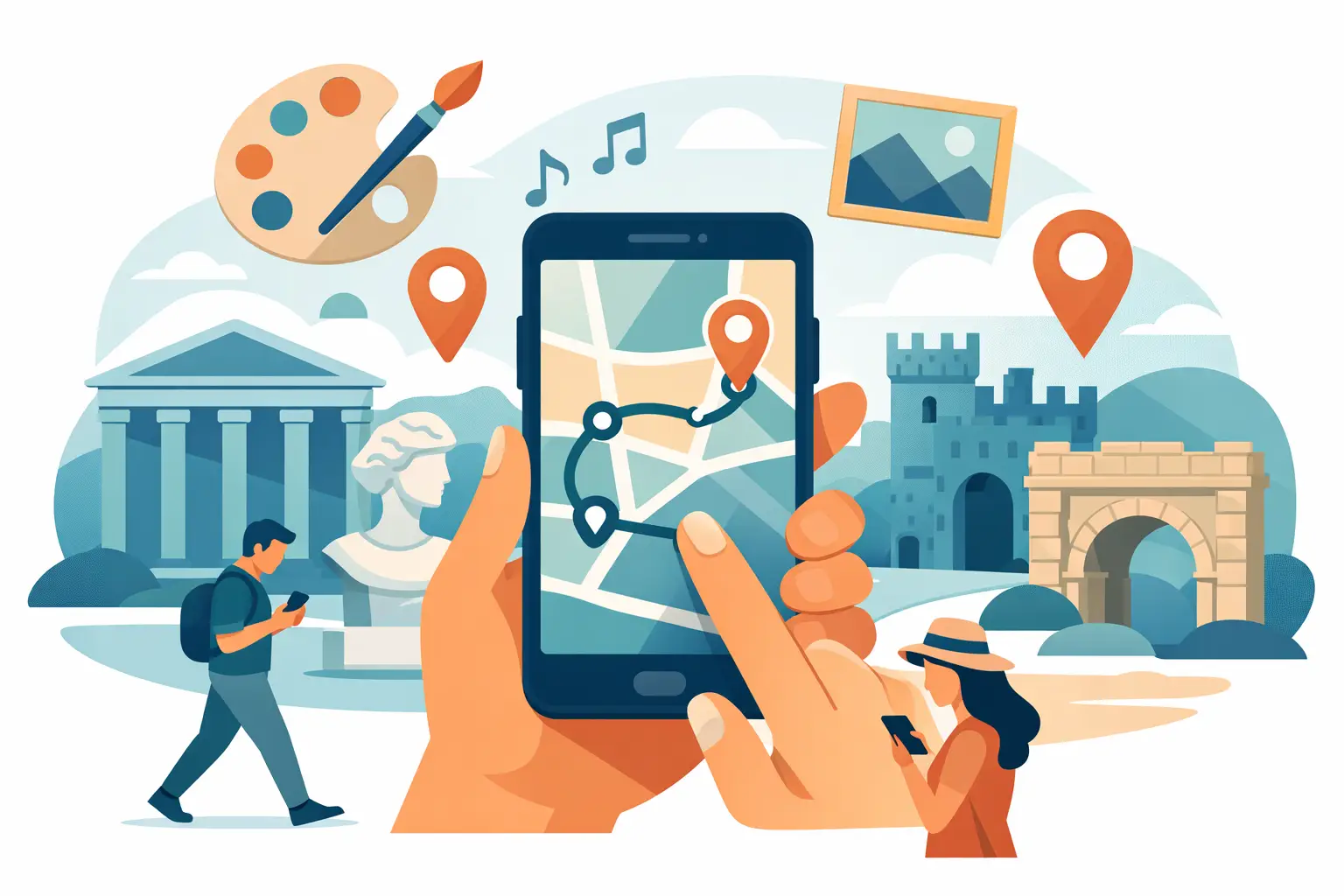
A visitor arrives in front of a Romanesque church, an old market hall or a major work. In a few seconds, your phone can become a precise, multilingual mediation tool adapted to your pace. Creating a cultural tour on a smartphone is therefore not about transposing a paper booklet onto a screen: it is about designing a visit experience that connects a very different place, stories and audiences.
For museums, heritage sites, tourist offices and communities, this format also responds to an operational reality. It avoids the purchase, loan, recharge and maintenance of a fleet of audio guides. Provided the route is prepared methodically, the visitor's personal smartphone becomes a transmission medium that is flexible, economical and inclusive.
Start from the visit experience, not the tool
The first instinct is often to choose an application or to think about the available features. However, a successful journey begins with a simpler question: what should the visitor understand, feel or notice at the end of their journey? This intention gives direction to the content, the number of steps and the level of detail.
A visit to an old center should not be thought of as a visit to a museum. On an urban route, walking, changes in landmarks, ambient noise and traffic hazards must be taken into account. In a monument, progression is more controlled, but network, acoustic or accessibility constraints may be greater. The right format therefore depends on the location, its uses and its audiences.
It is useful to define a priority audience from the start. A family visit, a tour intended for schools, a discovery for international tourists and expert mediation have neither the same duration nor the same tone. Wanting to tell everyone everything often leads to an overly long experience. It is better to create a clear base and offer, when relevant, additional content: a short version, an additional language, in-depth historical analysis or a quiz.
Determine a realistic route
The duration announced must correspond to the duration experienced. A 45-minute course can include six to eight stages if the journeys are short and the content well calibrated. Beyond that, there is a risk of losing attention or giving the visitor the feeling of having to complete a task rather than enjoying the place.
Each stop must have an identifiable function: observe a detail, understand a transformation of the landscape, hear a testimony, make the link between two periods or invite us to look differently. If two steps say the same thing, one of them can probably be simplified or removed. The quality of a journey depends as much on what it chooses to keep silent as on the wealth of information it transmits.
Create a cultural journey on a smartphone with adapted content
The smartphone promotes brief, embodied and situated mediation. The audio is particularly effective: it leaves the hands and eyes available for the place. It also allows you to adopt a lively tone, with the voice of a mediator, resident, researcher or witness, without requiring prolonged reading on a small screen.
To maintain attention, an audio track of one to two minutes is often enough. Longer content remains possible for a particularly dense work, space or subject, but it must be justified by a real contribution. Good audio writing doesn't describe what the visitor already sees. It directs one's gaze, provides context, reveals a vanished use or provides a key to interpretation.
Images, archives, maps and short videos usefully enrich the story when they allow the invisible to be compared, located or made visible. An old photograph can transform the perception of a place; an architectural section can illuminate a building; a map can secure a route. On the other hand, multiplying the media without intention risks making the journey heavier and slowing down the loading of pages.
Writing for the listening and diversity of audiences
A text intended to be listened to must be written differently than a label or a scientific file. Short sentences, concrete references and explicit vocabulary make the discussion more comfortable. It is better to say “look at the darker stone to the left of the gate” rather than talking about an architectural element without anchoring it in the field of vision.
Accessibility must be integrated from the writing stage, not added at the end. Audio transcriptions, subtitles for videos, readable contrasts, textual alternatives to visuals and understandable navigation benefit all visitors, including in a noisy or bright environment. Translation deserves the same attention: adapting content to a language does not just mean replacing words. Cultural references, units of measurement and levels of context may need to evolve.
Guideius addresses every digital cultural mediation challenge
Create a multilingual smartphone audio guide that is easy to deploy, accessible and tailored to your museum, heritage site or destination.
Choose a simple and reliable trigger
The triggering of content largely determines the fluidity of the visit. The QR code is particularly suitable for rooms, facades, interpretation panels and clearly identified stopping points. The visitor decides when to launch the content, which gives him great autonomy. It is also easy to deploy and renew without modifying the physical route in depth.
GPS is more suitable for walks, territorial discovery tours and routes in which the place itself must trigger the story. It can guide the visitor on a route, provided that sufficient location space is provided. On a narrow street, in a forest or near a building, accuracy may vary. A map, a list of steps and the possibility of manually launching content therefore remain essential security.
The most relevant choice is often hybrid. QR codes provide immediate access to specific content, while GPS supports orientation on outdoor routes. Whatever the solution chosen, the route must be tested in real conditions: with the brightness of the site, the available network, the noise, the movements and several telephone models.
Plan for offline and limit irritants
A visitor should not have to use up their mobile plan to listen to a cultural tour. In rural areas, monuments with thick walls, gardens or certain exhibition spaces, the network may be weak or non-existent. The prior downloading of contents in offline mode provides a concrete response to this constraint.
This preparation must be simple and clearly explained at the starting point. A visible display can indicate how to scan the QR code, choose your language and save the route before starting. It is also useful to have headphones available for sale or to invite visitors to bring their own, without excluding those who prefer to listen at low volume or read transcriptions.
Technical sobriety is a quality choice. Properly compressed audio files, optimized images and a lightweight interface improve visiting comfort while reducing data and battery requirements. This attention is particularly consistent with the expectations of public and heritage structures, concerned with useful rather than demonstrative digital technology.
Give teams an manageable tool
A journey does not remain fixed. Schedules, access, works, cultural programming, new research or local partnerships may require rapid updating. The chosen solution must allow teams to modify text, replace a visual, publish a new language or deactivate a step without systematically depending on a technical service provider.
This is where a platform designed for non-expert teams makes a concrete difference. Guideius allows you to manage multilingual audio routes on application and web app, with triggering by QR code or GPS, offline content and accessibility features. The challenge is not to add technology to the course, but to give teams the means to manage it sustainably.
Usage statistics also have their place, provided you read them with discernment. The number of starts, the languages chosen, the most listened to stages or abandonments can help to understand visit practices. This data does not replace feedback from the field, discussions with reception staff and observation of the public. However, they offer valuable benchmarks for adjusting content or better sizing a route.
Launch, observe, improve
Before going fully online, a test with a few representative profiles is often more useful than a long internal meeting. Have someone familiar with the area, an outside visitor, a family and, if possible, someone with specific accessibility needs walk the route. Observe the hesitations: a poorly placed QR code, unclear instructions or audio that is too long appear immediately on the ground.
The launch is not the end of the project. A cultural journey on a smartphone becomes more relevant when it evolves with the place, its seasons, its inhabitants and its visitors. Starting with a clear mediation intention and a first, well-mastered itinerary, the teams create a solid basis for bringing heritage to life without burdening their daily lives.
Would you like to apply these ideas to your site?
Guideius helps deploy multilingual audio tours with QR codes, GPS, offline mode, multimedia content and privacy-friendly analytics.