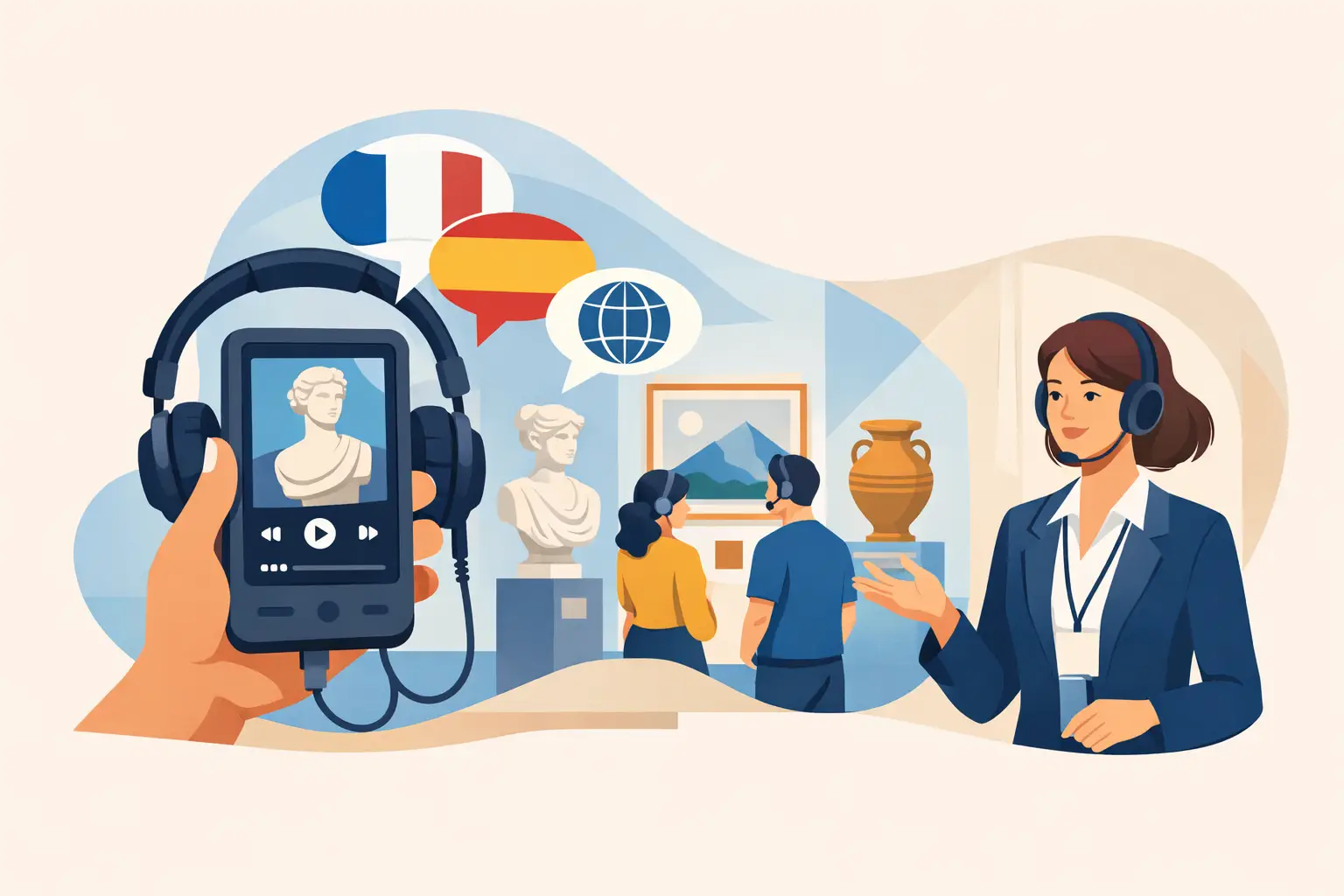
A German visitor scans a QR code at the entrance. A Spanish family continues the visit in the lower rooms where the network is poor. A local school group activates a smartphone quiz. Behind these very different uses, the same question arises for field teams: how to deploy a multilingual audio guide in a museum context that is both simple to manage, useful for the public and sustainable for the structure?
The subject is no longer just about translating a few audio tracks. For a museum, a heritage site or an interpretation route, multilingual involves both the quality of mediation, accessibility, internal organization and the economic model. The right device is not the one that stacks functions. It is the one that responds to real constraints, without creating new burdens for the teams.
Why the multilingual audio guide has become strategic for museums
In many cultural structures, the diversification of audiences is no longer an abstract objective. It is experienced at the counter, in return visits, in the expectations of institutional partners and in the need to better promote a territory. Offering several languages then becomes a reception condition, not a simple addition to comfort.
A well-designed multilingual audio guide firstly broadens access to content. It offers international visitors an independent understanding of the route, but it also serves French-speaking audiences who prefer an audio tour, groups prevented by prolonged reading, or visitors who wish to progress at their own pace.
There is also an image issue. A museum that offers a clear, fluid and coherent multilingual experience sends a strong signal about the quality of its welcome. Conversely, partial content, a language only available on certain media or a complicated system to launch quickly create frustration.
Finally, we must look at budgetary reality. Many establishments want to improve mediation without investing in a fleet of devices to purchase, distribute, recharge, clean, store and renew. The visitor's smartphone, when used methodically, profoundly changes the equation.
What a museum should really evaluate
The first criterion is not technological. It is the coherence between the course, the audiences and internal resources. A small structure with few reception staff does not have the same needs as a large museum with high international attendance. Between the two, there is a large area where simplicity of administration counts as much as functional richness.
Useful languages, not just desired languages
Many projects start from an ideal list of languages. It is better to start with observed uses. Which nationalities are actually present? Which audiences do you want to develop in the next two to three years? What languages are expected by financiers, tourist offices or territorial networks?
This approach avoids a common pitfall: multiplying versions without being able to maintain their quality. A multilingual audio guide is only relevant if each language benefits from real editorial work, with the right tone, an appropriate duration and natural understanding. Literal translation rarely produces good mediation.
The method of access must be obvious
If the activation of the journey requires too much explanation, adoption drops. In practice, the most effective devices are based on simple inputs: QR code at reception, direct link, or geolocated triggering on outdoor routes. This point seems secondary on paper. In the field, it often makes the difference between a tool used and one ignored.
For places with irregular connectivity, offline mode is equally decisive. Cellars, ramparts, extensive gardens, old buildings with thick walls: if the content does not remain accessible without a stable network, the experience quickly deteriorates.
Accessibility should not be a late option
In a cultural project, inclusion is not addressed at the end of the process. Subtitles, transcription, readability of the interface, rhythm of narration, compatibility with certain assistive uses: all this is part of the specifications from the start. Multilingual and accessibility are linked, because they ask the same fundamental question: how to make content truly available to different audiences, without making their visit more complex?
Guideius addresses every digital cultural mediation challenge
Create a multilingual smartphone audio guide that is easy to deploy, accessible and tailored to your museum, heritage site or destination.
The real decision: dedicated hardware or visitor’s smartphone
Dedicated equipment still reassures certain establishments. It gives an impression of control and helps standardize the experience. But it involves heavy constraints: initial investment, maintenance, hygiene, breakage, inventory management and mobilization of teams at each stage.
Conversely, a smartphone solution greatly reduces these logistics. The visitor uses their own device, which simplifies distribution and lowers operating costs. For small and medium-sized structures, this advantage is often decisive.
The choice is not completely binary. It is necessary to take into account the profile of the public, the network coverage, the expected level of autonomy and the reception policy of the establishment. Some museums maintain an additional loan solution for visitors without equipment. This is often a reasonable approach: limiting the material without excluding specific uses.
What teams gain with a well-thought-out solution
A good audio guide doesn't just serve visitors. It must also lighten the work of the teams. This is a point that is often underestimated when making a choice.
An administration accessible to non-specialists
In many cultural structures, digital mediation is carried out by small teams. The chosen system must therefore make it possible to update content, correct a language version, add a step or consult statistics without depending on a service provider for each modification.
This autonomy changes the relationship with the tool. An easy-to-administer device stays alive. It monitors temporary exhibitions, route adjustments and visitor feedback. A tool that is too technical often ends up frozen, even if it was ambitious at the start.
Really useful usage data
Knowing how many visitors launch the journey, which languages are used the most, where abandonment occurs and which sequences are listened to the most helps to manage the mediation. These data do not replace field observation, but they provide a solid basis for adjusting the offer.
These statistics still need to be readable and usable. Tables that are too complex do not help a cultural team decide. The challenge is not to collect a lot. It’s about understanding better.
Errors that weaken a multilingual project
The first is to consider the audio guide as a simple translation medium. A good audio course does not mechanically repeat the cartels. It tells, prioritizes, contextualizes. Depending on the language, it is sometimes necessary to adapt cultural references or clarify certain implicit ones.
The second mistake is to underestimate editorial production. Writing for audio requires a different logic than writing a panel. The text must be clear when listening, with a controlled rhythm and sequences of reasonable length. This is even more true in a multilingual context.
The third error concerns project governance. If no one is clearly responsible for the content, validations, updates and monitoring of usage, the system risks running out of steam after launch. Success depends as much on the organization as on the solution chosen.
Towards a more sober, more inclusive, more sustainable audio guide
The market has long valued technical sophistication as an end in itself. For heritage stakeholders, the question lies elsewhere. It is about disseminating knowledge more widely, with realistic tools, economically tenable and compatible with the constraints of the field.
This is where a well-calibrated digital solution makes sense. When it combines simple access, multilingual content, offline operation, accessibility options, statistics and clear administration, it becomes a concrete lever for mediation. Not a gimmick. Not an extra layer of complexity.
For many establishments, particularly small-sized structures, this approach makes it possible to take a step forward without changing administrative scale. This is also the logic behind solutions like Guideius: making the multilingual digital audio guide more accessible to teams who have neither a dedicated IT department nor an expandable budget, but who have strong requirements for the quality of reception and transmission.
Basically, choosing a multilingual audio guide for a museum comes down to asking a simple question: does your tool really serve the purpose of bringing together a place, a story and diverse audiences? If the answer is yes, the technology almost disappears. And that’s often the best sign.
Would you like to apply these ideas to your site?
Guideius helps deploy multilingual audio tours with QR codes, GPS, offline mode, multimedia content and privacy-friendly analytics.