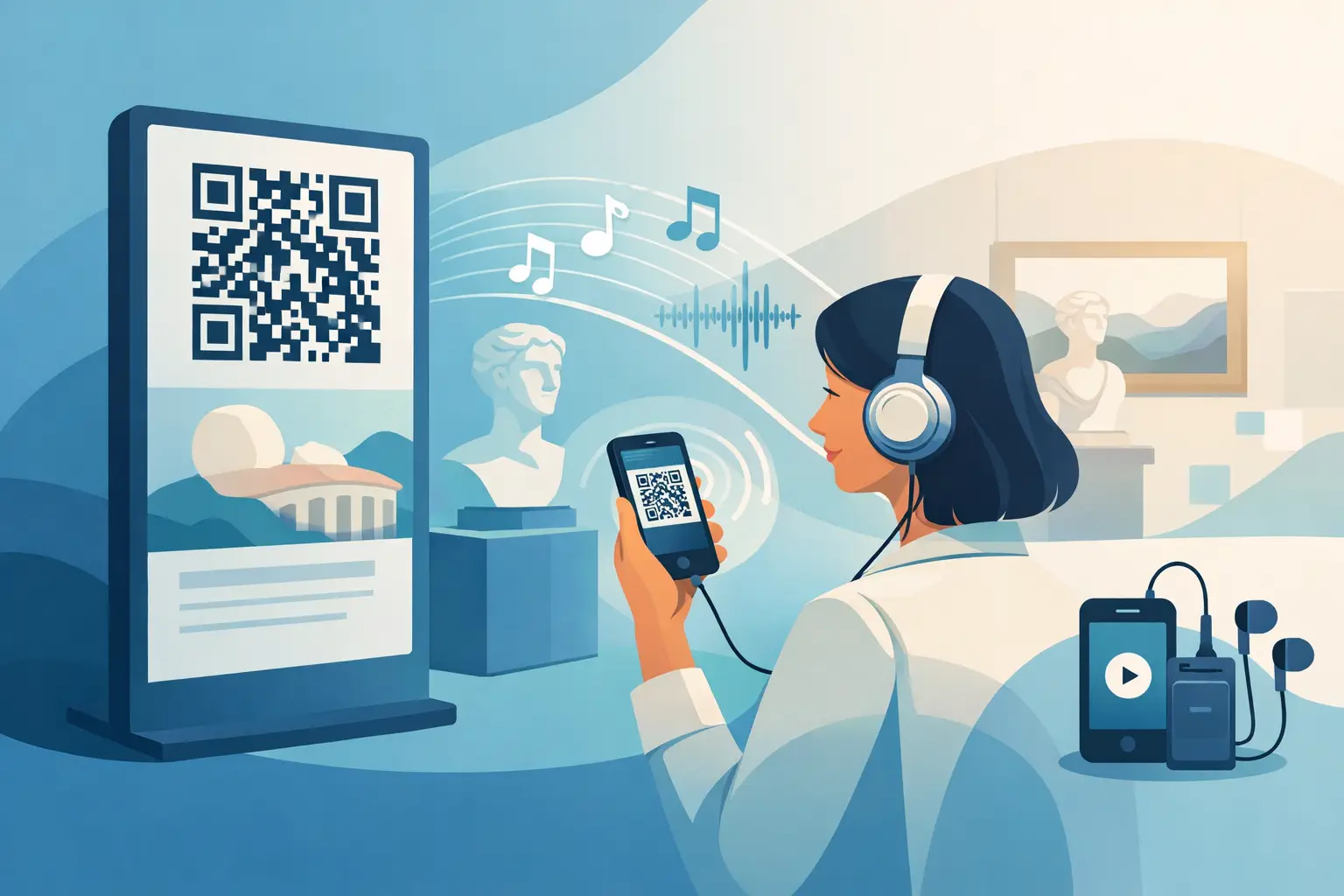
A sign, a welcome sign or a simple sticker placed at the entrance can now do much more than indicate a direction of visit. With an audio tour using a QR code, a museum, a heritage site or a tourist office provides access, in a few seconds, to audio content on the visitor's smartphone, without distributing a dedicated device. This change seems simple. In reality, it profoundly changes the organization of teams, the quality of experience and the way of disseminating knowledge.
Why the audio tour by QR code is essential
The success of this format is primarily due to its logic of use. The visitor scans, opens the route, listens. There is no need to go through a circulation desk, leave ID or understand a specific terminal. For cultural structures, the benefit is just as concrete: less equipment to purchase, less maintenance, less time spent on logistics management.
This model also responds to an expectation that has become very strong in the field: to offer quality digital mediation without burdening daily operations. This is particularly true for small and medium-sized structures, which wish to enrich their routes but have neither an internal IT department nor a team dedicated to audio guide equipment.
However, we must avoid an overly simplistic idea. Scanning a code is not enough to make good mediation. A QR code audio tour is only relevant if it is part of a clear route, well-written content and an experience designed for varied audiences.
What the QR code audio tour changes for teams
On an operational level, the interest is immediate. The first area of reduction concerns equipment. Without a fleet of audio guides to manage, the structure reduces purchases, storage, recharging, cleaning and replacements linked to wear or breakage. In an often constrained budgetary context, this argument counts.
The second change concerns team autonomy. A well-designed solution makes it possible to administer content, update a point of interest, add a language or correct a text without heavy technical work. For a municipal museum, a heritage association or a tourist office, this simplicity is not a secondary comfort. This is the condition for keeping the courses alive over time.
The audio tour by QR code also provides better management. When combined with usage statistics, it makes it possible to observe the most viewed content, the most used languages or the steps that really attract attention. These data do not replace field observation, but they provide valuable benchmarks for adjusting a mediation offer.
A more flexible experience for visitors
On the public side, the main advantage is fluidity. The visitor uses their own phone, at their own pace, with their headphones if they wish. This freedom is particularly suitable for independent journeys, family visits, open sites or tourist destinations where flows vary greatly depending on the season.
This flexibility also favors multilingualism. Where physical media required severe trade-offs, the digital format makes it easier to offer several languages and different reading levels. The same place can thus appeal to locals, international tourists, schoolchildren or knowledgeable visitors without multiplying the number of devices.
However, there are points to be vigilant. Not all visitors are comfortable with digital technology, not everyone has enough battery power, and some places suffer from unstable connectivity. This is why the quality of a solution is also measured by what it provides for these very concrete cases: offline mode, clear interface, quick access without unnecessary friction, and alternatives for less equipped audiences.
QR code alone or enriched route?
The QR code is a trigger, not a mediation project in itself. Used alone, it can be perfectly suited to a simple, linear route, with a few well-identified stations. This is often a very good entry point for a structure that wants to quickly deploy an accessible audio offering and control its budget.
But in many contexts, it benefits from being combined with other trigger logics, notably GPS. In a historic center, a heritage garden or an outdoor discovery route, this combination avoids depending solely on physical supports. It also makes it possible to accompany more open routes, where we wish to maintain a degree of freedom in wandering.
The challenge is therefore not to choose the most visible technology, but the one that corresponds to the site, the public and real uses. In a showroom, the QR code provides great precision. On an urban circuit, GPS can become more relevant. In some cases, the two work together and complement each other very well.
Guideius addresses every digital cultural mediation challenge
Create a multilingual smartphone audio guide that is easy to deploy, accessible and tailored to your museum, heritage site or destination.
The conditions for a successful audio visit by QR code
The first factor for success remains content. Good audio doesn't just repeat the cartel. It contextualizes, tells, relates, allows us to see differently. For heritage professionals, this requires real editorial work: prioritizing the information, choosing the right level of detail, adapting the tone to the target audience and maintaining a listening time compatible with the visit.
The second factor is accessibility. Digital mediation should not create a new barrier. Video subtitling, audio transcription, readable contrasts, simple navigation, adaptation to different consultation rhythms: these points are not a comfort option. They fully participate in the mission of cultural dissemination.
The third factor is the quality of the on-premises deployment. A poorly placed QR code, too discreet or placed in a poorly lit area greatly reduces usage. Conversely, clear signage, very simple instructions and entry into the experience in just a few seconds change everything. On this subject, the field quickly decides: if access seems complicated, part of the public immediately gives up.
Finally, you have to think about post-launch. An audio tour by QR code is not fixed. It lives with the programming, visitor feedback, changes in scenography or territorial development priorities. Choosing a solution that is easy to administer, with maintenance included and support, helps prevent a route that was initially relevant from becoming obsolete within two seasons.
A technological choice, but also budgetary and ethical
For many establishments, the question is not just about modernizing the experience. It’s about finding a sustainable model. An audio tour using a QR code generally reduces hardware costs, but the real calculation must integrate the entire life cycle: content creation, updates, support, statistics, accessibility, team support and possible customization of the interface.
The cheapest on paper is therefore not always the most economical in the long term. A very limited solution can generate hidden costs in human time, external service providers or technical rework. Conversely, a platform designed for non-expert teams often provides better operational control.
The ethical dimension also deserves to be looked at carefully. In the cultural sector, data control, technological sobriety and inclusiveness are not secondary subjects. They condition the confidence of institutions and visitors alike. A serious solution must therefore avoid intrusive logic, remain legible in its operation and serve mediation before serving fashion.
It is in this balance that players like Guideius find their place: offering digital audio courses that are simple to deploy, rich enough to respond to realities on the ground, and designed for cultural structures that want to combine quality of experience, budgetary control and accessibility.
Who is this format best suited to?
The QR code audio tour is particularly suitable for small or medium-sized museums, monuments, interpretation centers, outdoor tours and tourist offices that wish to broadcast audio content without burdening their organization. It is also very suitable for multilingual projects, busy tourist seasons and teams looking for a quick solution to get started.
It will be less sufficient if we expect a very scenographic system based on complex interactions, or if a significant proportion of the public cannot use their telephone. In this case, a mixed device may be preferable. The right choice is not the one that promises the most, but the one that really delivers on the ground, on a daily basis, with your resources and your audiences.
The real question is therefore not whether the QR code is modern. It is to know if it helps you to better transmit, to better welcome and to better manage your mediation. When the answer is yes, it becomes much more than technical access: a concrete lever to make heritage more readable, more alive and more accessible.
Would you like to apply these ideas to your site?
Guideius helps deploy multilingual audio tours with QR codes, GPS, offline mode, multimedia content and privacy-friendly analytics.