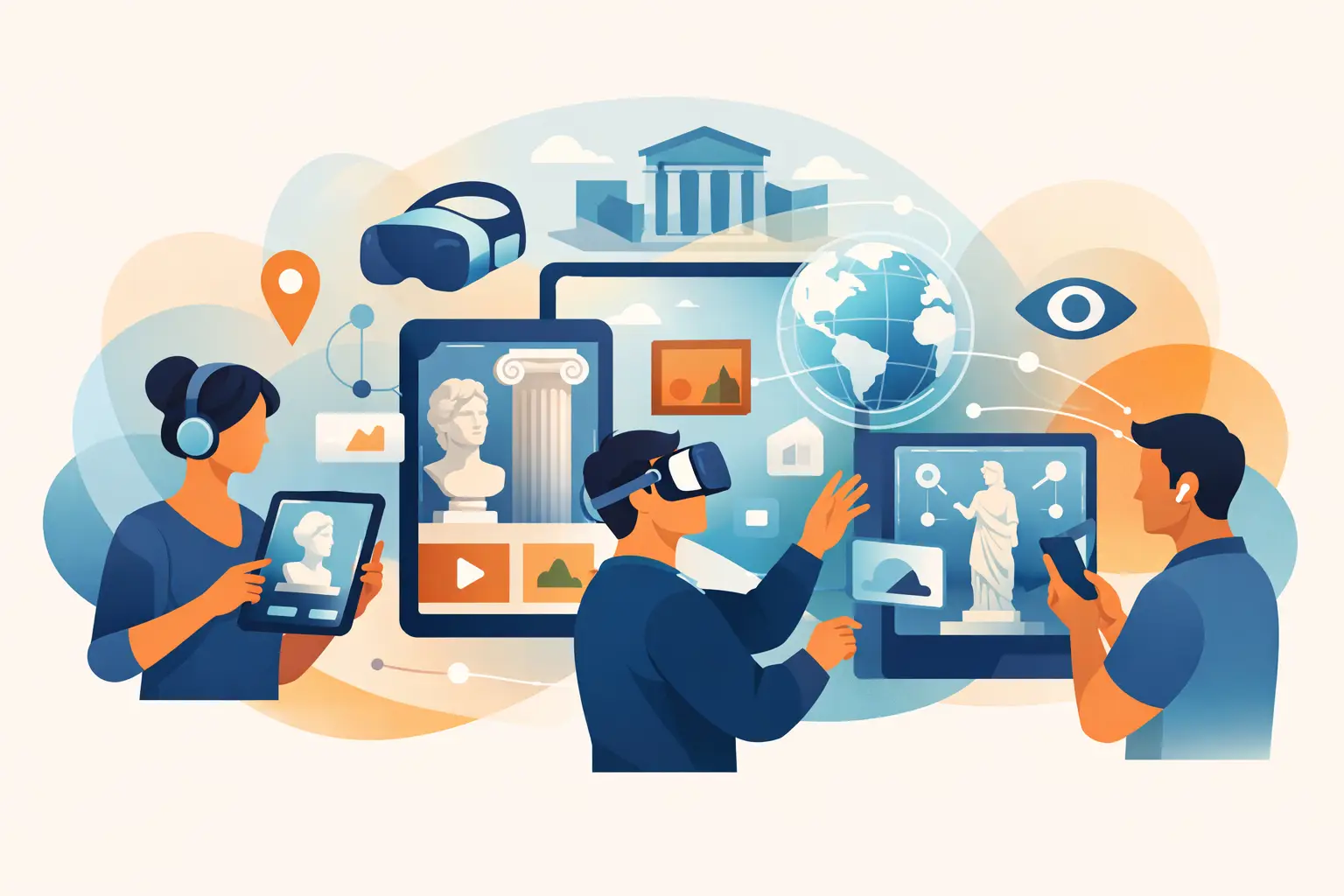
A visitor who scans a QR code in front of a work, listens to a story in their language and continues their discovery despite limited network coverage is not waiting for a technological demonstration. He expects mediation to be fair, simple and adapted to the location. The trends in digital cultural mediation in 2026 confirm this shift: digital is no longer a spectacular supplement, but a transmission tool which must serve collections, territories and audiences.
For museums, heritage sites, tourist offices and communities, the challenge is therefore less about adding functionalities than choosing those which really improve the visiting experience while remaining manageable by the teams. Accessibility, autonomy, sobriety, editorial quality and data control outline the priorities for the year.
More discreet, but better integrated mobile mediation
The smartphone remains the main point of access to digital mediation. This choice responds to an operational reality: visitors already have their device in their pocket, while structures avoid the purchase, loan, cleaning, maintenance and renewal of a dedicated set of audio guides.
In 2026, the most relevant mobile experience does not seek to retain the visitor on a screen. On the contrary, it allows him to look, listen and move around the place. Audio takes a central place, because it accompanies the gaze without requiring the reading of a long text. Archive images, short videos or comparison documents remain useful, provided they shed light on a detail, an era or a gesture.
Triggering by QR code remains useful in interior spaces and in front of specific stopping points. GPS is particularly suitable for urban routes, gardens, memory paths and territorial discovery circuits. These two approaches are not opposed to each other: they can complement each other depending on the configuration of the site and the expected precision.
The good digital journey is often one that the visitor understands without instructions. Clear signage, immediate access without compulsory downloading and readable navigation do more for adoption than an overly busy interface.
Accessibility becomes a design criterion
Accessibility can no longer be treated as an option added after going live. It influences the way of writing, recording, structuring and presenting content from the start of the project.
Audio descriptions, transcriptions, subtitles, sufficient contrasts, adjustable character sizes and sign language courses meet concrete needs. They also benefit much wider audiences: non-French-speaking visitors, families, elderly people, schoolchildren, tired people or simply visitors who prefer to listen rather than read.
The quality of accessibility, however, depends as much on the editorial as on the technique. An unread automatic transcription, an imprecise description or cluttered text do not create an inclusive experience. Content must be designed with clear sentences, understandable vocabulary and hierarchical information.
For a small structure, it is not necessary to deploy all the options from day one. It is more realistic to define priorities: make audio content available in text form, offer simple navigation, then gradually enrich the route. This trajectory allows us to move forward without renouncing the requirement.
Multilingualism, serving real welcome
Multilingualism continues to progress, particularly in tourist areas and sites frequented by international audiences. But translating word for word is not enough. Good multilingual content adapts cultural references, units of measurement, tone and sometimes the length of the story.
It is in the teams' interest to concentrate their resources on the languages that really correspond to their visitors. Consultation statistics, attendance data and field feedback help identify these priorities. Better three well-produced and regularly updated languages than an extensive catalog that is difficult to maintain.
More embodied and better contextualized content
One of the major trends in digital cultural mediation in 2026 concerns the form of stories. Visitors expect content that is reliable, but also situated and lively. They want to understand why an object, a building, a landscape or a tradition matters today.
This expectation favors plural voices: curators, guides, artisans, residents, researchers, artists, reception agents or community volunteers can provide complementary perspectives. A well-prepared testimony can make a complex period accessible or make the memory of a territory heard without oversimplifying its history.
The short format is gaining ground, without eliminating in-depth content. A two-minute capsule can be ideal in front of a work, while a longer thematic tour will respond to visitors wanting to go further. The main thing is to leave a choice of pace. Not everyone visits with the same amount of time or the same level of knowledge.
Quizzes and interactions also find their place when they extend the observation. Asking a question about an architectural detail or inviting you to compare two historical uses stimulates attention. On the other hand, gamification loses its meaning when it transforms each step into a points mechanism disconnected from the content.
Guideius addresses every digital cultural mediation challenge
Create a multilingual smartphone audio guide that is easy to deploy, accessible and tailored to your museum, heritage site or destination.
Digital sobriety moves from discourse to concrete choices
Cultural establishments are increasingly attentive to the environmental footprint of their tools. This concern is often linked to a budgetary and practical requirement. A low-cost device is generally easier to maintain, faster to charge and more reliable in the field.
Sobriety does not mean giving up multimedia. It involves using the right media at the right time. A carefully compressed audio track, a useful image and an early download of the course can provide more value than a heavy animation or automatic video.
Offline mode thus becomes a determining element, particularly for rural sites, monuments with thick walls, outdoor routes and areas with low coverage. It secures the visitor experience and limits dependence on a random connection. For teams, it also reduces the risk of associating a network outage with a course failure.
Sobriety finally concerns the material. Relying on visitors' smartphones reduces flows linked to dedicated devices, provided that a support solution is maintained for people who are not equipped or uncomfortable with digital technology. Inclusion means leaving no audience behind.
Useful data, without unnecessary surveillance
Usage statistics become a valuable tool for managing a journey: number of starts, languages consulted, most listened to content, completion rate or moments of abandonment. These indicators make it possible to identify a step that is not very visible, content that is too long or a language that needs to be reinforced.
But the search for data should not take precedence over trust. Publics and institutions expect transparent, proportionate and compliant practices with respect to the protection of personal data. In most cases, anonymized and aggregated data is more than enough to improve the offer.
This ethical approach is particularly important for communities and public structures. It involves knowing where data is hosted, who accesses it, how long it is kept and for what purposes. A mediation tool does not need to track visitors individually to be effective.
Administration becomes a sustainability issue
A digital journey is not a fixed project. Schedules, prices, temporary accessibility, cultural programming, works or practical information are changing. The ability of teams to update their content themselves therefore determines the lifespan of the system.
Digital cultural mediation trends 2026 favor platforms accessible to non-specialists: adding a step, replacing a visual, publishing a translation or consulting statistics must be possible without systematically depending on a service provider. Support remains useful for editorial strategy and more complex developments, but daily autonomy protects the budget and responsiveness.
It is in this logic that solutions like Guideius combine simplified management, multilingual audio tours, access by QR code or GPS, offline operation and accessibility tools. Technology then takes its place: that of reliable support for the teams and a discreet mediator for visitors.
Choose the trends that correspond to your project
Not all innovations are relevant for all locations. A small society museum, a citadel, an interpretation center and a tourist office have neither the same flows, nor the same contents, nor the same field constraints. Before choose a solution, it is useful to start with simple questions: which audiences do we want to better accommodate? What stories do we want to convey? Where do visitors encounter difficulties today? Who will update the content?
The answer can lead to a very simple multilingual audio tour, a thematic visit for families, accessible content or a geolocated circuit linking several municipalities. Relevance is not measured by the number of activated functions, but by the quality of the use obtained.
In 2026, the most sustainable digital mediation will be the one that leaves more room for works, places and the voices that bring them to life. When it is accessible, mastered and designed for the field, it does not replace the cultural encounter: it gives it more chances of taking place.
Would you like to apply these ideas to your site?
Guideius helps deploy multilingual audio tours with QR codes, GPS, offline mode, multimedia content and privacy-friendly analytics.