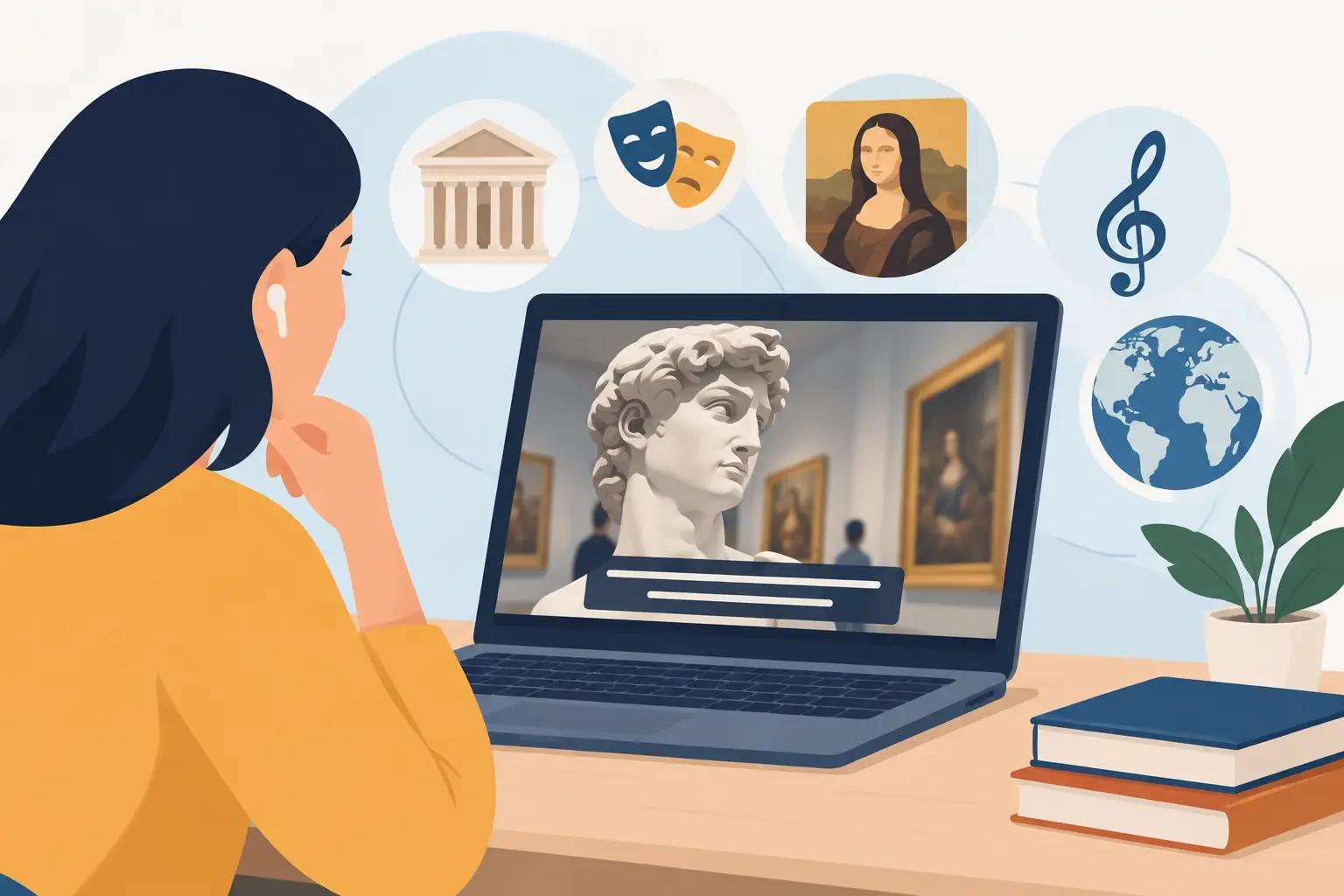
A two-minute video about restoring an altarpiece, the recollections of a former resident or a craftsperson at work can lose some of its impact when the audio becomes difficult to hear. In a busy room, on public transport, at home without headphones, or for someone who is deaf or hard of hearing, the images remain, but the meaning can be lost. That is why adding subtitles to cultural videos is more than a technical finishing touch: it helps ensure that the story gets across.
For a museum, heritage site, local authority or tourist office, subtitles open up the story without asking visitors to make an extra effort. They make audiovisual content clearer, more inclusive and often more effective, both at the venue and online.
Why subtitles make cultural videos more accessible
The first benefit is clear: subtitles give deaf and hard-of-hearing viewers access to spoken content. But their value goes well beyond that. They also help visitors who are not fully fluent in the language, children, people with concentration or reading difficulties, and anyone watching in a setting where the audio is hard to hear.
Listening conditions on a cultural tour are rarely ideal. Visitors might watch a video in a busy entrance hall, beside a road, in a windy courtyard or in a room with several audio installations. Subtitles offer another way into the content. They do not necessarily replace the voice, music or background sounds that help convey a story's emotion. They do, however, prevent the absence of audible sound from becoming a barrier to understanding.
This reflects a broader approach to accessibility: rather than creating a separate route for a few visitor groups, design content that as many people as possible can use from the outset. This is generally fairer for visitors and easier for staff to manage.
Subtitles also help viewers understand the images
A cultural video is more than spoken commentary. It may show an architectural detail, archive material, an artwork being restored, an old map or a demonstration of traditional skills. When the narration provides the right context, subtitles help viewers connect what is being said with what they see.
They can clarify a place name, date, technique or specialist term. In a film about archaeology, for example, they make unfamiliar vocabulary easier to follow. In a recorded personal account, they can help viewers understand a local accent, an older person's voice or a less clear archive recording. For heritage content, where individual words can convey historical information, this accuracy matters.
A better visitor experience without complicating the tour
Subtitles support everyday viewing habits: watching without sound, returning to a sentence, moving at one's own pace or viewing content in a language one is still learning. These are not niche uses. They reflect how visitors use smartphones and digital screens every day.
On a tour accessed via QR code, visitors choose whether to start a video, adjust the volume or read the subtitles. This independence is particularly valuable in places that aim to reduce noise and maintain a pleasant experience for everyone. It also reduces reliance on dedicated equipment, loaned headphones or a guide accompanying every visit.
The right approach still depends on the format. A content-heavy ten-minute interview benefits from being divided into shorter segments with clearly structured subtitles. A thirty-second clip may only need a concise message. The aim is not to display every word if that makes reading difficult, but to convey the meaning, tone and important information faithfully.
Guideius addresses every digital cultural mediation challenge
Create a multilingual smartphone audio guide that is easy to deploy, accessible and tailored to your museum, heritage site or destination.
Use subtitles to welcome international visitors
Cultural and tourist sites welcome visitors with different language skills. A video available only in French may leave much of its content inaccessible, even if exhibit labels, brochures or tours have been translated. Multilingual subtitles offer a flexible way to reach a wider audience without additional filming or voice-over recordings.
They also preserve the original voice of a guide, curator, resident or craftsperson. That voice conveys identity, emotion and sometimes a strong connection to the local area, qualities that dubbing can soften. Translated subtitles make the meaning accessible while retaining that personal dimension.
Translation and adaptation are not the same. A literal translation may be accurate but difficult to read on screen. Languages differ in rhythm, length and cultural references. Subtitle text should be short, natural and suited to the intended audience's knowledge. For local expressions or complex heritage concepts, a brief explanation is often better than an approximate equivalent.
Content that reaches more people and is easier to reuse
Subtitles also help content circulate. A video that can be understood without sound is more likely to be watched to the end on a mobile screen, in a news feed or on an introductory web page. For cultural organisations, this can give event recordings, collection features, personal accounts or footage from temporary exhibitions a second life.
Providing subtitles as a synchronised text file rather than burning them into the image also makes content easier to reuse. Staff can correct a date, update a translation, add a language or adapt the same video for several tours without exporting a new film every time.
This creates a useful resource for other content. Video scripts can feed into transcripts, information sheets, quizzes or short versions for social media. In a small organisation with limited production time, planning video content and subtitles together helps make better use of the research, writing and filming work.
How to create genuinely useful subtitles
Subtitle quality depends on practical details. Text that moves too quickly, is too long or covers an important part of the image makes viewing tiring. Clear formatting, by contrast, improves the experience straight away.
A few simple principles help: synchronise text accurately with speech, favour short sentences, maintain enough contrast with the image and avoid covering essential visual details. A maximum of two lines on screen is often a useful guide, provided the display time suits a realistic reading pace. Proper names, dates and technical terms should be checked as carefully as printed interpretation materials.
For fuller accessibility, captions for deaf and hard-of-hearing viewers can also identify important sounds: music, applause, a tool in use, a door closing or a change of speaker. These details are not needed in every video, but become essential when sound carries narrative or emotional information.
A transcript meets a complementary need. It presents the full spoken content as text, sometimes with added descriptions. It is particularly useful for talks, longer personal accounts or educational resources. Subtitles and transcripts therefore complement each other: one supports viewing, while the other allows a closer reading of the content.
Plan subtitles when designing the tour
Subtitling costs less and works better when it is planned from the writing stage. While developing the storyboard, identify scenes where the image already conveys a lot of information, voices that may be difficult to understand and content that will need translating. This helps avoid overcrowded subtitles and last-minute changes.
Staff can also agree on a simple style guide covering font, size, colour, position, how people's names are presented and translation rules. Consistency strengthens the tour's identity and makes updates easier across exhibitions, seasons and new heritage projects.
In a digital interpretation solution such as Guideius, subtitled videos sit naturally alongside audio, images, text and quizzes on visitors' smartphones. The point is not to add another feature, but to offer a tour that remains understandable, welcoming and true to the area's stories in a wide range of viewing conditions.
Good subtitles do more than put words on a screen. They let visitors follow the story even when the setting makes listening difficult. For cultural venues, this is a practical way to share knowledge more widely while maintaining high editorial standards.
Would you like to apply these ideas to your site?
Guideius helps deploy multilingual audio tours with QR codes, GPS, offline mode, multimedia content and privacy-friendly analytics.