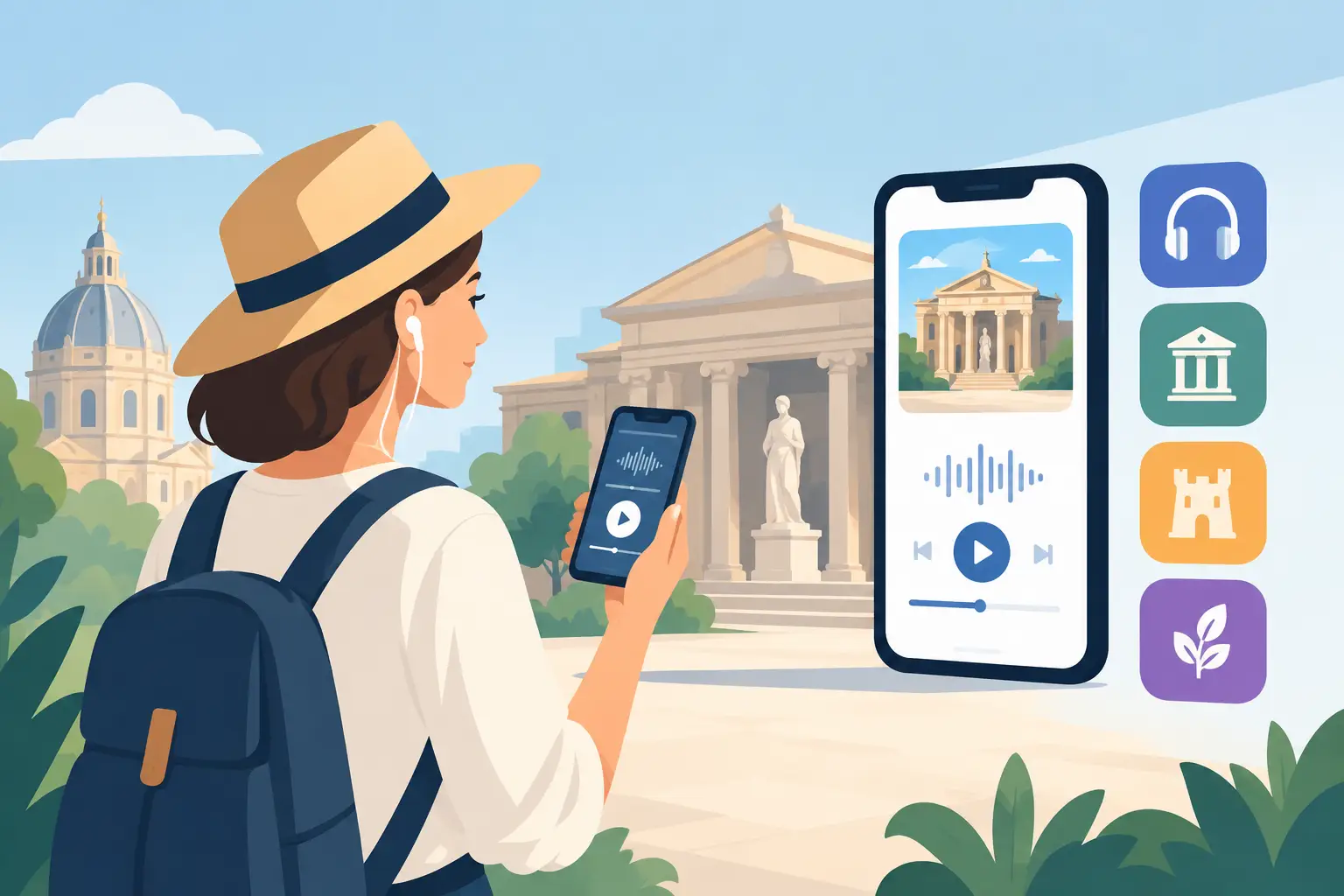
At the entrance to a museum, monument or visitor route, the same question often arises: how can you enrich the experience without creating queues, disinfecting headsets or maintaining a fleet of dedicated devices? An audio-guide web app is designed for precisely this need. Visitors access the content on their own smartphones while the cultural team remains in control of the route, languages and information provided.
This choice is about more than replacing a traditional audio guide with a screen. It makes it possible to rethink interpretation around real-world use: independent visitors, often small teams, sometimes extensive sites and growing expectations around accessibility. For a cultural organisation, the challenge is to find a tool that is simple to deploy but complete enough to support a long-term interpretation project.
What is an audio-guide web app used for?
An audio-guide web app is a digital tour that runs in a smartphone browser. It generally does not require an app-store download. A QR code displayed at reception, on a wall label or in a leaflet is enough to open the route. Depending on the site, stages can also be triggered by GPS.
Visitors can listen to commentary, view images, read a transcript, answer a quiz or find the next stage. The experience can be offered in several languages and remain available after the visit. This continuity is valuable: content discovered on site can extend interest in a collection, monument or destination.
For teams, the benefits are practical. There are no devices to hand out, recharge, count, clean or replace. Content is managed through an online interface, making it easier to update opening times, prices, texts, media and stages. A temporary exhibition, a new work or a restoration project no longer requires every visitor leaflet to be reprinted immediately.
Using visitors’ smartphones without putting the whole burden on them
The “bring your own device” principle is attractive, but it needs a pragmatic approach. Not every visitor has a charged phone, headphones or reliable network coverage. A serious interpretation solution must take these situations into account, especially at rural sites, in historic buildings and underground spaces.
Offline access is essential. When content is downloaded before the visit or at the start of the route, the experience remains smooth even if the connection becomes unstable. Teams can also provide a few alternatives for visitors who need them, without managing an entire fleet of audio guides. The aim is not to force everyone to use digital tools, but to use them where they genuinely improve welcome and understanding.
Ease of access matters just as much. A clearly visible QR code, a straightforward home page and a start-up process that takes only a few steps prevent the first stage of the visit from becoming a technical-support session. Interface quality is part of interpretation quality: if access is difficult, even excellent content may go unused.
Routes that offer more than simple audio tracks
Audio remains at the heart of the experience because it leaves visitors’ eyes free for the works, landscapes and architecture. A web visit can enrich that format in meaningful ways. An archive photograph can show how a place has changed. An illustration can clarify an architectural detail. A short video can make an artisanal gesture or a complex restoration easier to understand.
These media should serve the story rather than overload it. In a museum, an additional image can illuminate a technique. On a heritage trail, it can help visitors identify a feature of the landscape. In a city, it can show an urban transformation. The right level of enrichment depends on the site, the time available and the audience’s expectations.
Quizzes and interactions also have a role when they sustain attention or help visitors engage with the content, particularly families and school groups. They do not replace thoughtful interpretation. When well designed, they create a pause, invite observation and make visitors feel involved rather than passively following a commentary.
Accessibility should guide the choice of tool
For cultural venues and local authorities, accessibility is not an add-on at the end of a project. It should shape the route from the start. An audio-guide web app can offer transcripts, sign-language content, suitable contrast, clear navigation and media designed for different needs.
Accessibility also concerns languages and levels of understanding. A multilingual route can welcome a wider range of international visitors, but adaptations must be carefully produced. Word-for-word translation is not always enough. Text written for listening should remain natural, clear and faithful to the scientific or heritage subject.
It is useful to offer formats suited to different audiences: an in-depth version for enthusiasts, a short visit for people in a hurry, a route for young audiences or easy-to-read content where appropriate. This does not mean producing everything at once. It means allowing the interpretation to evolve according to visitor feedback and the site’s priorities.
Guideius addresses every digital cultural mediation challenge
Create a multilingual smartphone audio guide that is easy to deploy, accessible and tailored to your museum, heritage site or destination.
QR code, GPS or manual selection: which trigger should you use?
QR codes are particularly well suited to indoor spaces and routes with clearly defined stops. They are easy to understand, inexpensive to install and independent of signal accuracy. On a wall label, sign or map, a QR code creates a direct link between what visitors are looking at and what they are hearing.
GPS is better suited to urban circuits, gardens, trails and larger areas. It can trigger content as visitors approach a point of interest and support a more flexible visit. Its effectiveness depends on the surroundings, however: narrow streets, dense vegetation, uneven terrain and thick walls can reduce accuracy. Visitors should therefore also be able to select a stage manually.
For many projects, combining both methods is the most effective approach. GPS supports movement outdoors, while QR codes provide reliable access to key content indoors or at essential stops. The choice should be guided by visiting conditions, not by the most spectacular technology.
Administration designed for cultural teams
A mediation tool is useful only if the team can keep it alive. Heritage professionals do not always have a dedicated digital department or time to contact a provider to change a sentence or replace an image. An accessible administration interface helps them remain autonomous.
The team should be able to create stages, add audio and image files, organise languages, reorder a route and publish a change without specialist technical skills. Support is still important, especially at launch. Developing a visitor narrative, adapting text for listening, recording voices and producing accessible content all require a method and editorial expertise.
Guideius follows this approach by combining simplified administration, features designed for real sites and support suited to cultural organisations. Digital technology becomes a controlled interpretation tool rather than another technical layer to manage.
Useful statistics go beyond the number of scans
Usage data can help steer a route, provided it is interpreted carefully and visitors are respected. Knowing which stages are consulted most, in which languages, at what time and where people stop can reveal what works and what needs revision.
A low listening rate for one stage does not automatically mean that the subject is uninteresting. The QR code may be poorly placed, the content too long, the signage unclear or the location better suited to contemplation than listening. Statistics should support on-site observation and conversations with mediators, not replace them.
Data governance is particularly important for public and publicly funded organisations. An ethical solution should collect only what is useful for improving the service, explain its practices clearly and avoid turning visitors into commercial profiles.
Choose a solution that fits your cultural project
Before comparing features, define the role the audio guide should play. Is it meant to make a museum visit more independent, extend the welcome provided by a tourist office, promote a village, support a walking route or accompany a temporary exhibition? The project’s scope determines its languages, media, trigger method and offline requirements.
The total cost also deserves careful attention. An attractive price may hide configuration time, paid options, maintenance fees or dependence on a provider for every change. Conversely, a complete solution with maintenance included and pricing that grows with the project can provide greater budget visibility, especially for small and medium-sized organisations.
The best tool is the one that respects the team’s pace, the site’s constraints and the uniqueness of its content. A well-designed web app does not try to make visitors forget the place it describes. It helps them look more closely, listen differently and perhaps want to return.
Would you like to apply these ideas to your site?
Guideius helps deploy multilingual audio tours with QR codes, GPS, offline mode, multimedia content and privacy-friendly analytics.