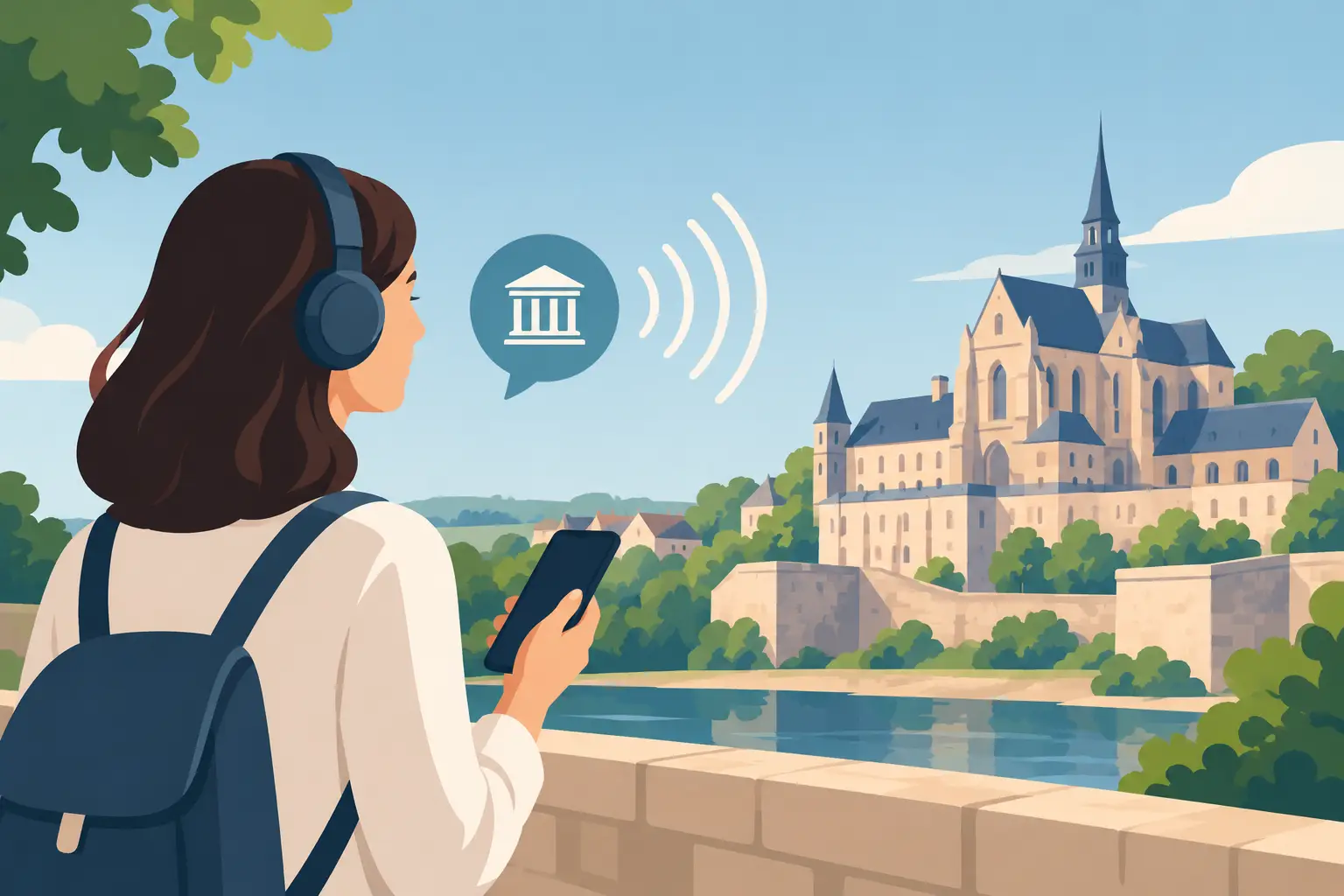
A visitor stops in front of an ancient fortified gate, an archaeological showcase or a landscape of memory. He is not just looking for a date or a name: he is trying to understand what he sees, why this place matters and what connection it has with the territory. Heritage sound narration meets this expectation when it gives a fair voice to the works, buildings and human stories, without transforming the visit into a conference.
For cultural teams, the challenge goes beyond the production of audio files. This involves designing a mediation that respects the audiences, the constraints of the site and the means available. A good audio tour can enrich a self-guided visit, make content accessible to more people and extend the experience well after the outing.
What is successful heritage audio storytelling?
Heritage sound storytelling is the art of transmitting the history, uses and meanings of a heritage through voice and sound. It can take place in a museum, on an urban route, in a monument, on a natural site or in the heart of a village. Its function is not to say everything. It consists of guiding attention and creating the conditions for an encounter.
This requires a delicate balance between scientific precision and listening pleasure. Content that is too dense is tiring, especially when added to walking, contemplation or the demands of a group. Conversely, a narrative that is too general gives the impression that the same text could apply to any place. Quality is born from concrete details, an assumed point of view and words adapted to the context of the visit.
Sound also offers a special place to the imagination. The creaking of a mill wheel, the atmosphere of a workshop, the testimony of a resident or a few seconds of silence can help us understand an era in a different way than a room description. These choices must, however, serve the purpose. The sound effect is not a decoration: it becomes relevant when it helps the visitor to look, locate or feel.
Start from the visitor experience, not from the documentary stock
Heritage institutions often have abundant documentation: inventories, archives, research, catalogs and testimonies. This richness is precious, but it does not in itself constitute an audio journey. The first job is to identify what the visitor should be able to remember or feel at each stage.
Before writing, it is helpful to observe the actual journey. Where does the public enter? What landmarks does he see easily? Where does it stop spontaneously? What is the realistic length of a visit? In an old center, traffic noise and detours influence listening. In a museum, crowds, proximity to works and fatigue modify attention. A relevant narrative takes these realities on the ground into account.
Each sequence benefits from responding to a simple intention: revealing a detail, explaining a transformation, recounting a use, making a word heard or connecting the object to a broader story. If a track pursues too many goals at once, it becomes difficult to follow. It is better to build a progressive narrative thread than to juxtapose audio notes.
Define a clear common thread
A journey can be organized around daily life, know-how, a historical period, a local figure or the relationship between landscape and human activities. The common thread provides coherence, but it must not force heritage to enter into an artificial narrative.
The right angle depends on the location and the target audience. A fortress welcoming families will be able to prioritize the life of its occupants and defensive uses. A memorial will require a more sober approach, based on sources and testimonies. A heritage trail could bring together geology, agriculture and resident memory. There is no universal formula: the accuracy of the story depends on the identity of the site.
Writing for the ear and for movement
A text intended to be read is not automatically pleasant to listen to. When spoken, long sentences, accumulated dates and unexplained technical terms quickly lose the listener. Sound writing favors direct sentences, precise words and regular breathing.
From the first seconds, the track must provide an anchor point. It can invite us to observe a shape, to turn towards an architectural element or to imagine a past scene. This indication is particularly useful on outdoor sites, where the visitor needs to verify that he is in the right place before letting himself be guided by the story.
Duration is a real choice of mediation. A two- to three-minute segment is often suitable for a standalone stop, while longer content may be relevant to a major work or strong testimony. It is better to offer several short sequences than a single ten-minute commentary. The visitor thus retains the freedom to continue, deepen or move on to the next step.
The vocabulary must remain demanding without becoming closed. A specialized term has its place if it allows us to better understand heritage, provided it is explained in the movement of the story. Simplification does not consist of impoverishing the content: it consists of removing what does not help to understand.
Guideius addresses every digital cultural mediation challenge
Create a multilingual smartphone audio guide that is easy to deploy, accessible and tailored to your museum, heritage site or destination.
Make accessibility a design rule
An audio mediation is not accessible by nature. It may exclude deaf or hard of hearing people, visitors who do not master the language offered, audiences with comprehension difficulties or people who cannot easily operate a smartphone. Accessibility must therefore be thought of from the scenario, and not added at the end.
A complete transcript allows you to view the content differently and also facilitates translation or adaptation into plain language. Helpful verbal descriptions make visual elements more shareable with people with visual impairments. Simple landmarks, readable controls, sufficient contrast and paths without cognitive overload improve the experience for all visitors.
Multilingualism deserves the same attention. Translating a French text word for word rarely produces good listening. Each version must maintain the intention, language level and references necessary for understanding. Depending on the resources available, it is better to offer fewer languages, but truly adapted versions, than to multiply approximate solutions.
Choosing reliable broadcasting in the field
The best content loses its appeal if it's difficult to launch. Dedicated hardware has long structured audio guidance, but it involves purchase, maintenance, recharging, cleaning, storage and loan management. For many structures, the visitor's smartphone constitutes a more flexible alternative, provided that access is immediate and the support is clear.
A visible QR code can trigger listening in the right place, while geolocation makes it easier to travel outdoors. These two modes are complementary. The QR code gives the visitor explicit control and works well in front of a work or panel. GPS provides fluidity over an extended route, but it must provide sufficient margin: in dense areas, under plant cover or near old buildings, its accuracy varies.
Offline mode remains essential whenever network coverage is uncertain. In rural areas, monuments with thick walls or underground spaces, asking the visitor to depend on their mobile plan creates an unnecessary disruption. A simple download at the start of the course secures the experience and limits frustration on site.
A solution such as Guideius makes it possible to associate these triggering methods with multimedia content, multiple languages and accessibility parameters, without imposing heavy technical management on teams. The tool, however, remains at the service of the editorial project: it does not replace either documentation work or narrative choices.
Test before publishing, then learn from use
A sound narration really reveals itself when listened to under visiting conditions. Having people outside the project test the route allows ambiguities to be identified: a starting point that cannot be found, an instruction that is too fast, an incomprehensible reference or a track that is triggered too early.
It is useful to bring together varied profiles: regulars of the place, passing visitors, families, people who are not comfortable with digital technology and audiences concerned by accessibility devices. Their feedback does not always lead to the same decisions, but it makes the necessary trade-offs visible. For example, a very refined interface may be suitable for an independent audience while requiring more explicit signage for other visitors.
Usage statistics complete this observation. They can indicate which steps are launched, which are abandoned or in which languages the route is consulted. They don't tell the whole story about the quality of an experience, but they help to ask the right questions. Is a little-played track poorly located, too long, poorly announced or simply less interesting for the audience?
This continuous improvement approach is particularly suited to heritage sites. A journey can evolve with an exhibition, a scientific discovery, new testimonies or feedback from mediators. Digital then becomes a living medium, without requiring you to reprint all of the signage or renew a fleet of equipment.
Giving heritage a lasting voice
The strength of a sound narration is not measured by the number of effects, nor by the quantity of information delivered. It can be recognized by the quality of the attention it provokes: a visitor looks up, notices a trace, understands a local story or feels authorized to ask a question.
Conceiving this message requires time, reliable sources and attentive listening to the public. It is also an opportunity to circulate knowledge between researchers, mediators, residents and visitors. When it remains simple to access, respectful of uses and open to developments, sound narration extends the primary mission of heritage: making a common heritage closer, more understandable and more alive.
Would you like to apply these ideas to your site?
Guideius helps deploy multilingual audio tours with QR codes, GPS, offline mode, multimedia content and privacy-friendly analytics.