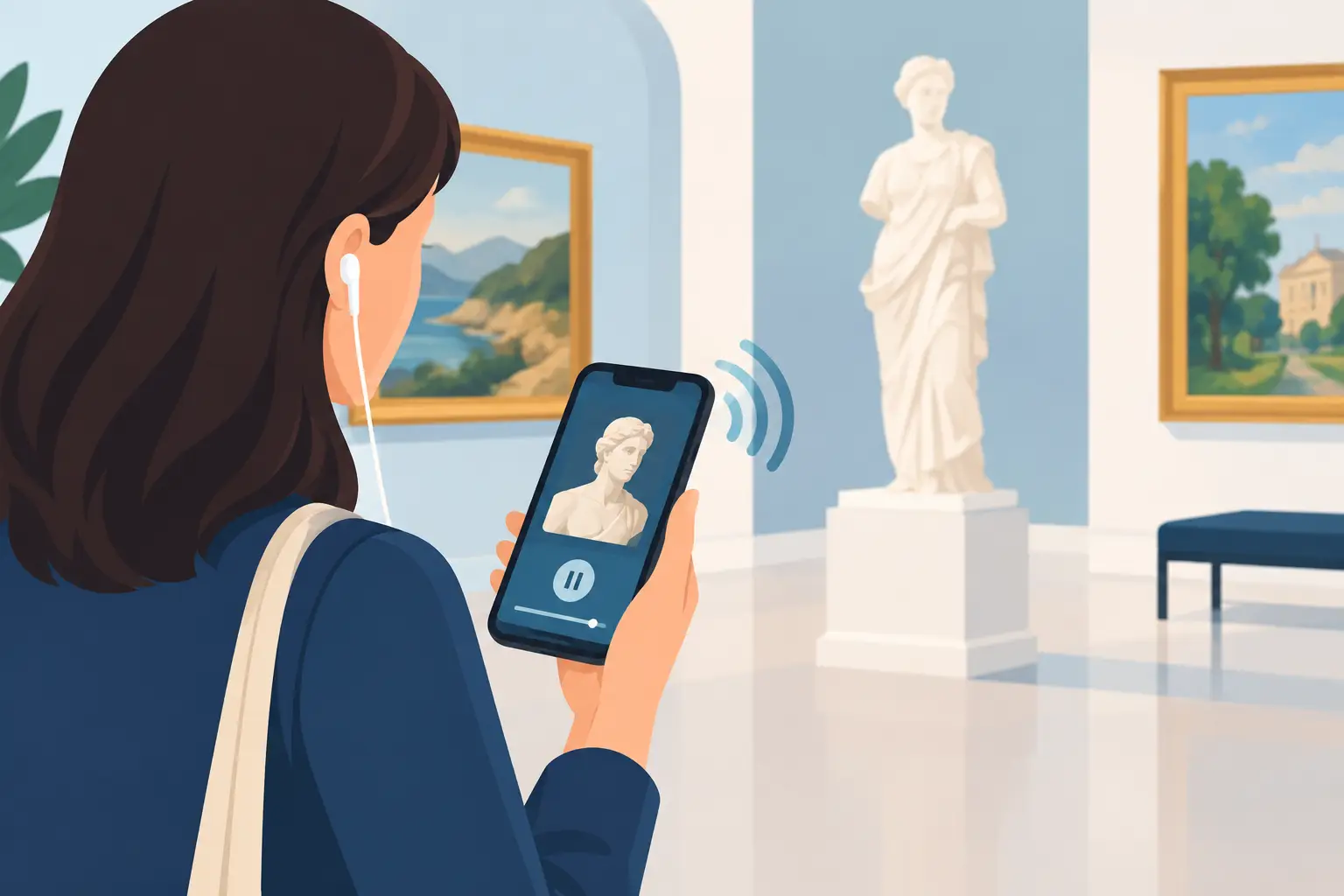
At reception, it’s not always the tickets that slow down entry into a museum or heritage site. These are often the audio guides to distribute, explain, disinfect, reload and then collect. An audio guide on the visitor's phone concretely changes this equation: the visitor uses a device they already know, while the team refocuses on reception, advice and mediation.
This choice does not just consist of replacing a case with a smartphone. It invites us to design a more autonomous visit experience, more accessible and better adapted to realities on the ground. For small and medium-sized cultural structures, it can also represent a pragmatic way of offering ambitious digital mediation without increasing operating costs.
Why choose the audio guide on the visitor's phone?
The first benefit is operational. Without a dedicated hardware fleet, there are no more devices to purchase, inventory, insure, recharge or maintain. The teams reduce daily handling and the risks linked to breakdowns, losses or incomplete returns. This simplification is particularly valuable when reception is staffed by a small staff, during periods of high attendance or at several locations in the same area.
The second benefit is the continuity of the experience. The visitor can start the tour upon arrival using a QR code, resume listening after an interruption and, depending on the solution chosen, keep certain content within reach after the visit. The audio guide no longer stays at the counter: it really supports everyone’s pace of discovery.
Finally, the smartphone opens up possibilities that a traditional audio guide rarely offers at a reasonable cost: choice of language, archive images, maps, videos, quizzes, content suitable for families or supplements intended for informed audiences. Audio remains central, but it can be part of a richer mediation without distracting from the works, landscapes or buildings.
A solution that does not rely on an application to install
For a visitor, each additional step is a point of giving up. Downloading an application, creating an account or searching for content in a store can slow down usage, especially for a short or impromptu visit. A accessible web app per QR code limits this friction: access is immediate, without installation and without unnecessary collection of personal information.
This does not mean that a native application is never of interest. It may be relevant for a network of sites, a tourist destination or an institution that wishes to retain regular audiences. But for many cultural places, the priority is first to make the route available simply, at the right time and on the phone already in hand.
An autonomy that must remain inclusive
Putting the visit on the visitor's phone should not transfer all responsibility to the visitor. A successful digital journey anticipates concrete situations: low battery, absence of headphones, limited network coverage, ignorance of the QR code or absence of a smartphone.
Offline mode is then a decisive element. In a castle with thick walls, a rural route, an archaeological site or an old mine, the connection can be uneven. Allowing content to be downloaded upstream or viewed without a network avoids involuntary silences and preserves the quality of the experience.
Accessibility must be thought of with the same requirements. Transcriptions, subtitles, readable navigation, adapted contrasts, content in sign language or audio description can make digital a real inclusion tool. Their relevance depends on the location, the audiences welcomed and the resources available, but these functions benefit from being considered from the design stage rather than added at the margins.
It also remains necessary to provide an alternative for people who do not want or cannot use their telephone. A printed support, a one-off loan of equipment, human mediation or interpretive signage can complete the system. The objective is not to impose a single channel, but to broaden the possibilities of access to knowledge.
Guideius addresses every digital cultural mediation challenge
Create a multilingual smartphone audio guide that is easy to deploy, accessible and tailored to your museum, heritage site or destination.
Design a route adapted to mobile listening
Good audio content does not automatically become a good audio guide because it is posted online. On a smartphone, the visitor is contacted by his environment, by movements and sometimes by the presence of other people. The sequences must therefore be structured, embodied and short enough to maintain attention.
It is often preferable to offer several capsules rather than a very long comment. An introduction can provide the essential points of reference, then let the visitor delve deeper into an architectural detail, an object or a local story as they wish. This freedom is particularly suitable for family visits, tourists in a hurry and regular visitors who are not all looking for the same level of information.
QR code, GPS or both?
The QR code is effective inside a museum or in front of a clearly identified point of interest. It makes the trigger visible and voluntary: the visitor chooses to find out more. However, it requires well-integrated signage and thoughtful positioning so as not to clutter the spaces or harm the heritage interpretation of the place.
GPS is more suitable for urban walks, interpretive trails and routes spread over an area. It can trigger content as you walk and guide visitors without multiplying panels. However, its accuracy varies depending on the environment. In narrow streets, in forests or near imposing buildings, GPS triggering must be tested on site and supplemented, if necessary, by visual cues.
In many cases, the most reliable approach combines the two. The GPS provides general orientation, while the QR code secures access to a specific step. The technology must adapt to the actual route, and not impose an artificial way of moving on visitors.
Multilingual as a reception service
Translating an audio guide is not limited to transposing words. It involves adapting the references, the pace and sometimes the length of the content. A foreign visitor must be able to understand the essential without having the impression of consulting a secondary or oversimplified version.
Offering several languages makes it possible to welcome tourists more widely, but also non-speaking residents, international school groups or visitors passing through a tourist office. On the phone, the language change is immediate and no longer depends on the stock of devices available in each version.
This flexibility also facilitates editorial development. A new language can be added gradually, based on observed attendance and the priorities of the territory. A platform like Guideius makes it possible to administer this content without requiring in-depth technical expertise, which leaves cultural teams in control of their discourse.
Measure usage without monitoring visitors
Digital technology provides access to useful data: number of launches, languages selected, most listened to stages, average consultation duration or completion rate of a journey. These indicators help identify an inconspicuous point, content that is too long or a particularly popular theme.
But the measure must remain proportionate. For cultural institutions and communities, public trust is a central issue. It is possible to improve a journey using aggregated usage statistics, without requiring the creation of an account or transforming the visit into the collection of personal data. An ethical approach is based on transparency, sobriety and the real usefulness of the information collected.
Evaluate the cost beyond the price of the material
Comparing an audio guide on a smartphone to a fleet of devices is not just a matter of comparing a subscription to a purchase. The cost of dedicated equipment also includes its daily preparation, storage, maintenance, renewal, accessories and the time spent by the teams. These positions are sometimes scattered across several budgets, which makes them less visible.
Conversely, a digital solution requires planning for content creation, translations, sound quality and access signage. These are essential editorial investments: technology is only valuable if it serves a precise, fair and pleasant story to listen to. The right choice therefore depends on the volume of attendance, the configuration of the location, the desired autonomy and the internal resources available.
To successfully deploy, four points deserve particular attention: test the route on site with different phones, write very short access instructions, train the reception team to answer simple questions, then observe the first uses to adjust the content and signage. This fieldwork often does more for visitor satisfaction than an additional feature.
An audio guide on the telephone does not erase the role of mediators, reception agents or tour guides. Rather, it gives them complementary support to circulate stories, make a place more autonomous to explore and welcome more audiences. When it is carefully designed, it does not replace the cultural relationship: it leaves more room for it.
Would you like to apply these ideas to your site?
Guideius helps deploy multilingual audio tours with QR codes, GPS, offline mode, multimedia content and privacy-friendly analytics.