A visitor has just arrived in front of the museum gate, on the square in front of a castle or at the start of a heritage trail. He wants to understand what he sees without downloading a complex tool, creating an account or waiting at the counter. This is precisely where the choice between audio guide web app or application takes on its full meaning. This is not just a technical decision: it conditions access to content, the workload of the teams and the perceived quality of the visit.
For a cultural structure, the right answer rarely depends on an absolute principle. A web app can facilitate entry into the course. A downloadable application can better meet certain intensive uses or specific offline operation needs. The challenge is to choose a solution that remains simple for the public, manageable by your teams and consistent with the realities of your site.
Audio guide web app or application: understand the difference
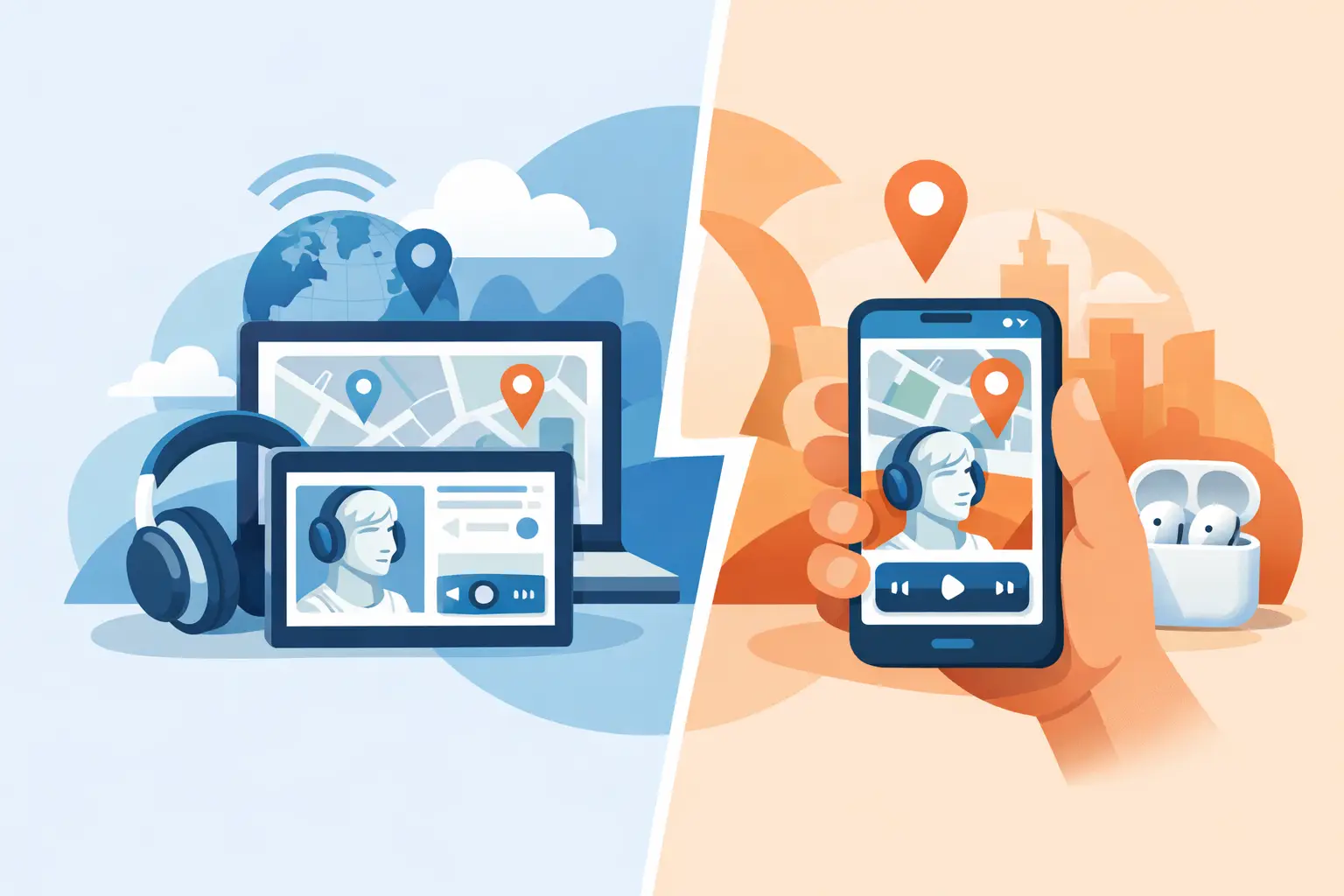
A web app is a service consulted from the smartphone browser. The visitor generally accesses it by scanning a QR code, by opening a web address or via a dedicated home page. No compulsory passage through an application store is necessary. The experience can be designed to resemble that of an application: home screen, map, audio players, images, videos, texts and quizzes are accessible in a mobile-friendly interface.
A native application is installed on the phone from an application store. It may offer deeper integration with certain device functions, including notifications or management of downloaded resources. In return, it introduces an additional step: the visitor must find it, install it, accept the requested authorizations and keep enough storage space.
This distinction has an immediate consequence on the ground. In a spontaneous visit, every friction counts. A QR code placed at reception or in front of a work allows the web app to open the route in a few seconds. For a tourist office, a freely accessible site or a temporary exhibition, this speed encourages discovery and limits requests to the reception team.
Immediate access, first criterion for adoption
Downloading an application is not always an obstacle. It can be accepted by a public who prepares a visit in advance, returns regularly to an area or is looking for an enhanced service before their arrival. But for a large proportion of visitors, notably day-trippers, families and international audiences, requesting a facility at the time of the visit can reduce the actual use of the route.
The web app responds well to this need for immediacy. The QR code can be integrated into the existing signage, labels, the reception counter or printed materials. It also makes it possible to offer several languages from the first page, without creating a parallel path. The visitor uses their own smartphone and headphones, which avoids the need to lend, clean, recharge and maintain a fleet of audio guide boxes.
This simplicity must, however, be accompanied. A QR code alone is not enough: you need clear instructions, a Wi-Fi connection if mobile coverage is limited, and an interface that is readable from the first seconds. An explicit sentence such as “Scan, choose your language, listen” is often more effective than an overloaded graphic device.
Offline: a question of context, not promises
Connectivity is one of the main points of vigilance in heritage sites. Thick walls, underground spaces, extensive gardens, rural areas and some listed buildings can make the mobile network uncertain. Under these conditions, only offering content online exposes visitors to frustrating interruptions.
A native app has long been considered the natural answer to offline, because it can bring media onto the device. However, a modern web app can also provide for the prior downloading of content, or their caching, depending on the architecture chosen. The main thing is therefore not the name of the technology, but the scenario offered to the visitor.
For a museum where Wi-Fi is available at the entrance, downloading the route before the start of the visit may be sufficient. For a heritage hike in a rural environment, it is preferable to plan for a consultation possible without a network on the entire or most of the route. For a dense city center, online access may remain relevant, provided that you test the actually busy areas and not just the areas around the office.
The right choice is based on a field diagnosis. Map coverage, measure content duration, estimate media weight and observe visitors’ physical journey. An offline promise is only valuable if it works when the audience needs it.
Guideius addresses every digital cultural mediation challenge
Create a multilingual smartphone audio guide that is easy to deploy, accessible and tailored to your museum, heritage site or destination.
Administration, updates and cost control
For small and medium-sized structures, the question is not only “what can the tool do?” ”, but also “who will be able to keep it alive? ". A cultural journey evolves: new rooms, temporary closures, historical corrections, added translation, local news or exhibition renewal. A mediation solution must allow these adjustments without systematically depending on a technical service provider.
The web app has a major operational advantage: updated content is immediately available to all visitors. With an application to install, you also have to manage the published versions, store validation times and devices that do not update. This does not make the application unsuitable, but increases the level of monitoring necessary.
The overall cost deserves the same attention. It is not limited to the starting price. It is necessary to integrate the production of content, translations, hosting, maintenance, assistance, the evolution of the course and, if necessary, the renewal of the equipment. The “bring your own smartphone” model greatly reduces logistical constraints. It also frees up time for what really matters: reception, mediation and editorial quality.
Solutions like Guideius are designed with this logic in mind: giving teams accessible administration, while retaining the functions expected in the field, such as triggering by QR code or GPS, multimedia content, consultation statistics and multilingual routes.
Accessibility should not be a late option
Choosing between web app and application must also lead to questioning the accessibility of the experience. Digital mediation can broaden access to knowledge, provided it is designed for a real diversity of audiences. Readable texts, sufficient contrast, subtitles, transcriptions, sign language content or easy-to-understand adaptations can transform a visit for many people.
The personal smartphone offers useful possibilities here. The visitor can adjust the volume, use their headphones, enlarge the display or use the assistance functions of their device. But this autonomy does not exempt us from designing suitable content. Too long audio, ambiguous navigation or a button that is difficult to select remain obstacles, regardless of the format chosen.
Inclusion also involves non-digital alternatives. A responsible solution provides that visitors who are not equipped, are uncomfortable with the smartphone or do not wish to use it can still access quality mediation. Panels, synthetic booklet, human support and one-off loans constitute essential complements, not second-rate solutions.
GPS, QR code: choose the right trigger
Trigger technologies must serve the visit story. The QR code is particularly suitable for museum rooms, specific objects, stations on an urban route and places where we want to allow the visitor to choose their own pace. It is reliable, understandable and easy to combine with discreet signage.
GPS is valuable for outdoor routes, trails and territory visits. It can offer content when the visitor arrives near a point of interest. Its use, however, requires a margin of tolerance: the precision varies depending on the streets, the weather, the terrain and the phone settings. A good GPS route must always allow you to find a step manually, so that a technical unforeseen event does not interrupt the visit.
In many cases, the combination of the two is most relevant. The GPS guides you through space and the QR code confirms arrival at a specific element. This complementarity limits frustration while maintaining a fluid experience.
A decision to be made based on the actual journey
The best solution is not the one that accumulates functions, but the one that responds accurately to your context. A web app will often be preferred when the objective is to make an audio guide available immediately, without downloading and without dedicated hardware. An application can be justified for recurring use, advanced integration needs or a destination strategy already structured around a mobile tool.
Before deciding, have a prototype tested on site by people who are unfamiliar with the site and your team. Observe their actions: do they find the starting point, do they understand how to change language, do they manage to restart an audio, do they find a step? These few minutes of testing often provide more information than a long comparison of features.
A successful audio guide does not stand out for its technology. It leaves room for works, landscapes, stories and the visitor's curiosity. It is this very concrete criterion that should guide your choice.
Would you like to apply these ideas to your site?
Guideius helps deploy multilingual audio tours with QR codes, GPS, offline mode, multimedia content and privacy-friendly analytics.