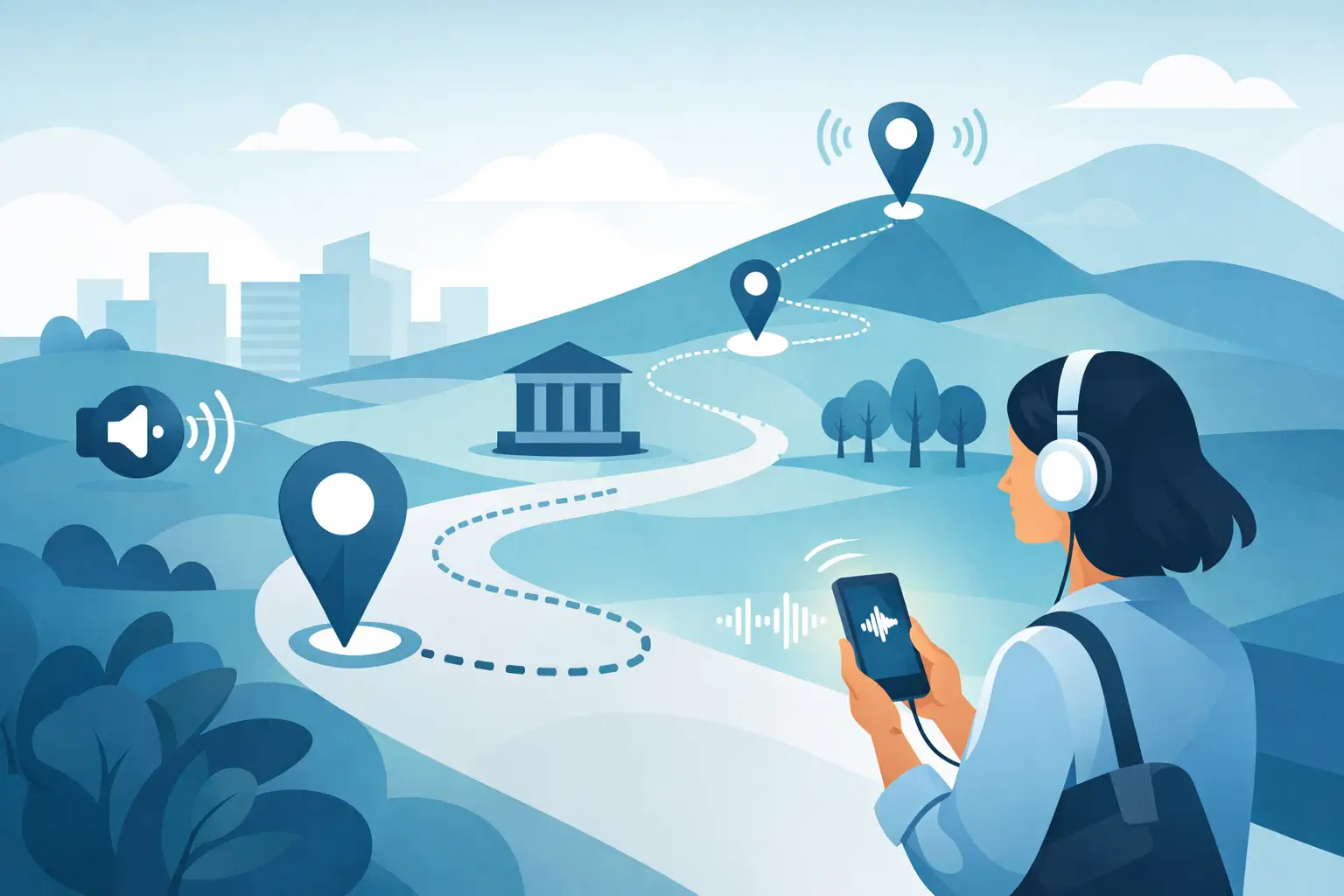
A visitor does not remember a route because he has listened to a lot of content. He remembers it because he understands what he is looking at, when to look up and why this place deserves his attention. Knowing how to create an audio tour therefore amounts less to stacking tracks than to organizing a meeting between a territory, works or heritage, and audiences with very different expectations.
For a museum, a heritage site or a tourist office, the audio tour must also remain realistic to produce and administer. The good project is one that serves mediation without adding a disproportionate technical load to the teams. It must be able to evolve, accommodate several languages, work on visitors' smartphones and be reliable in the field, including when the connection is limited.
Start with visit intention
Before drawing an itinerary or writing any text, you must answer a simple question: what would you like the visitor to take with them when they leave? It may be a new understanding of the history of a neighborhood, a more attentive look at the details of a monument, or the feeling of having met the inhabitants and the know-how of a territory.
This intention gives an editorial line to the course. Without it, the content risks becoming a succession of notices, certainly accurate, but not very memorable. Conversely, a well-defined common thread helps choose the steps, prioritize information and maintain a consistent voice from one listening point to the next.
The expected audience is just as important. A family tour adopts neither the same pace nor the same level of vocabulary as a visit intended for architecture enthusiasts. It is possible to offer several courses in the same place, but it is better to start with a clear and well-calibrated experience than to disperse the efforts in too many variations.
How to create an audio journey step by step
Choose a route that makes sense
A good itinerary does not necessarily follow the order of an inventory or a plan. It follows a logic of discovery. Start by identifying the stopping points capable of telling your subject: a remarkable view, a revealing object, an unexpected trace, a testimony or a place conducive to observation.
On the ground, walk the route in real visit conditions. Check distances, crossings, changes in level, ambient noise and times when the visitor can stop without disrupting traffic. This recognition often makes it possible to rule out a step that may be interesting on paper, but difficult to listen to or locate.
The number of steps depends on the site and the time available. For a first experience, it is better to have a short, dense and complete route than a circuit that is too long and the latest content will almost never be listened to. An honest announced duration also helps the visitor to engage. Allow some time: walking times, breaks and contemplation are part of the visit.
Write for the ear, not for a brochure
The audio text is constructed with direct sentences and one main idea per sequence. From the first seconds, situate the visitor: what he has in front of him, the specific element to look at, then the reading key that you offer him. This progression avoids demanding abstract attention while the audience is standing outside, surrounded by other demands.
An effective track alternates facts, descriptions and stories. A date can be useful, but it gains strength when it illuminates a visible transformation. An architectural detail becomes more telling if it tells of a use, a profession, a collective decision or daily life. Heritage is not fixed: audio can make its layers of history, its tensions and its contemporary uses heard.
The ideal length depends on the context, but content of one to three minutes is often easier to follow. Longer sequences can work against a major work or in a quiet space. In a busy city center or on a hiking trail, brevity is generally a better ally.
Also write the travel instructions precisely. “Go forward to the fountain located to the left of the church” is more useful than “continue on your way”. If the journey presents a difficulty, announce it clearly. This attention improves visitors’ autonomy and reduces requests made to reception.
Give content a voice
The voice is not final dressing. It changes the way the story is perceived. A professional voice provides stable listening quality and can be particularly suited to an institutional or multilingual background. A local voice, a curator, an artisan or a resident can give a unique presence to the story.
The choice depends on your editorial proposal and the necessary rights. Above all, it is necessary to ensure proper sound recording, a natural delivery and an interpretation that allows the information to breathe. Music and soundscapes can support immersion, but they should never drown out speech or create artificial emotion. They also require rigorous management of rights.
Guideius addresses every digital cultural mediation challenge
Create a multilingual smartphone audio guide that is easy to deploy, accessible and tailored to your museum, heritage site or destination.
Design an accessible experience from the start
Accessibility should not be added after the journey is completed. It influences the choice of layout, the clarity of instructions and the very form of content. An alternate route may be necessary when certain areas are difficult to access. Transcriptions allow allows deaf or hard of hearing people to follow the course, while helping those who prefer to read or find themselves in a noisy environment.
Audio descriptions provide real value to visually impaired visitors, particularly for works, landscapes and architectural elements. Clear language, readable contrasts in the interface, simple controls and downloadable content are also concrete choices for inclusion.
Multilingualism deserves the same attention. Translating word for word is not always enough: a play on words, a local reference or a unit of measurement may require adaptation. It is better to have versions reviewed by competent speakers and to plan for updates by design, rather than treating languages as a late addition.
Choose a trigger adapted to the location
The triggered by QR code is particularly suitable for museum rooms, interpretation panels and clearly marked stopping points. The visitor maintains control over his listening: he scans, launches the content and moves forward at his own pace. It’s a simple solution to explain, with no equipment to distribute or materials to disinfect or refill.
GPS is relevant for urban routes, gardens, trails and large sites where the visitor moves freely. It can trigger a step when approaching a place and make orientation more fluid. However, its effectiveness depends on the precision of the signal, the density of the building and the network coverage. In certain contexts, combining GPS and QR codes offers a more reliable experience.
Offline mode is especially valuable in rural areas, buildings with thick walls, or spaces where the network is unstable. It protects the quality of the visit against a constraint that the team cannot control. This is a point to anticipate when choosing the solution, such as the simplicity of the initial download for the public.
Test the route with real visitors
Even an editorially solid journey reveals its limits when experienced for the first time. Have it tested by people who do not know the site: locals, volunteers, regular visitors, families or tourist partners. Observe them without intervening too much. Do they find the start easily? Do they know where to stand? Do they listen until the end? Do they understand the rest of the route?
Field feedback makes it possible to correct very concrete problems: a poorly located stage, a track that is too long, vocabulary that is too specialized or a QR code that is insufficiently visible. They also make it possible to identify the content that arouses the most interest. Usage statistics complete this qualitative listening by showing, for example, the most initiated steps and possible abandonments.
A platform like Guideius allows teams to manage these developments without depending on complex development. This autonomy is decisive: a temporary exhibition, a new testimony or a historical correction should not require starting from scratch.
Prepare the launch and life of the course
The launch isn't just about releasing the tracks. At reception, on printed materials and near the starting point, the visitor must understand in a few seconds how to access the route, whether to use their headphones and how much time to expect. Simple but visible signage is often enough to remove hesitation.
Also plan who will update content, check QR codes and track returns. An audio tour is a living tool: schedules change, a path can be closed, a restoration can modify the reading of a monument. Organizing this maintenance from the start guarantees reliable mediation that respects the location.
The fairest course is not the one that impresses with technology. It is the one that leaves the visitor the freedom to advance at their own pace, while giving them the necessary points of reference to look, understand and in turn transmit what they have discovered.
Would you like to apply these ideas to your site?
Guideius helps deploy multilingual audio tours with QR codes, GPS, offline mode, multimedia content and privacy-friendly analytics.