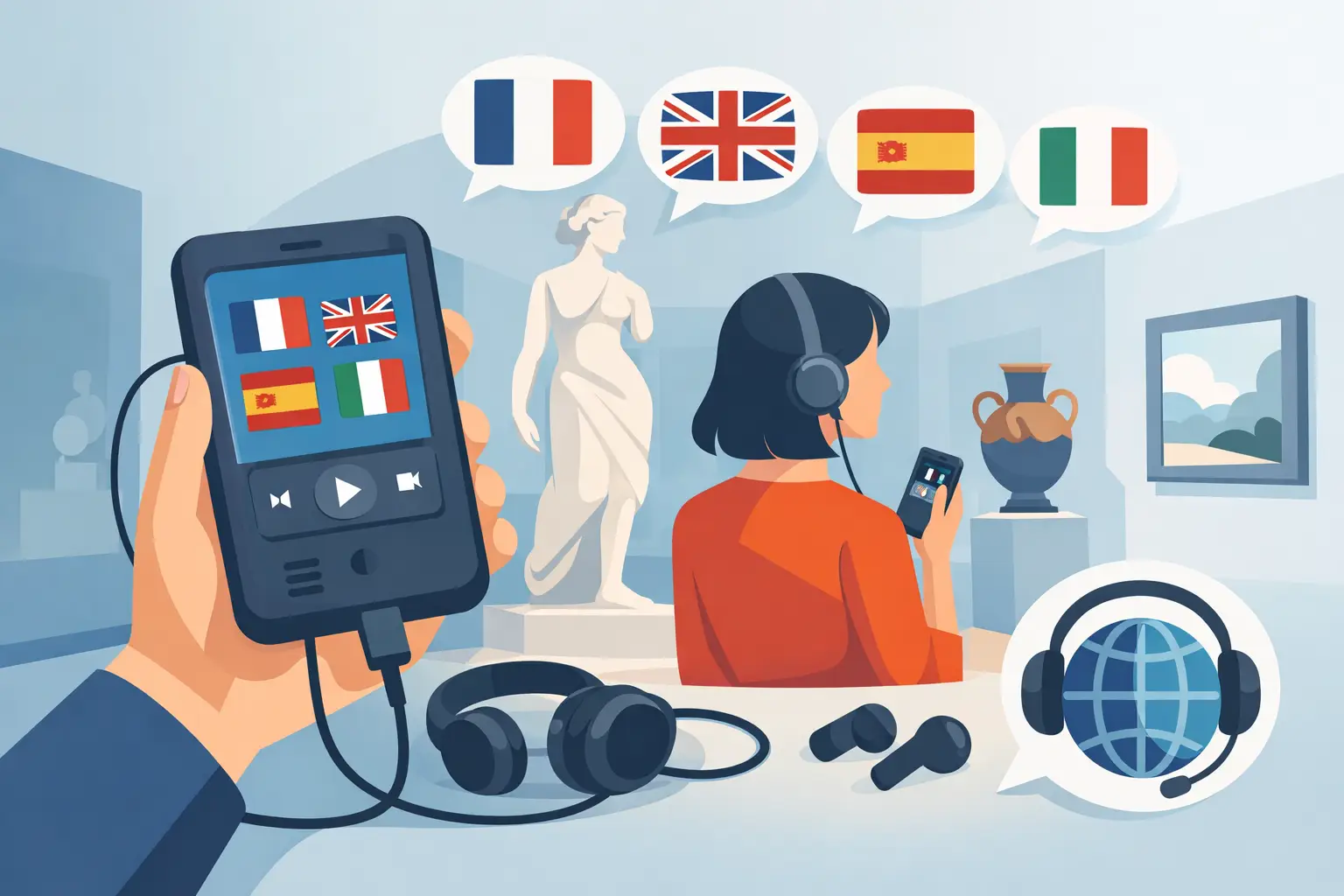
A Dutch visitor stops in front of a major work, while a Spanish family searches for the starting point of the visit. For them, the quality of the welcome is immediately at stake: can they understand the content in their language, easily and without delay? A multilingual audio guide for museums meets this expectation while helping teams to better control their costs, their equipment and the evolution of their routes.
Multilingualism is not a supplement intended only for large establishments. It is a concrete mediation lever for regional museums, monuments, artists' houses and heritage sites which wish to address all their audiences. On condition that it is conceived as a real visitor service, and not as a simple juxtaposition of translations.
Why offer a multilingual audio guide for museums?
International visitors do not just come looking for factual information. They want to understand a place, put the objects they see into context and grasp the human and territorial stories that give them meaning. When content is only available in French, part of this experience remains inaccessible, including for visitors who are familiar with digital uses.
An audio tour in several languages therefore improves autonomy. The public chooses their language from the start of the tour, advances at their own pace and listens to comments that correspond to their interests. For reception teams, it is also a reliable response to recurring requests, without having to multiply printed documents or take time for repeated explanations.
This approach also serves the attractiveness of the territory. A tourist office, a community or a cultural site can promote to its partners an offer adapted to foreign customers. But the number of languages is not enough to ensure the quality of the device. A tour available in six languages, poorly translated or difficult to use on site, will create more frustration than a well-designed tour in three relevant languages.
Start from real audiences, not from a theoretical list of languages
The right choice begins with observation. What languages do foreign visitors speak? When do they come? Which groups are hosted, and which countries do they come from? Attendance data, questions asked at reception and feedback from tourism partners often provide a very solid basis.
In many French structures, English is the first starting point. Depending on the territory and the type of site, German, Dutch, Spanish or Italian may then be given priority. A museum located in a border area will not have the same needs as a site frequented by cruise passengers or a cultural facility in a rural area.
It is also necessary to distinguish the language of consultation from nationality. Visitors from multiple countries may prefer a tour in English. Conversely, some audiences will greatly appreciate finding their mother tongue, particularly when the content addresses complex subjects: local history, archaeology, memory, fine arts or industrial heritage.
It is better to gradually deploy quality versions than translate everything too quickly. A digital solution makes it possible to add a language when attendance or development strategy justifies it. This scalability protects the budget and leaves the possibility of improving the content based on field feedback.
Translate the meaning, not just the words
A good audio guide is not just a label read aloud. The text must be written for listening: clear sentences, natural rhythm, accessible vocabulary, precise instructions for looking at the work or moving around. The translation must preserve this orality and adapt cultural references when necessary.
Machine translation can facilitate initial understanding or speed up certain work steps, but it does not replace qualified human proofreading. Proper names, heritage terms, puns and historical references require particular vigilance. Clumsy wording can weaken the credibility of an establishment, even if the initial content is excellent.
The voice also participates in the experience. A voice that is too fast, artificial or poorly recorded is tiring for listening. Depending on the budget and the ambition of the project, the recording can be entrusted to professional actors or carried out carefully by the teams, provided that a calm environment, suitable equipment and editorial validation are provided. The main thing remains consistency: same tone, same level of precision and same sound quality from one language to another.
Guideius addresses every digital cultural mediation challenge
Create a multilingual smartphone audio guide that is easy to deploy, accessible and tailored to your museum, heritage site or destination.
The visitor smartphone: an operational and responsible choice
Traditional audio guides involve purchasing, loading, cleaning, lending, retrieving and renewing dedicated boxes. These operations take time, require secure storage and generate costs that are sometimes difficult to anticipate for small and medium-sized structures.
An accessible route on the visitor's smartphone changes this organization. A QR code at the entrance, on a panel or near a step allows you to launch the experience quickly. GPS activation can complement this setup for outdoor tours, old centers or heritage walks. In a museum, the QR code is often particularly suitable: it is visible, precise and does not depend on satellite coverage inside the buildings.
However, this approach should not leave out visitors without a smartphone, without a battery or who are not very comfortable with digital technology. A inclusive mediation provides alternatives: one-off loan of a device, essential printed materials, support at reception or guided tours. Digital is relevant when it expands the possibilities of visiting, not when it creates a new barrier.
Plan for offline and ease of use
In the thick walls of a castle, in an old mine or along a heritage trail, the mobile network may be weak or absent. An effective multilingual audio guide must allow the route to be downloaded in advance, so that the audio files remain accessible without connection during the visit.
On the visitor side, the interface must go to the essentials: choose a language, understand where to start, launch a track, find your position on the route. A map can be useful in a large site, but it should not become essential if the public can follow a simple order of visit. Icons, titles and instructions are easier to understand without having to read long explanations.
On the administration side, simplicity is just as decisive. Teams must be able to update a text, correct a translation, add a temporary step or publish an exhibition without systematically depending on a technical service provider. With Guideius, this autonomy is based on an administration designed for cultural professionals, including when they do not have a dedicated digital team.
Making multilingualism an accessibility tool
A multilingual experience and an accessible experience meet the same requirement: allowing as many people as possible to access content. Subtitles or transcriptions benefit deaf and hard of hearing people, but also visitors who prefer to read, who are in a noisy space or who wish to consult the content after their visit.
Plain language versions, audio descriptions, readable contrasts and assistive technologies compatible navigation should be considered from the design stage. It’s not about checking off a series of options at the end of the project. Editorial and technical choices have a direct effect on the autonomy of audiences.
Multimedia content can reinforce understanding: detailed images, archives, maps, old photographs or short videos. However, they must serve the purpose. A succession of busy screens distracts attention from the collections and unnecessarily lengthens the visit time. The best tool remains the one that accompanies the gaze rather than capturing it.
Measure usage to improve routes
Deployment is not the last step. Usage statistics allow us to know which languages are actually selected, which tracks are listened to the most and when visitors leave the tour. This information helps to adjust durations, prioritize a new translation or identify a step that is insufficiently reported.
Data must be used judiciously. A low listening rate does not necessarily mean that the content is bad: it may correspond to a busy room, to a work already heavily commented on by the signage or to a connection problem. Cross-referencing the indicators with the observations of reception staff and feedback from visitors avoids hasty decisions.
For public and parapublic structures, data control is also a criterion of choice. It is best to know what data is collected, for what purpose, for how long and by whom it is accessible. Ethical digital mediation respects visitors as much as it helps teams manage their offer.
A well-designed multilingual audio guide doesn't try to impress with technology. It gives each visitor the means to understand, to be moved and to maintain a stronger connection with the place they have just discovered.
Would you like to apply these ideas to your site?
Guideius helps deploy multilingual audio tours with QR codes, GPS, offline mode, multimedia content and privacy-friendly analytics.