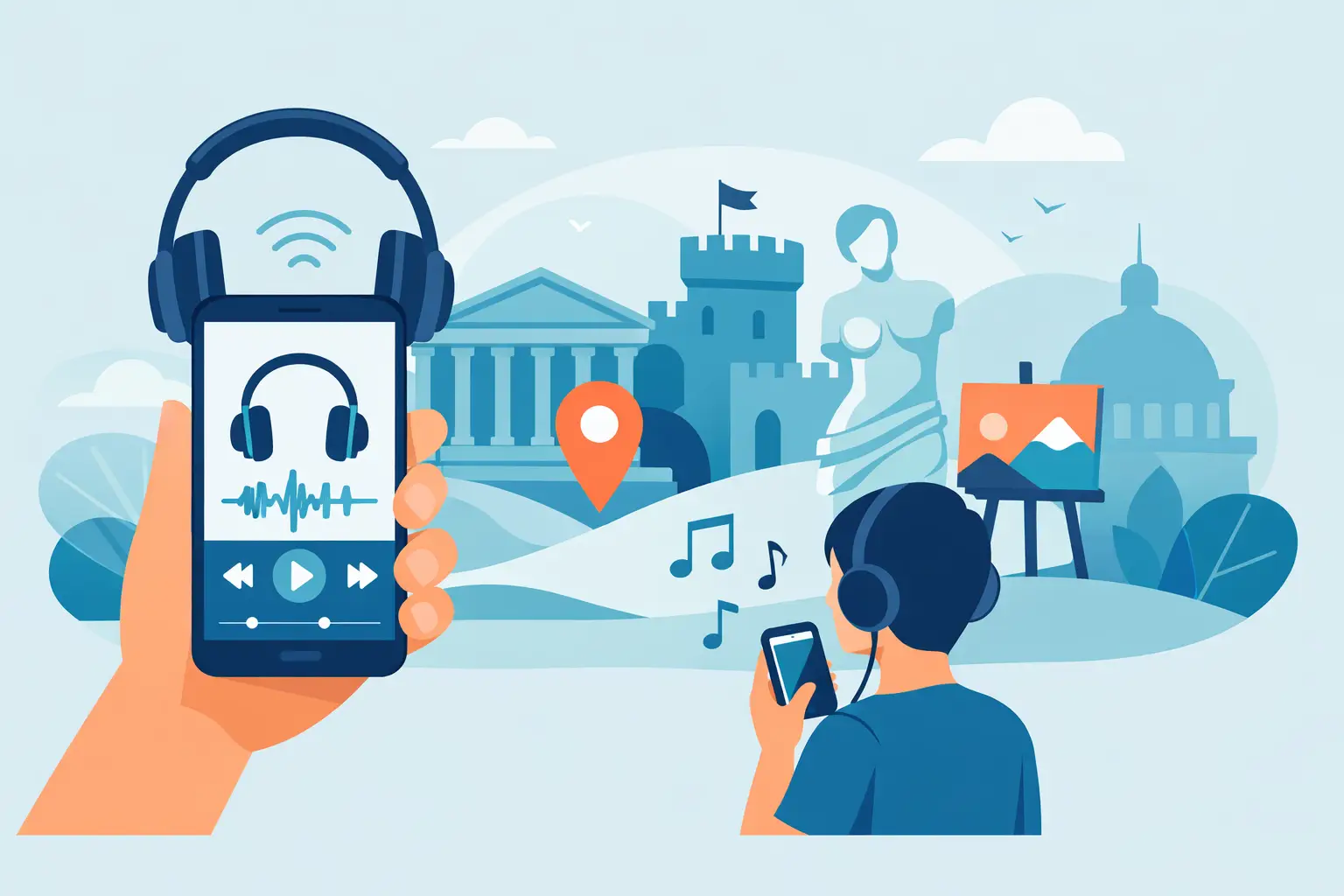
At the reception of a museum or heritage site, the queue does not always form in front of the ticket office. She can also appear in front of an audio guide loan counter, when distributing the devices, explaining their operation or managing an incomplete return. An audio guide application responds to this very concrete reality: it makes it possible to offer rich sound mediation on the visitor's smartphone, while making the daily life of the teams easier.
This change is not just about replacing a case with a screen. Well designed, a digital solution improves visitor autonomy, makes content more easily accessible in several languages and gives establishments a clearer vision of the actual use of their routes. It is still necessary to choose a tool adapted to the cultural, technical and budgetary constraints of the field.
Why adopt an audio guide application?
The traditional audio guide has long been an effective response to a specific need: to accompany the visit without mobilizing a mediator at each stage. But it also involves the purchase, storage, cleaning, recharging, maintenance and renewal of a fleet of equipment. For a modest-sized structure, these constraints can take up a disproportionate amount of space.
With an application or web app, the visitor uses their own phone and headphones. The route can be opened using a QR code at reception, in the rooms or on communication media. On an outdoor route, GPS can also offer content in the right place. The team no longer has to manage the circulation of dedicated devices and can concentrate its time on reception, human mediation and the quality of the experience.
The benefit is also editorial. An audio guide application is not limited to a linear audio track. It can combine narration, archive images, additional texts, maps, short videos or quizzes. This diversity makes it possible to adapt the reading level to different audiences without making the physical signage heavier. A child, a foreign visitor and an informed amateur do not necessarily expect the same story from the same place.
The functions that really matter in the field
Not all applications meet the same needs. For a cultural establishment, the quality of the journey depends less on the accumulation of functions than on their relevance and reliability in use.
Immediate access, without unnecessary friction
Pre-downloading an application may be suitable for a busy site or a destination that retains its visitors. In other cases, a web app accessible directly by QR code greatly reduces the obstacles. The visitor scans, chooses their language and begins their journey without creating an account or searching for an application on a store.
The ideal therefore depends on the context. A native app can provide a more integrated experience, while a web app is often quicker to deploy and easier to use for a one-time visit. In both cases, access must be clearly indicated and accompanied by a simple instruction: provide headphones or offer an alternative solution when necessary.
Offline mode, essential in certain places
Romanesque church with thick walls, isolated valley, underground gallery, nature trail: mobile connection is not guaranteed everywhere. An audio guide that depends entirely on the network risks creating frustration precisely where the visitor should be able to be guided.
Downloading the route before or at the start of the visit provides a concrete answer. Content remains available without network coverage, loading times disappear and the route remains reliable. For teams, this function also limits requests related to connection problems that are difficult to resolve on site.
Multilingual as a reception condition
Translating a label is not always enough to make a visit come alive. The audio restores an intention, a rhythm, atmospheres and sometimes testimonies which give another depth to the story. Offering several languages in the same application makes it possible to welcome international visitors without multiplying equipment or printed materials.
However, multilingualism should not be reduced to a simple word-for-word transposition. Each version must maintain a quality of narration and take into account the references understood by the public concerned. It is better to start with the languages that are most useful for visitors to the site, then gradually enrich the offer, than to publish approximate translations.
Accessibility designed from the writing stage
The digital mediation can broaden access to heritage, provided it does not create new obstacles. Readable transcriptions, sufficient contrast, clear navigation, content in sign language or descriptions adapted to visually impaired people contribute to a more inclusive visit.
Accessibility also concerns uses. Easy-to-identify buttons, short instructions and the ability to freely choose your pace make the route more welcoming for families, the elderly or visitors unfamiliar with digital tools. It’s not about adding a technical layer: it’s about allowing more people to access the meaning of the works and places.
Guideius addresses every digital cultural mediation challenge
Create a multilingual smartphone audio guide that is easy to deploy, accessible and tailored to your museum, heritage site or destination.
An audio guide application does not replace human mediation
One of the fears frequently expressed is that of a visit becoming solitary, standardized or entirely mediated by the screen. This fear is legitimate when digital technology is deployed without a mediation project. A relevant audio guide application does not seek to constantly capture attention. It accompanies the gaze, offers benchmarks and leaves space for observation.
It can also strengthen the work of mediators. A permanent tour provides essential information, while guided tours, workshops and meetings can focus on exchange, interpretation and questions from the public. The teams thus have several visiting methods rather than a single answer for everyone.
Quality depends first of all on the scenario. Each step must answer a simple question: what will the visitor understand, feel or notice here? Good audio content does not describe everything that is visible. It draws attention to a detail, places an object in its history, gives voice to an inhabitant or creates a link between the landscape and the uses that have shaped it.
Design a useful route before choosing the tool
The technical choice benefits from coming after a framing phase. Which audience do we want to better welcome? Is the course indoor, outdoor or mixed? Do visitors have an average of thirty minutes or two hours? Which languages have priority? These questions avoid designing an experience that is too long, too dense or difficult to maintain.
For a first deployment, a narrower route is often preferable. A dozen well-written steps, with a reasonable audio duration and a clear direction, gives better results than an exhaustive succession of content. The visitor must be able to choose to follow the entire route or listen to only a few points of interest without feeling like they are missing their visit.
Editorial creation deserves particular attention. Voices, sound quality and reading rhythm strongly influence the perception of the place. A text written to be read aloud must remain alive, precise and breathable. Scientific or historical information can be demanding without becoming academic, as long as it is linked to what the visitor sees.
Simply administer and measure without monitoring
Small and medium-sized cultural structures do not always have a dedicated digital service. The administration interface must therefore make it possible to modify text, replace media, add a language or update schedules without systematically depending on a technical service provider. This autonomy is essential to keep the content up to date and to evolve the route over the seasons or exhibitions.
usage statistics also have real value, if they remain proportionate and respectful of visitors. Knowing which steps are most consulted, when routes are interrupted or which languages are preferred helps improve mediation. This data must serve the cultural project, not transform the visit into an individual monitoring system.
Control of data, transparency over their processing and the absence of intrusive advertising constitute criteria of choice in their own right, particularly for communities and public institutions. Sober and ethical technology protects the relationship of trust with the public.
Evaluate the cost beyond the subscription
Comparing solutions only on their monthly price gives an incomplete vision. It is necessary to integrate the initial cost of content creation, editorial support, maintenance, developments, team training and, above all, the avoided expenses linked to dedicated equipment. Depending on the number of visitors and the organization of the site, the savings made on logistics can be significant.
Scalable pricing is generally more adapted to the reality of the territories: a small municipal museum, a village trail or a heritage association does not have the same needs as a large establishment. The possibility of starting on a reasonable scale, then adding languages, courses or functionalities, limits risks and facilitates appropriation by teams.
Guideius is part of this approach by offering cultural structures a manageable solution without technical expertise, designed for multilingual audio tours, accessible and usable even when connectivity is limited.
The right choice is not recognized by the quantity of options displayed, but by the tool's ability to circulate a story, without complicating the work of those who transmit it. Starting with the real needs of visitors and teams remains the best way to build a digital journey that lasts.
Would you like to apply these ideas to your site?
Guideius helps deploy multilingual audio tours with QR codes, GPS, offline mode, multimedia content and privacy-friendly analytics.