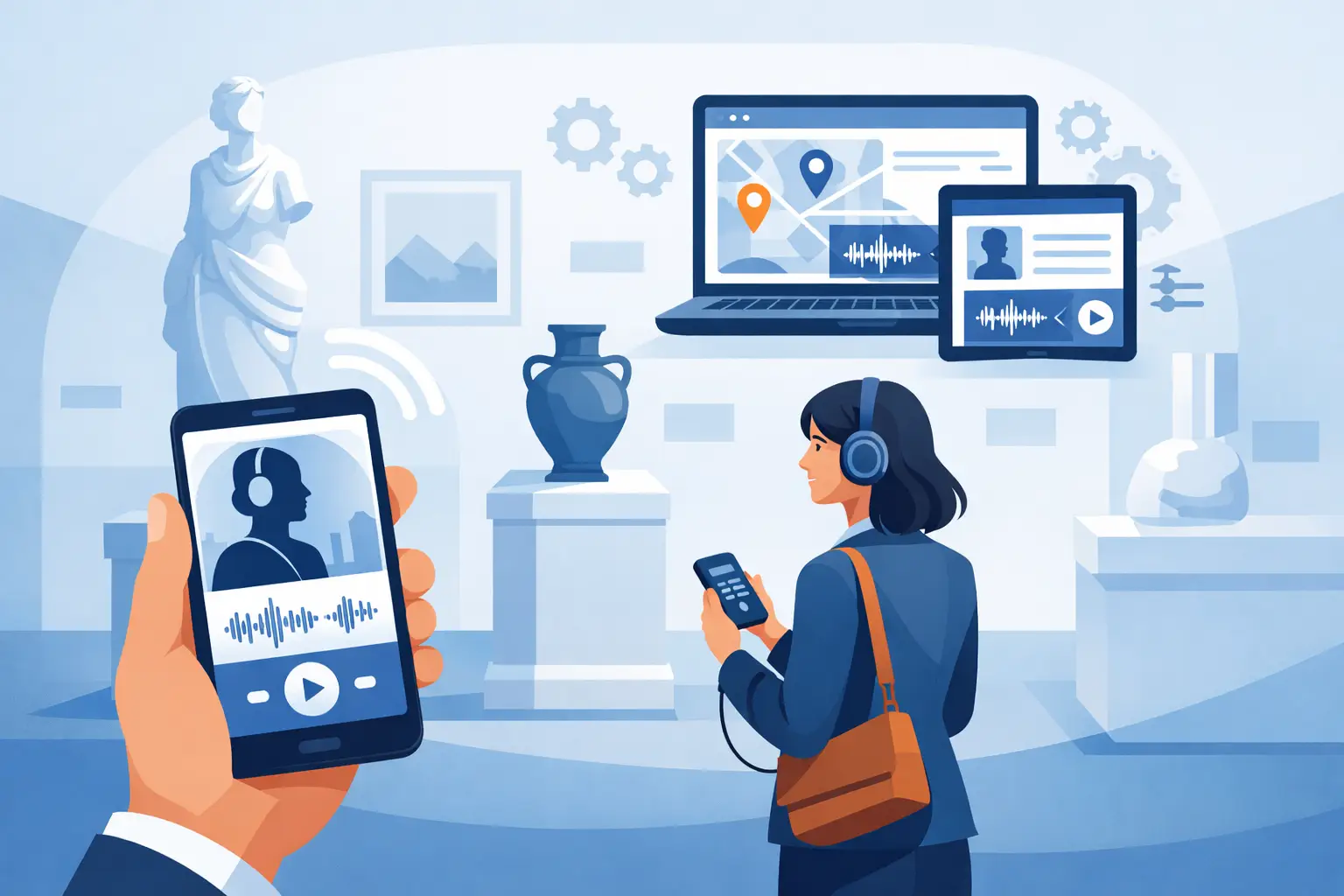
At the entrance to a museum, the quality of mediation is often decided in a few seconds: does a visitor understand how to start, does he find content in his language, can he continue the visit without a network? A museum audio guide software must respond to these concrete situations. It is no longer just a question of replacing a box with a smartphone, but of offering a cultural journey that is reliable, accessible and easy for teams to experience.
For museums, heritage sites and tourist offices, the choice of a digital solution involves both the visiting experience and the daily organization. The right solution is one that serves the scientific and cultural purpose, without creating a new technical dependency or multiplying management tasks.
What museum audio guide software should really solve
The digital audio guide firstly responds to an expectation of freedom. Visitors use their own phone, move at their own pace and access content that meets their curiosity. For the establishment, this approach avoids the purchase, loan, recharging, cleaning and renewal of a fleet of dedicated equipment.
But the personal telephone is not enough to make a good visit. Relevant software should remove friction rather than displace it. Getting started must be immediate, ideally by QR code, without complex installation or mandatory account creation. The visitor must also be able to easily find the right content, both indoors and on an outdoor trail.
This is where trigger modes are important. The QR code is particularly suitable for rooms, windows, panels and identified works. GPS is valuable for ancient centers, gardens, memory routes or circuits on a territorial scale. These two approaches can coexist: one provides precision, the other accompanies wandering.
Prioritize a reliable experience, including offline
Connectivity remains patchy in many cultural venues. Thick stone walls, basements, listed buildings, rural areas or remote outdoor spaces: relying solely on the mobile network exposes visitors to frustrating interruptions.
The offline mode is therefore not a secondary option. It allows you to download a route before or at the start of the visit, then listen to the content without depending on continuous network coverage. For a reception team, it is also an easier promise to keep: the course works in the real conditions of the site, and not just during a demonstration with a good signal.
Reliability also concerns the simplicity of the interface. A cluttered screen, buttons that are too small or confusing navigation distract attention from the collections. The application or web app must remain discreet: a map if it really helps with orientation, visuals when they clarify the point, clear progression and understandable instructions without constant support.
Application or web app: choose according to use
The mobile application can be relevant when a structure wishes to offer recurring access, build audience loyalty or offer a very personalized experience. It nevertheless requires a download, which some visitors hesitate to carry out for a one-off visit.
The web app is often more suited to immediate discovery journeys: a QR code is enough to open the experience in the browser. This choice reduces the entry threshold and facilitates use for passing audiences. In both cases, the criterion is not the most visible technology, but the one that makes the visit the simplest.
Make accessibility a design requirement
An audio tour is not automatically accessible. Audio helps some audiences, but can exclude people who are deaf or hard of hearing if content is not accompanied by transcriptions. Conversely, dense text may be difficult for other visitors to read or understand.
Audio guide software for museums must make it possible to offer several entry points to the same content: searchable texts, subtitles for the media, images, readable settings and adapted routes when necessary. Accessibility should not be thought of as a layer added at the end of the project. It improves the experience for everyone: families, non-speaking audiences, elderly people, visitors in a hurry or people who prefer to read before listening.
The language of the content matters just as much. Digital mediation can preserve scientific requirements without reproducing the cartel in an audio format. An embodied voice, short sentences, spatial cues and well-researched stories make the collections more relatable. Multilingualism extends this attention by welcoming international visitors in languages adapted to the actual use of the place.
Guideius addresses every digital cultural mediation challenge
Create a multilingual smartphone audio guide that is easy to deploy, accessible and tailored to your museum, heritage site or destination.
Evaluate the functionalities from the cultural project
A feature-rich solution is not necessarily the most useful. Before comparing the tools, it is preferable to define what the route must accomplish: accompany a temporary exhibition, guide a family audience, promote a village, make an archaeological site more intelligible or offer an independent visit outside mediation hours.
Multimedia content has meaning when it provides what the object alone cannot show: an archive, a restitution, an enlarged detail, a testimony, a work in context or an old map. Quizzes can sustain the attention of young audiences, provided they remain at the service of discovery rather than transforming the visit into a succession of screens.
Usage statistics are also useful if they remain readable and respectful. Knowing which points of interest are most visited, where visitors interrupt the journey or which languages are used helps to improve mediation. This data must inform team decisions, without imposing disproportionate collection or blurring the relationship of trust with the public.
An administration designed for field teams
In a small structure, the person who updates a route is often also responsible for collections, communication, reception or programming. She is not intended to become a system administrator. The management interface must therefore make it possible to modify a text, replace a media, publish a new step or consult uses without particular technical skills.
The included maintenance and support for creating the courses are concrete criteria, not simple commercial elements. They determine the establishment's ability to evolve its audio guide over the course of exhibitions, visitor feedback and seasonal changes. A scalable solution allows you to start with a core journey, then add languages, formats or routes as the project matures.
Compare the overall cost, not just the subscription
The price of software must be examined in relation to its operating cost. Physical equipment may seem manageable at first, but it entails recurring expenses: purchase of devices, accessories, maintenance, replacement, hygiene, storage and loan time. Conversely, a smartphone solution reduces these constraints, while requiring clear signage and launch support.
You also need to anticipate content costs. Writing, translation, recording, iconography, scientific validation and accessible adaptation represent an investment. This deserves to be valued over time: well-designed content can be updated, reused and adapted for different audiences.
The most relevant pricing depends on the number of courses, languages, visitors and the level of customization desired. A white label offer can respond to an organization that wishes to deploy its complete visual identity. For others, an immediately operational solution will be fairer, quicker to launch and more compatible with the means available.
Ask the right questions before choosing
An exchange with a service provider gains in precision when needs are formulated from the field. How many languages are needed? Is the site covered by the network? Should content be available offline? Who will update the routes? Which audiences should benefit from specific adaptations? What data does the establishment wish to monitor, and within what ethical framework?
It is also useful to test the route as a visitor would: outside, in a dimly lit room, with an old phone, without headphones and with a limited connection. This testing often reveals more than the list of features.
Guideius is part of this logic by offering cultural structures manageable, multilingual and accessible digital mediation, without the constraints of a fleet of physical audio guides. The challenge remains the same for each establishment: putting technology in the right place, that of a discreet tool that makes works, stories and territories more accessible.
The best choice is not the one that adds the most effects to the visit. It is the one that allows each visitor to look better, understand better and keep track of what they have just discovered for longer.
Would you like to apply these ideas to your site?
Guideius helps deploy multilingual audio tours with QR codes, GPS, offline mode, multimedia content and privacy-friendly analytics.