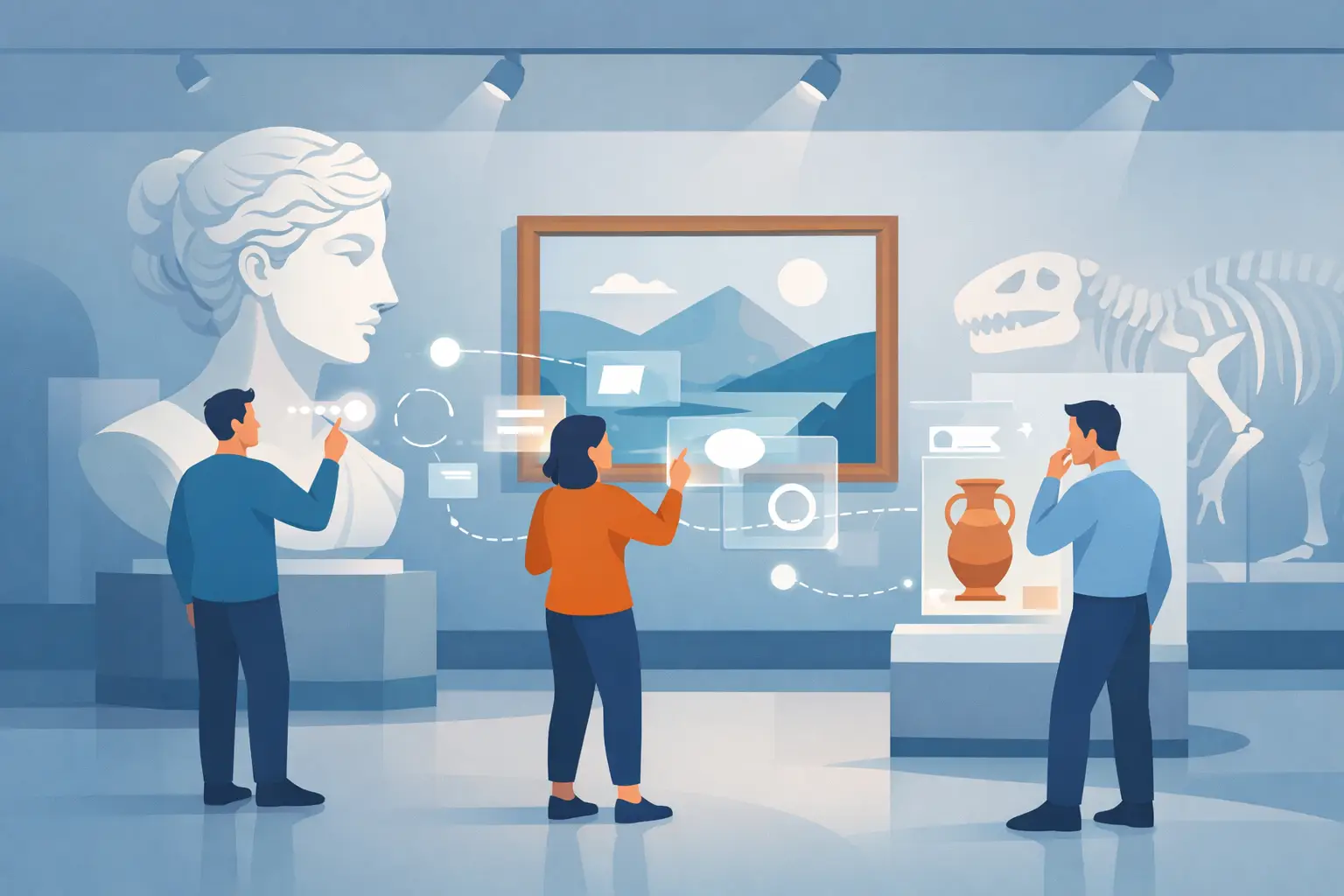
A visitor does not remember a terminal, a QR code or a screen. He remembers the moment when information helped him to look at a work, a building or a landscape differently. The expression “interactive museum visitor experience” therefore designates much more than the addition of technologies to a journey: it questions the quality of mediation, the autonomy left to the public and the capacity of a place to address varied profiles.
For museums and heritage sites, the challenge is not to make each visit spectacular. It is to offer useful interactions, consistent with the collections and realistic to use. A successful solution enriches attention without competing with what is in front of the eyes.
Interactivity begins with an intention of mediation
A device becomes interactive when it gives the visitor a real possibility to act: choose a reading level, listen to a testimony, compare two points of view, answer a question or follow a route according to their interests. The interaction doesn’t have to be complex to be engaging. Above all, it must have meaning in the visit story.
Before choosing a tool, a team benefits from formulating what the course should allow. Does she want to give guidelines to a first audience? Make the social history of a territory visible? Suggest a family visit? Facilitate the understanding of a monument where certain spaces are not accessible? These goals determine the right content format, pace, and necessary features.
Audio, for example, is particularly suitable for works that require observation time. It leaves the gaze available and can restore voices, atmospheres or archives. A detailed image helps to read a facade that is difficult to approach. A quiz can consolidate a discovery at the end of the stage, provided you do not transform the course into a school questionnaire. Each media must serve a specific mediation gesture.
Design an interactive museum visitor experience
A relevant experience is built from the actual journey, and not from a list of functions. It is necessary to observe movements, waiting areas, points where the public hesitates and places where the connection is uncertain. In a small museum, a few carefully positioned contents can be more effective than an exhaustive visit. On an outdoor route, geolocation can guide progress, while triggering by QR code remains valuable when the GPS is imprecise or when the visitor wishes to maintain control of their path.
The experience must also respect the right not to do everything. Some audiences want a twenty-minute tour, others an in-depth exploration. Planning short courses, optional in-depth studies or thematic content makes it possible to respond to this diversity without imposing a single itinerary. This logic is particularly useful for families, school groups, passing visitors and regulars.
Give simple choices, not an interface to decipher
Autonomy does not consist of placing the visitor face to face with a multitude of options. It is based on immediately understandable benchmarks: starting the visit, choosing a language, selecting a theme, finding a point of interest. A clear interface limits interruptions and reassures people unfamiliar with digital uses.
The personal smartphone is a practical support, but it should not become an implicit condition of access to knowledge. Readable signage, room contents and supporting alternatives remain necessary. Digital technology complements human and physical mediation. It does not replace it.
Create a story rather than a succession of cards
Interactivity gains strength when the steps respond to each other. A first piece of content can pose a question, a subsequent work adds nuance, then an archive or a testimony shifts the perspective. This continuity gives a reason to move forward and promotes memorization.
The tone matters as much as the format. Audio texts should be written for listening, with short sentences, useful silences and attention to the context of observation. A voice that is too dense is quickly exhausting. Conversely, content that is too general does not justify the use of the telephone. The right length depends on the location and the audience, but each sequence must provide information or emotion that the cartel alone could not offer.
Guideius addresses every digital cultural mediation challenge
Create a multilingual smartphone audio guide that is easy to deploy, accessible and tailored to your museum, heritage site or destination.
Choose a technology adapted to the realities on the ground
For a cultural structure, the question is not only that of innovation. It concerns reliability, operating costs and the time required of the teams. The purchase, recharging, cleaning and loan of dedicated equipment represent a significant cost, often underestimated when launching a project. A visit accessible from the public's smartphone reduces these constraints, provided that getting started is really simple.
The QR code meets this requirement: it triggers access to the right content in the right place, without a complex application to search for. Geolocation provides another form of comfort in urban routes, gardens or large sites. The offline mode remains essential as soon as thick walls, rural areas or crowds weaken the network. These functions do not oppose each other: they can complement each other depending on the configuration of the site.
The choice of a web app or an application must also take into account visiting habits. A web app facilitates immediate access, particularly useful for passing audiences. An application can make sense for a destination offering several regular routes or wishing to extend the relationship with its visitors. In both cases, technical sobriety deserves to be a decision criterion: a light, maintainable and durable device will be more useful than an ambitious experiment that has become difficult to develop.
Make accessibility a design principle
Interactive mediation cannot be considered successful if it excludes part of the audience. Accessibility must be considered when writing and not added at the end of the project. This concerns languages, contrasts, text size, audio transcription, image descriptions, ease of navigation and compatibility with support tools.
Easy-to-read French content, audio versions, translations and adapted pathways all contribute to a more inclusive experience. They also benefit beyond the audiences directly concerned: a tired visitor, a parent accompanied by children or a non-French-speaking tourist also benefits from clear and well-structured information.
However, we must avoid thinking of accessibility as a single option. Needs differ depending on disabilities, ages, languages and visiting situations. Dialogue with local associations, mediators and the public concerned makes it possible to identify concrete improvements, often simple to implement.
Preserve the teams’ capacity for action
A digital journey only remains alive if it can evolve. A temporary exhibition, a change in schedule, a new scientific point of view or a territorial event must be able to be integrated without systematically depending on a technical service provider. Content administration is therefore a subject of mediation as much as of organization.
A solution designed for non-expert teams allows you to correct text, add a language or update an image with autonomy. It also facilitates coherence between several routes: museum, old center, memory circuit or heritage hiking route. Guideius supports this logic by combining smartphone streaming, multimedia content, offline operation and simplified route management.
Data control deserves the same attention. Usage statistics can indicate the languages chosen, the most consulted stages or the moments of abandonment. They help to improve a course, to objectify a need for mediation and to prepare assessments. They must not lead to surveillance of visitors. Collection that is proportionate, transparent and respectful of the public framework strengthens trust.
Measure what really improves the visit
The number of scans or starts is not enough to evaluate an experience. It is useful to cross-check several signals: completion rate of a route, listening time, most viewed content, questions received at reception and qualitative feedback from visitors and mediators. A little-used step is not necessarily bad: it may be difficult to spot, too long or placed at a time when attention is waning.
Improvement may be gradual. Modifying a starting instruction, shortening two audio tracks, making a QR code more visible or adding an explanation in a foreign language sometimes produces a more concrete effect than a complete overhaul. This adjustment work transforms digital technology into a cultural public service tool, as close as possible to observed uses.
The fairest interactive experience is not one that engages the visitor at every step. It is the one that offers him, at the right moment, an additional gateway to heritage - then leaves him the necessary space to look, understand and feel.
Would you like to apply these ideas to your site?
Guideius helps deploy multilingual audio tours with QR codes, GPS, offline mode, multimedia content and privacy-friendly analytics.