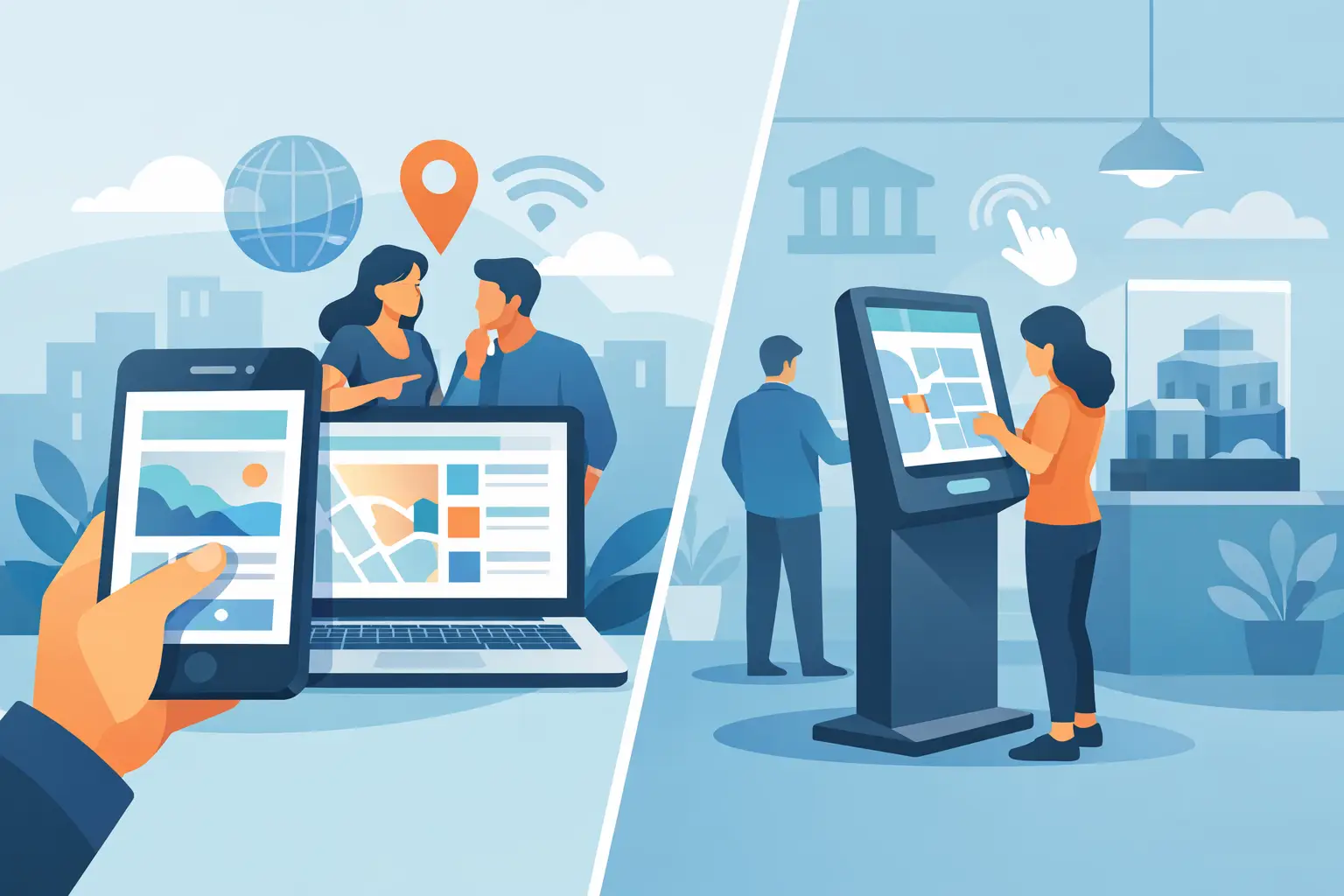
At the entrance to a museum or at the start of a heritage tour, a very concrete question arises: should we install a screen accessible to all or allow everyone to use their own smartphone? The choice between web app versus interactive terminal is not limited to technical preference. It conditions the budgets, the organization of the teams, the accessibility of the visit and the capacity of the site to develop its content.
For cultural and tourist structures, there is no universal answer. A terminal can be relevant to a specific location, while a web app often better meets the need for support throughout a journey. The challenge is to select the device that really serves the purpose of mediation, the audiences and the constraints of the field.
Web app versus interactive terminal: two different uses
An interactive terminal is a physical piece of equipment, generally installed at reception, in a room or in front of a point of interest. It provides access to content that can be consulted on site: map, timeline, videos, archives, games or practical information. Its strength lies in its visibility. It catches the eye, materializes the digital offer and allows immediate consultation, without personal device or prior manipulation.
A visit web app operates from the visitor's smartphone browser. Access can be offered by QR code, by short link or, depending on the context, by geolocation. It accompanies the person on their travels with audio, textual, visual or interactive content. When the route is prepared to work offline, it remains usable in spaces where the network is insufficient: underground sites, monuments with thick walls, isolated gardens or rural routes.
The essential difference is therefore spatial. The terminal sets a consultation point. The web app extends the mediation throughout the experience, inside and outside the site.
The real cost does not stop at the purchase
The interactive terminal involves a material investment: screen, casing, fixing, power supply, sometimes custom furniture and compliance with the location. Added to this are maintenance, technical updates, cleaning and possible replacement of components. In a heritage building, each installation may also require special attention to preserve spaces and respect architectural constraints.
Its cost can be justified when it plays a lasting and very targeted role, for example presenting a digital model at reception or providing access to a documentary collection. On the other hand, multiplying the number of terminals to cover an entire route quickly increases expenses and operating costs.
The web app strongly limits these material constraints since the visitor uses their phone. The teams do not have a fleet of audio guides to load, distribute, disinfect, recover or replace. The budget can be devoted more to what makes the visit valuable: writing, translations, recordings, iconography and accessibility.
However, it is necessary to provide clear signage, support for getting started and, for those who are not equipped, an alternative solution. Lending a few devices or keeping concise paper remains a pragmatic response. Personal digital technology must never become a condition of access to knowledge.
Mobility changes the relationship to the visit
On a terminal, visitors often group together in front of the same screen. This dynamic can be useful for a short consultation or a collective activity. It also shows its limits during periods of attendance: waiting, screen difficult to read by several people, consultation time shortened by the presence of other people.
With a web app, everyone moves at their own pace. A family can listen to an audio track by sharing headphones, a visitor can reread an enriched map, a person can interrupt the journey and then resume it. The content is available at the moment it becomes relevant, in front of the work, on a street, at the top of a lookout or after the visit.
This autonomy is particularly useful for territorial routes. A tourist office can offer several itineraries without installing equipment in each municipality. An extensive heritage site can guide visitors to lesser-known points. Mediation becomes lighter to deploy and simpler to update when new places join the journey.
Guideius addresses every digital cultural mediation challenge
Create a multilingual smartphone audio guide that is easy to deploy, accessible and tailored to your museum, heritage site or destination.
Accessibility: thinking beyond the screen
A terminal can offer a visible and intuitive interface, provided that its height, contrast, location and controls have been designed for a diversity of audiences. It can also be a valuable access point for people who don't want to use a smartphone. But it remains a fixed piece of equipment, subject to the availability of space and ergonomic choices that are sometimes difficult to correct after installation.
The web app offers other possibilities. The visitor can increase the size of the text on their phone, adjust the volume, use their own assistance tools or view content in the chosen language. transcriptions, subtitles, audio descriptions, simplified texts and adapted visuals can be integrated directly into the course. Accessibility does not depend only on technology: it relies on editorial quality and content designed from the outset to be understood by as many people as possible.
The best strategy is often complementary. Essential information must remain visible without a smartphone: timetables, visiting rules, orientation, safety instructions and basic landmarks. The web app enriches this first layer with stories, additional languages and formats adapted to everyone's desires.
Updates and data: a decisive advantage of the web app
In a cultural place, the contents change. A work is loaned, a path is temporarily closed, an exhibition is renewed, a translation is corrected or programming is added. Modifying a terminal may require on-site intervention, depending on its technical architecture. On an administrable web app, a team can update a text, an image or a route step much more quickly.
This flexibility is valuable for small teams, provided that the tool does not require development skills. A clear administration interface allows you to maintain control of content internally, without creating systematic dependence on a service provider.
Usage statistics also provide useful insight: languages selected, steps consulted, average duration, most listened to content or completion rate. These indicators do not replace discussions with visitors, but they help to adjust a route and to argue the mediation choices with partners or funders. Their collection must remain proportionate, transparent and respectful of personal data.
When a terminal remains the right choice
Systematically opposing the two formats would be a mistake. The terminal remains truly relevant when it carries an experience that is difficult to transpose onto a smartphone: handling a large format map, shared consultation of very detailed archives, an immersive device in a scenography or a collective game at reception.
It is also suitable when the content must be immediately available without any prior action from the visitor. In a busy place, a well-placed terminal can arouse curiosity in a few seconds. It is then a point of call, not a substitute for the entire journey.
Before choosing, four questions help clarify the decision: should the content follow the visitor or stay in a specific location? Can the teams maintain equipment? Does the venue have reliable connection and power? And above all, what format allows more people to understand, choose and enjoy the visit?
Design a system consistent with the field
For a small museum, a web app can become the main support for a multilingual audio guide, supplemented by reception signage and occasional loan of devices. For an urban route, it allows the contents to be distributed spatially and the stages to be triggered by QR code or GPS. For a temporary exhibition, it avoids producing material supports that are difficult to amortize over a short period of time.
A terminal can, for its part, enrich this system at a strategic moment: to present the site map, announce the available routes or make you want to listen to a first extract. This articulation works particularly well when each tool has a clear mission. The terminal informs and attracts. The web app supports, deepens and extends the discovery.
It is in this logic that solutions like Guideius favor mediation on smartphones that is easy to administer, available in several languages and designed for the connectivity realities of cultural places. The system remains at the service of the story, rather than imposing a heavy infrastructure on the teams.
The right choice is not measured by the number of screens installed, but by the quality of the attention given to visitors. Start with the journey you want them to experience, then choose the technology that makes it more accessible, more lively and easier to sustain.
Would you like to apply these ideas to your site?
Guideius helps deploy multilingual audio tours with QR codes, GPS, offline mode, multimedia content and privacy-friendly analytics.