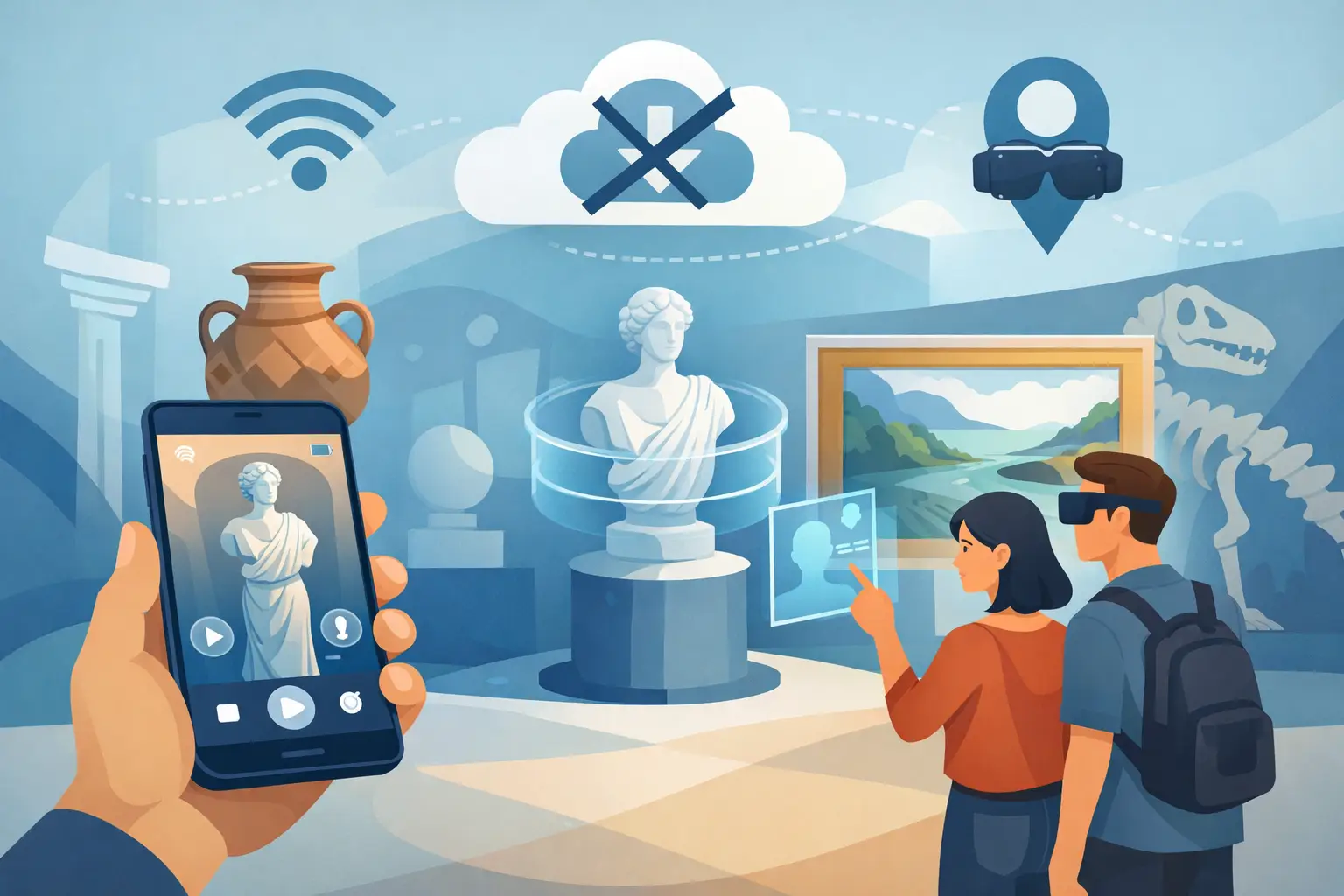
One summer Saturday, a line forms at reception. Visitors want to start their journey without delay, while the team must answer questions, manage tickets and guide groups. For structures looking for visit solutions without downloading, the challenge is very concrete: offering immediate digital mediation, without adding a technical step which discourages part of the public.
A smartphone visit should not become a procedure. When access is based on a simple QR code opening a web page, the visitor can listen, read and watch the content from their browser. There is no account to create, no application to install, no storage space to free up. For a museum, a monument or a tourist office, this choice also reduces equipment and distribution constraints.
Why avoid downloading during a visit?
Downloading an application may seem trivial to a public accustomed to digital uses. In fact, it’s friction. Some visitors have a limited plan, an old phone or full storage. Others simply don't want to install an app that they'll use for an hour. Families, school groups and international tourists do not all have the same level of digital comfort.
A visit solution without downloading meets this diversity of uses. The QR code, placed at reception, on a room support or near a point of interest, opens the route in the visitor's browser. They maintain control of their device, quickly access content and can choose their language without systematically requesting a member of the team.
This principle does not consist of dismissing digital in favor of a simplified version. On the contrary, it allows us to concentrate the effort on what makes mediation valuable: the quality of the story, the clarity of the orientation, the images, the archives, the testimonies and the information useful for understanding the place.
A web app, yes, but designed for the field
Not all browser-accessible experiences are created equal. A simple mobile page can help, but it quickly shows its limits as soon as the route includes several stages, audio content, different languages or areas where the network is weak. The solution must be designed as a real visitor tool, and not as a digitized brochure.
Immediate access must not sacrifice continuity
In an old building with thick walls, in a heritage garden or on a hiking route, network coverage is sometimes patchy. A visit without downloading remains relevant provided you provide an offline mode. The necessary content can then be loaded at the start of the journey, then consulted without relying on a permanent connection.
This nuance is essential. “No download” means no app installation, not no technical preparation. The visitor must be able to launch their visit in a few seconds, while benefiting from a reliable experience where the signal is uncertain.
The right trigger in the right place
The QR code is particularly suitable for reception areas and museum rooms. It is visible, familiar and leaves the visitor the choice to enter into the experience. GPS becomes valuable for urban routes, interpretive trails and large sites: it can offer content as the person approaches a point of interest.
In many projects, these two approaches complement each other. The QR code guarantees simple and controlled access. Geolocation accompanies the wandering and allows the story to be more naturally linked to the territory. The choice depends on the configuration of the site, the attendance and the degree of autonomy expected of the public.
An inclusive experience by design
The personal smartphone facilitates the use of headphones, volume settings and accessibility tools already known to the visitor. But inclusion isn’t just about the device you use. It also depends on the quality of the texts, the readability of the interface, the hierarchy of information and the diversity of the formats offered.
For some audiences, an audio-enhanced transcription is essential. For others, content in sign language, suitable contrasts or particularly simple navigation will make the difference. Foreign languages must also be thought of as a component of the course, not as an extra added late. A relevant digital solution makes it possible to adapt access to knowledge without imposing a uniform experience.
Guideius addresses every digital cultural mediation challenge
Create a multilingual smartphone audio guide that is easy to deploy, accessible and tailored to your museum, heritage site or destination.
Operational benefits for cultural teams
The use of dedicated devices involves purchases, maintenance, recharges, inventories, cleaning and management of losses or breakdowns. For a small or medium-sized structure, these logistics can absorb time and budgets that would be more useful for creating content or welcoming visitors.
Visit solutions without downloading rely on the equipment that visitors already have in hand. The team can spend less time distributing materials and more time supporting people who really need it. This development does not mean that we must abandon all alternatives: an establishment welcoming audiences without smartphones or without digital autonomy must provide a one-off loan, printed materials or additional human mediation.
The objective is not to transfer responsibility to the visitor. This involves offering mostly independent access, while maintaining inclusive reception solutions. This approach is often fairer than a single model that is expensive and difficult to maintain.
An administration accessible to non-specialists
A cultural tour evolves: a room temporarily closes, a work is loaned, a schedule changes, a new thematic visit is created. If each modification requires complex technical intervention, the tool quickly becomes restrictive.
A well-designed platform allows teams to update content, organize steps, add a language or correct information without development skills. Simplicity of administration does not reduce editorial ambition. It gives heritage professionals the ability to bring their story to life through the seasons, exhibitions and research.
Usage statistics also provide a useful benchmark. They allow you to observe the number of starts, the languages consulted or the points which arouse the most interest. This data does not replace field feedback, but it helps to adjust a route with discernment. In a public or parapublic context, their collection must remain proportionate, transparent and respectful of privacy.
Design a course worth opening
Technology makes access easier, but it alone doesn’t create a good visit. A QR code will only arouse interest if it provides access to identifiable and useful content. Clear signage, a simple promise and appropriate listening time are often more effective than a multiplication of features.
Before choosing a solution, it is useful to define the role of the route. Should it offer a first thirty-minute reading, delve deeper into a permanent collection, guide an independent walk or make a site more accessible to audiences far removed from the cultural offering? The answer determines the number of steps, the media format, the choice of languages and the possible need for offline operation.
The writing deserves special attention. Orally, a text must breathe, describe without overloading and leave room for viewing. Short, embodied sequences linked to a visible detail often work better than too dense commentary. Multimedia content can enrich the subject when it provides an archive, a comparison or a complementary voice, rather than diverting attention from the place.
Guideius supports this logic with routes accessible by QR code or GPS, which can be administered by teams and enriched with audio, visual, multilingual and inclusive content. The challenge remains the same: putting digital technology at the service of transmission, without burdening the daily life of cultural structures.
Choose a solution adapted to your site
The best choice rarely depends on a single feature. A local museum will perhaps favor speed of deployment and autonomy of reception. An outdoor heritage site will give decisive importance to GPS and offline mode. A tourist office will look for the ability to make several circuits and several languages coexist. In all cases, it is necessary to check that the tool remains understandable for both the visitor and the administrator.
It is also relevant to evaluate the economic model over time. Beyond the initial cost, the teams must know the maintenance conditions, the possibilities for development, editorial support and data control. A simple solution is not the one that offers the fewest functions: it is the one that precisely meets the needs of the site without creating disproportionate technical dependence.
A successful visit without downloading is ultimately measured by a very simple gesture: the visitor scans, understands where he is, then takes the time to listen and observe. When technology fades behind heritage, it becomes a real mediation tool.
Would you like to apply these ideas to your site?
Guideius helps deploy multilingual audio tours with QR codes, GPS, offline mode, multimedia content and privacy-friendly analytics.