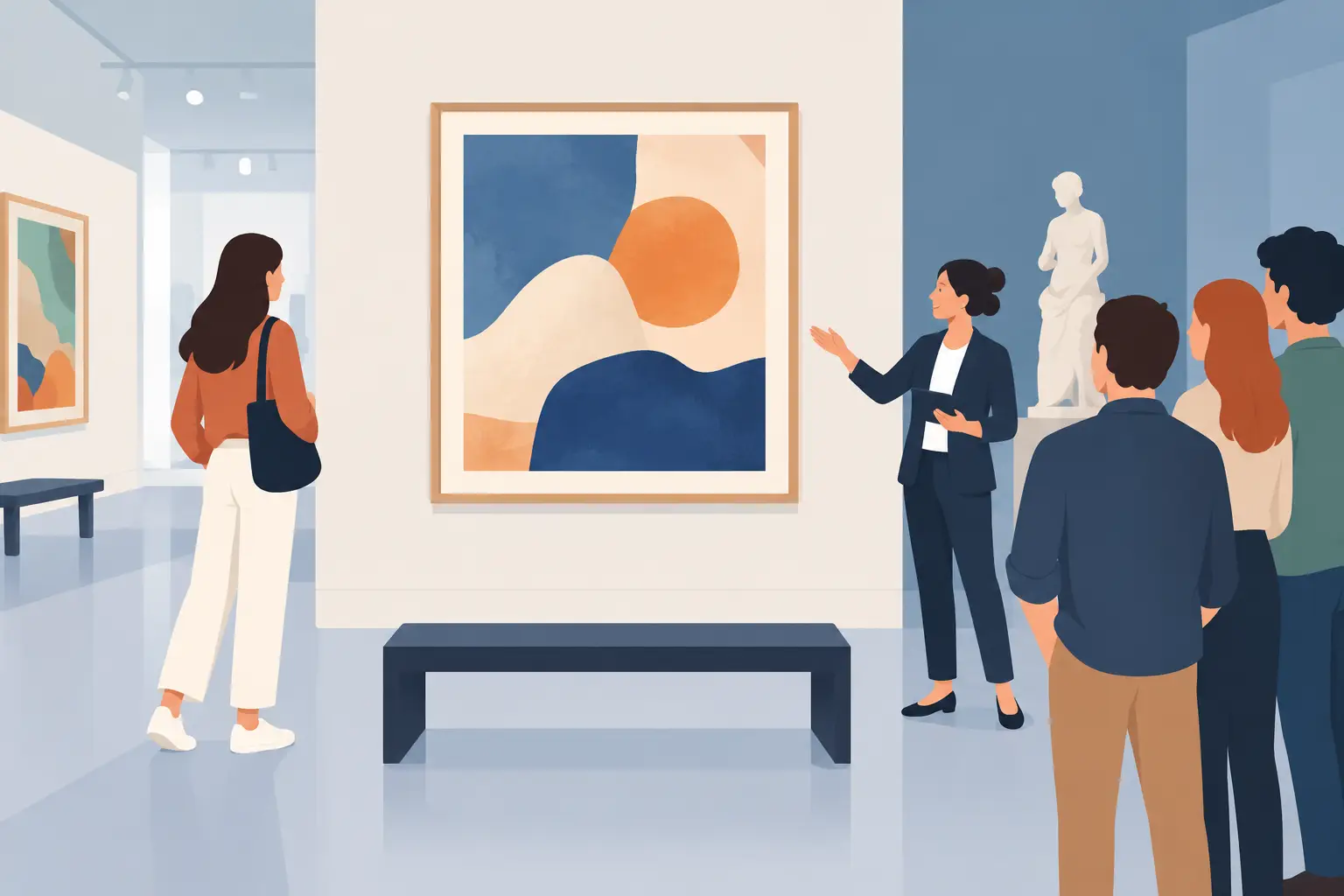
One summer Saturday, a family arrives ten minutes before closing. A school group is waiting for its leader. A foreign couple wants to understand the collections in their language. Faced with these very concrete situations, the question “free visit or human mediator” cannot be resolved by an opposition of principle. It questions the capacity of a cultural site to welcome varied audiences, to transmit accurately and to organize its resources over time.
The self-guided visit is not a visit without accompaniment. The human mediator is not the only guarantor of a quality experience. Everyone meets different expectations, with strengths and limitations that it is useful to face. For many museums, heritage sites and tourist offices, the most relevant response consists less of choosing a side than of building complementary mediation.
Free visit or human mediator: a false opposition
Human mediation remains irreplaceable when it creates a relationship. A guide or mediator can observe the reactions of a group, reformulate an explanation, welcome an unexpected question, connect an object to the personal story of a visitor. This presence gives a particular depth to the discovery, particularly for school groups, restricted audiences, thematic visits or moments of meeting with locals.
But this wealth has its constraints. It depends on schedules, staff numbers, available languages and the ability of visitors to be present at a specific time. In a small structure, maintaining frequent guided tours can represent a significant burden. The time for preparation, animation, coordination and training should not be underestimated.
The self-guided visit, when well thought out, fulfills another promise: that of autonomy. It allows you to stop longer in front of a work, to follow your own pace, to choose a short or in-depth route and to visit outside of group times. It also responds to a simple fact: some visitors prefer to explore without being part of a group.
The real challenge is therefore not to replace humans with digital technology. Visitors should not be left alone when faced with insufficient content or signage that says nothing. A quality self-guided tour is an editorialized experience, designed to guide without imposing.
What human mediation brings to the journey
A mediator does not only provide information. He creates listening conditions, gives depth to a story and can approach sensitive subjects with nuance. On a place of memory, in an archaeological site or within a complex exhibition, this ability to adapt is essential. It also makes it possible to adjust the level of speech for a group of children, enthusiasts or visitors unfamiliar with cultural codes.
The accompanied visit also promotes a collective experience. The exchanges between participants, spontaneous questions and shared observations are part of its value. For a community or an institution that wishes to bring local heritage to life, these times of dialogue are precious.
However, this value does not mean that every visitor must necessarily be guided. Imposing a single format can exclude people who have limited time, do not understand the language of the visit, wish to avoid a group or need a calmer pace. Human mediation is particularly effective when it is offered at the right time, to the right audience and with the necessary means to carry it out properly.
Situations where it makes the difference
Guided tours are often a priority for large groups, schools, one-off events and routes requiring in-depth interpretation. They also find their place during inclusive visits designed with associations or during meetings highlighting local expertise. In these contexts, the human presence does not just accompany: it becomes the very heart of the experience.
Guideius addresses every digital cultural mediation challenge
Create a multilingual smartphone audio guide that is easy to deploy, accessible and tailored to your museum, heritage site or destination.
A free visit that really conveys
Freedom of movement must not mean freedom left to chance. An independent visitor needs clear guidelines: where to start, how much time to allow, what are the essential points, how to go deeper if desired. A digital audio guide can perform this function discreetly, from the visitor's personal smartphone.
The audio format is particularly suitable for heritage places. It leaves the gaze available for architecture, landscapes, objects or works. It also avoids overloading spaces with texts that are too long. Archival photos, videos, maps or quizzes can complement the story when it really serves understanding, rather than multiplying the effects.
Multilingualism represents another decisive advantage. A structure that cannot provide human visits in four or five languages can still offer quality content to its international visitors. The same goes for individual arrivals out of season, passing visitors and audiences who choose an off-season slot.
Accessibility must be integrated into the design. Transcriptions, adapted content, clear language, choice of pace and features compatible with different needs help to open the course to more people. Autonomy is not isolation: it is the possibility for each person to choose the way in which they wish to access knowledge.
Think about hybrid mediation, according to your uses
The most fruitful model combines a solid open house base with targeted human meetings. Digital technology ensures continuity of reception, while the team focuses its energy where its presence brings the most value. An individual visitor can follow an audio tour upon arrival; a reserved group benefits from a lively visit; a family can take a fun route; an expert audience can go further thanks to in-depth content.
This organization also has an operational scope. It limits dependence on fixed schedules, reduces frustrations linked to full visits and avoids mobilizing an agent to answer the same orientation questions all day long. This does not diminish the role of teams. On the contrary, they can be more available to welcome, advise, resolve a difficulty or engage in a conversation with visitors who wish to do so.
For structures with limited resources, the challenge is to avoid a double penalty: investing in an expensive system, then lacking the time to run it. A solution accessible from visitors' phones, activated by QR code or geolocation, avoids the purchase, loan, cleaning and maintenance of a fleet of dedicated equipment. An offline mode remains particularly useful on rural sites, outdoor courses or buildings with thick walls.
Starting from field questions
Before deploying a route, it is useful to look at the attendance realities. When do visitors arrive? What languages do you hear at reception? Which spaces are misunderstood? What questions come up most often? Which audiences do not participate in existing guided tours?
These answers make it possible to define a realistic format. A small museum does not need to produce forty comments to offer a relevant experience. A route of eight to twelve stages, well written and clearly signposted, can already change the quality of a visit. Conversely, a very large site may need to provide several routes, with distinct durations and reading levels.
Usage statistics then provide useful insight: languages selected, stages listened to, average duration, most followed routes. They do not replace field feedback or team observation, but they help to develop content with concrete data. This measure must remain proportionate, transparent and respectful of visitors.
Digital must support teams, not alienate them
A mediation tool only has value if it remains manageable by the team using it. Reliance on a service provider to correct a sentence, add an event or update a schedule unnecessarily slows down projects. A simple interface, included maintenance and editorial support allow structures to keep control of their story.
It is in this logic that Guideius offers multilingual audio courses designed for the realities of cultural places: deployment without dedicated hardware, offline operation, multimedia content and accessibility tools. Technology does not replace mediation. It makes mediation available more often, for more audiences, while preserving human resources where they matter most.
The right choice is not between a recorded voice and a human voice. It consists of making each person heard when they are most useful, so that each visitor can encounter the heritage at their own pace and each team can transmit better, without exhausting themselves.
Would you like to apply these ideas to your site?
Guideius helps deploy multilingual audio tours with QR codes, GPS, offline mode, multimedia content and privacy-friendly analytics.