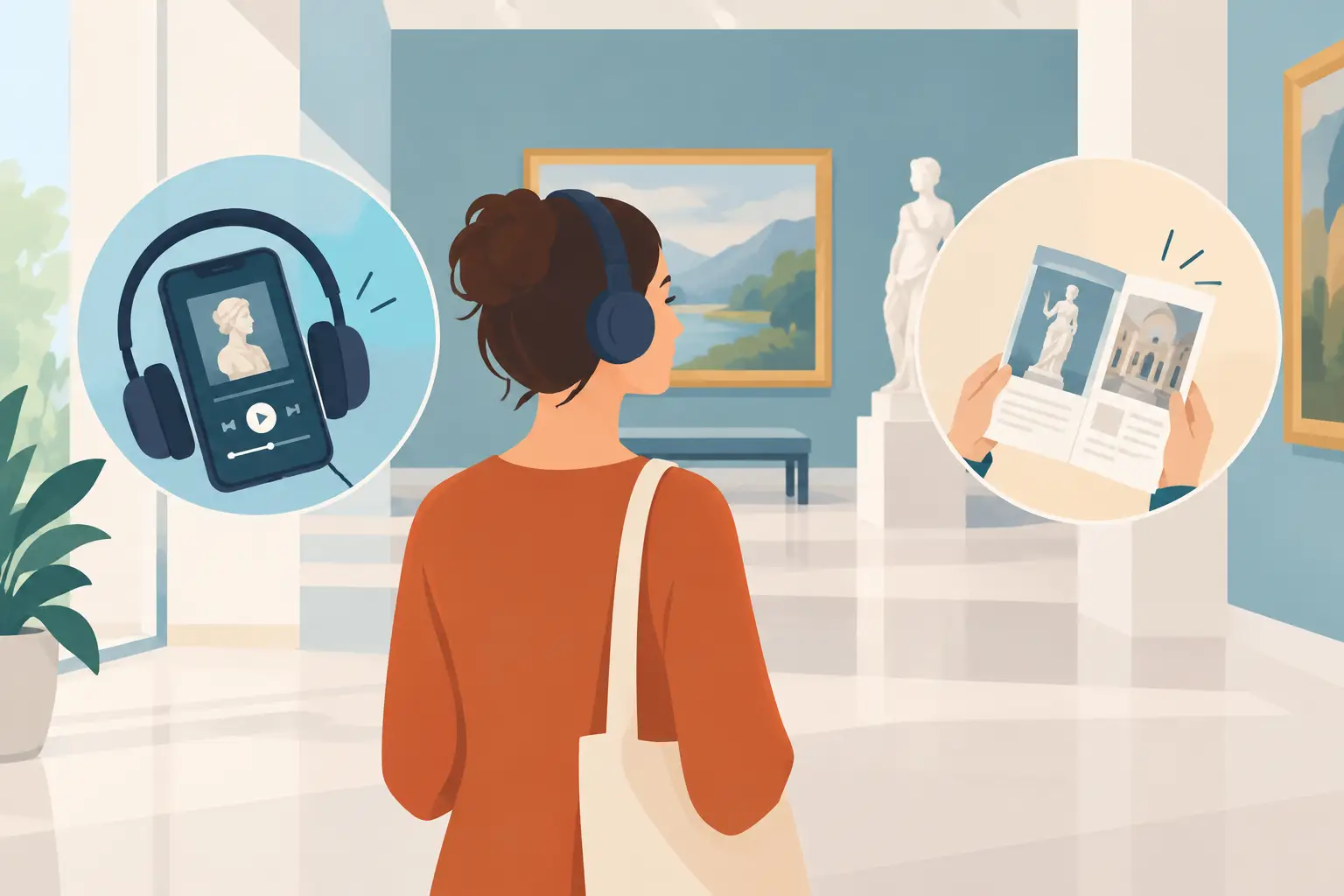
A booklet that remains closed in a pocket, a family that cannot find the version in their language, a room where the text becomes difficult to read: the choice between audio visit or paper booklet involves much more than a simple mediation support. It influences the quality of the welcome, the working time of the teams, the accessibility of the route and the capacity of a site to transmit its history to varied audiences.
For a museum, a monument, a tourist office or a community, the issue is not to declare paper obsolete. The libretto retains real qualities. But visitors' expectations, budgetary constraints and the possibilities offered by digital technology require each solution to be evaluated based on field usage.
Audio tour or paper booklet: two very different experiences
The paper booklet offers autonomous, tangible and immediately readable mediation. It gives the visitor a personal reading rhythm, the possibility of returning to a page, taking notes or keeping a memory of their visit. In certain places, notably for a tour for young audiences, a short temporary exhibition or a visit requiring precise diagrams, it can remain particularly relevant.
Its main pitfall is density. Faced with a label, a work or a landscape, reading requires you to divide your attention between the document and what you are looking at. The texts must therefore be short, hierarchical and very well laid out. Without this, the booklet risks becoming an information document rather than a real visitor companion.
The audio tour is based on another principle: it frees the gaze. The voice can guide observation, establish a context, make a testimony heard or introduce a sound ambiance. It is particularly suitable for heritage stories, urban routes, archaeological sites and collections whose understanding benefits from storytelling.
Audio doesn't solve everything, however. Too long content, a monotonous tone or poorly indicated triggering can discourage listening. A good audio tour is not reading a booklet out loud. It assumes writing designed for the spoken word, tight sequences and real freedom to choose the stages that interest the visitor.
The real criterion: the public and the visiting situations
The right choice depends first on how visitors frequent your site. In a small museum where the path is calm and the works require detailed observation, a well-designed paper support can meet some of the needs. In a city, an open-air site or a large monument, audio often provides greater comfort: it accompanies walking and avoids handling leaves in the wind, in the rain or in a crowd.
The question of languages is just as decisive. Producing, storing and updating several printed versions quickly becomes a burden, especially when visitor volumes vary according to the seasons. A digital visit makes it possible to offer multilingual courses from the same interface, without multiplying reprints or requiring the public to request the correct document at reception.
Accessibility calls for a more detailed analysis. A booklet can be adapted in large print, in easy-to-read and understand language or in a Braille version, but each of these versions requires specific production and constant availability. Audio facilitates access for people who are visually impaired or who are tired of reading, provided it offers clear navigation, associated texts when useful and carefully designed content. For people who are deaf or hard of hearing, audio alone is not enough: transcriptions, subtitles and visual media must complete the system.
The most inclusive solution therefore does not pit one medium against another. It provides several entry points into the contents, depending on the capacities, preferences and concrete conditions of visit.
Guideius addresses every digital cultural mediation challenge
Create a multilingual smartphone audio guide that is easy to deploy, accessible and tailored to your museum, heritage site or destination.
Costs and operating expenses: looking beyond the unit price
Paper often seems less expensive at first. However, the cost of a booklet is not limited to its printing. This includes writing, translation, layout, reprints, storage, distribution, unsold items and the team's time spent checking inventory. As soon as information changes - timetables, restoration, loan of work, change of route or correction - part of the print run may become unusable.
The digital audio guide requires a design investment: writing, recording, translation, integration and testing on the route. This work should be planned seriously, because it determines the quality of the experience. On the other hand, once the route is published, adjustments are simpler. A step can be modified, a language added, seasonal content activated without having to destroy or reprint documents.
The choice of material also changes the equation. Dedicated audio guides involve purchase, loan, recharge, cleaning, maintenance and loss management. A accessible web app by QR code allows the visitor to use their own smartphone, which greatly reduces these constraints. To preserve equal access, it remains desirable to offer a limited loan solution or a paper alternative to people who are not equipped or uncomfortable with digital technology.
This hybrid approach avoids two dead ends: excluding part of the public in the name of modernization, or maintaining heavy logistics to respond to uses that could be simplified.
What digital brings to field mediation
A smartphone audio tour can do more than play audio tracks. It can combine archive images, plans, short videos, quizzes or additional content. On an outdoor route, the GPS can suggest a nearby stopover; in a closed place, a QR code can trigger a sequence when the visitor needs it. Offline mode remains essential in rural areas, old buildings with thick walls or spaces where network coverage is uncertain.
For teams, the value also lies in administration. A tool adapted to non-specialist professionals makes it possible to maintain control of content, correct information quickly and develop a course without systematically depending on a technical service provider. The usage statistics provide valuable feedback: languages consulted, steps most listened to, completion rate or moments of abandonment. This data does not replace direct interactions with visitors, but it helps prioritize improvements.
This collection must remain proportionate and transparent. In the cultural sector, trust is an essential asset. Choosing a solution that respects data, without unnecessary tracking, extends the values of public service, transmission and hospitality supported by many establishments.
When the paper booklet remains the best choice
The paper remains a solid response when it clearly corresponds to the mediation project. This is the case of an illustrated game booklet given to children, an exploration notebook intended to be annotated, a scientific document that the visitor wishes to take away, or a site where the use of the telephone must be limited for reasons of conservation, meditation or security.
It can also play a useful role as a preparation or extension support. A summary plan, a few chronological markers or a selection of works can complete an audio tour without trying to reproduce its entirety. This complementarity gives the visitor the choice while avoiding the costs of an exhaustive booklet.
The main thing is not to confuse the presence of a document and the quality of mediation. A dense leaflet, distributed out of habit, does not automatically improve the visit. Conversely, a few well-targeted pages can be very effective if they meet a specific intention.
Building a sustainable choice for your establishment
Before choosing, observe your journey as it is actually experienced. What audiences did you welcome? Which languages are asked most often? Where are visitors hesitant? Do your teams spend time managing, restocking or updating documents? Do you have a reliable connection everywhere, or is it imperative to plan for offline? These questions allow us to move away from an abstract debate between tradition and innovation.
A solution like Guideius makes it possible to deploy multilingual audio tours without a dedicated hardware fleet, with triggers by QR code or GPS, multimedia content and accessibility options. But the tool never replaces editorial work: the best device is the one that serves the uniqueness of the place, its rhythm and its story.
Rather than looking for a winner between paper and audio, design a mediation capable of accommodating the differences. A visitor must be able to listen, read, look, choose their pace and leave with the feeling of having truly encountered your heritage.
Would you like to apply these ideas to your site?
Guideius helps deploy multilingual audio tours with QR codes, GPS, offline mode, multimedia content and privacy-friendly analytics.