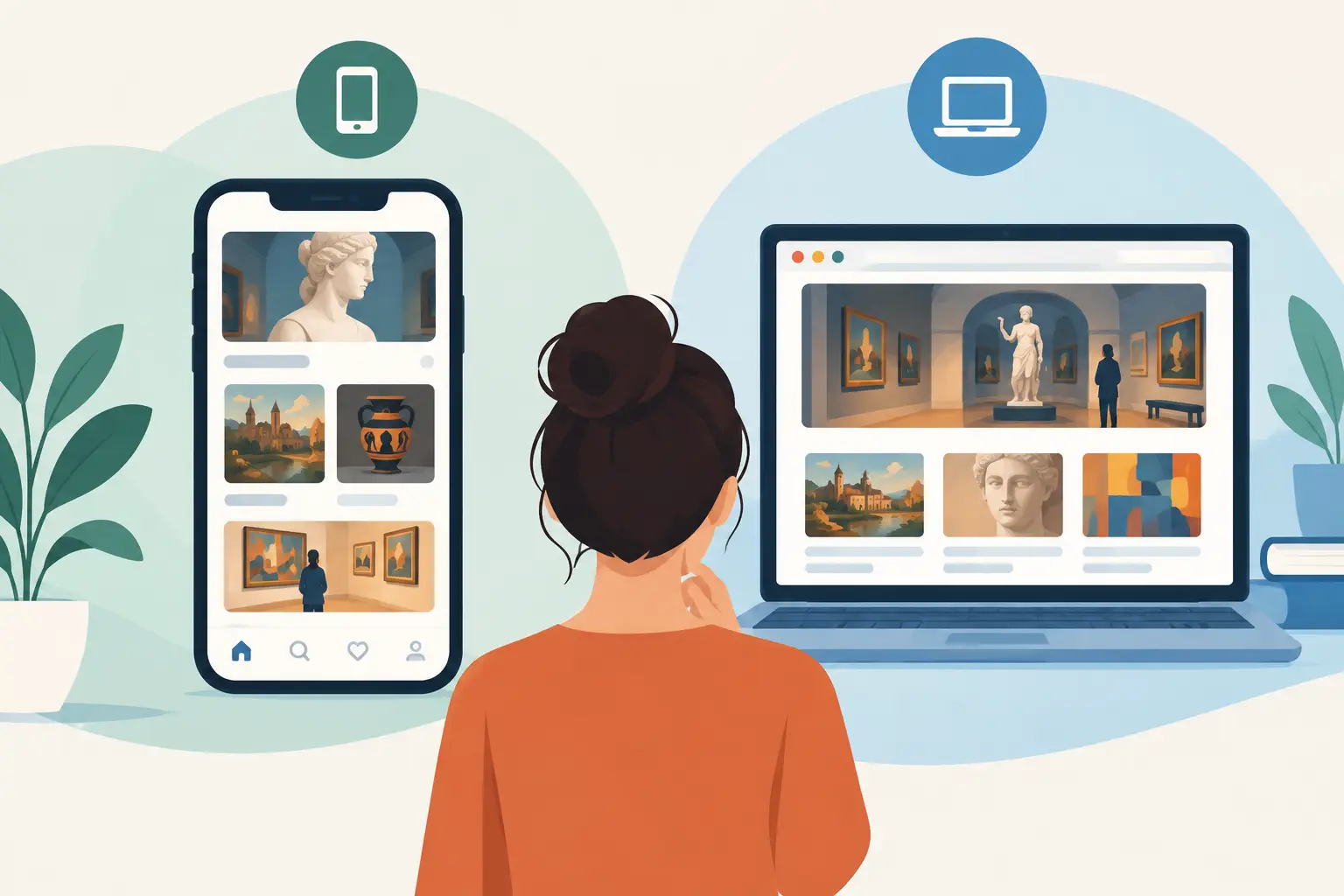
A visitor arrives in front of a castle, a local museum or the starting point of a heritage tour. He scans a QR code, chooses his language and begins his visit in a few seconds. Behind this very simple gesture arises a structuring question for the teams: should we choose a native application or cultural webapp?
This choice is not just about technology. It involves the budget, the administrative capacity of the teams, the accessibility of content, the relationship with data and, above all, the quality of the mediation offered to the public. For many cultural structures, the most relevant response depends less on the apparent sophistication of the tool than on its adequacy with the real uses of the field.
Native application or cultural webapp: two access logics
A native application is software downloaded from an application store and then installed on the visitor's smartphone. It is developed specifically for iOS and Android. This approach can provide a very integrated experience on the phone, with deep access to certain device functions and good offline performance.
A webapp, or web application, opens in the phone's browser. The visitor generally accesses it via a QR code, a short link or a home page. It does not require going to a store or prior installation. Depending on its design, it can also offer downloading of content for offline consultation.
The difference seems technical, but the experience of entering the course changes considerably. Downloading an app involves searching for its name, agreeing to an installation, having enough space, and sometimes creating an account. For a one-off visit, these steps may discourage some of the public. With a webapp, access is immediate: the visitor is already in front of the work, the monument or the landscape that he wishes to understand.
Visitor adoption: reducing obstacles from the start
In cultural equipment, every friction counts. A digital journey only creates value if it is actually used. However, most visitors do not want to install an app intended for a single visit, especially when they are traveling, have a limited connection or are simply looking for quick information.
The webapp responds well to this context. A QR code positioned at reception, on a leaflet or at the start of a route triggers access without a complex procedure. This simplicity is valuable for families, groups, international visitors and audiences unfamiliar with digital tools. It also makes the work of reception agents easier: a short explanation is enough, without having to accompany each person in a facility.
The native application can nevertheless be justified in certain cases. A network of museums, a popular destination or an institution offering a lasting relationship with its audiences may want to unite a community around the same tool. It can then integrate recurring content, programming, advantages or functionalities designed for repeated uses. Downloading becomes more acceptable when the app provides value beyond today's visit.
Offline does not depend on format alone
The idea that only a native application would work without a network is tenacious, but incomplete. A well designed webapp can allow the visitor to download the content before departure, then listen to the audio tracks and consult the media without connection. This is a major issue in monuments with thick walls, archaeological sites, ancient villages, natural spaces or rural routes where mobile coverage varies greatly.
The useful question is therefore not only “application or webapp?” ", but "how do we prepare for use in white zones? ". You must provide a clear invitation to download the route at reception, check the size of the files and test the device over the entire route. An offline mode must remain understandable for the visitor and simple to explain by the teams.
Triggering content deserves the same attention. The QR code is reliable in visiting areas and gives the public control of the rhythm. GPS provides fluidity on urban or wilderness routes, but it requires serious calibration and must take into account the variable precision of phones. Often, the combination of the two modes constitutes the safest answer.
Guideius addresses every digital cultural mediation challenge
Create a multilingual smartphone audio guide that is easy to deploy, accessible and tailored to your museum, heritage site or destination.
Costs, updates and real burden for teams
The cost of creation is frequently at the heart of the arbitration. A native app typically requires two developments, one for iOS and one for Android, as well as regular monitoring of store requirements and operating system updates. Even after it is posted online, it must be maintained to remain compatible, secure and visible.
A webapp is based on a common base accessible from a browser. Developments are published directly: visitors access the updated version without having to download a new version. For a structure with limited resources, this operation reduces dependence on complex technical operations and facilitates the updating of seasonal content, timetables, translations or practical information.
However, it would be simplistic to choose solely on the initial price. The most lasting expense often concerns the life of the route: adding a stage, correcting a text, replacing a visual, adapting an itinerary after work, enriching a language. A relevant solution must allow a non-technical team to carry out these developments, with clear access rights and support when necessary.
This is why administration must be part of the decision criteria. A mediation tool is not successful because it has a lot of functions, but because teams can use the ones they need without mobilizing a service provider for each modification.
Accessibility and inclusion: requirements to be integrated from the design stage
The choice between native application and webapp does not, in itself, guarantee an accessible experience. Accessibility depends on concrete editorial and technical choices: readable contrasts, adjustable text size, consistent navigation, subtitles, transcription of audio tracks, audio description, available languages and attention to easy-to-understand content.
The webapp has a practical advantage: it relies on the browser and the settings already used by the visitor on their smartphone. But this advantage is only valid if the interface respects good accessibility practices. A native application can also offer an excellent inclusive experience, provided that these needs are integrated into the specifications, and not added as an afterthought.
For heritage stakeholders, the issue goes beyond compliance. Accessible mediation really broadens audiences, promotes autonomy of visit and affirms that cultural knowledge must be able to circulate to everyone. Multimedia formats, multilingual versions and quizzes can enrich this transmission, without replacing the quality of the story, voices and interpretation.
Data, ethics and usage measurement
Digital journeys produce useful information: number of starts, languages consulted, steps most listened to, completion rate or moments of abandonment. This data makes it possible to improve an itinerary, better scale the reception and understand what interests the public.
However, they must be collected with discernment. For a public, associative or heritage structure, it is essential to know what data is collected, where it is hosted, who accesses it and for what purpose. The usage measure must serve to improve mediation, not transform the visit into a surveillance device.
A webapp also limits the obligation to create an account, which is often unnecessary for a one-off visit. Less data requested means a more direct route and a more respectful approach. When geolocation is used, it must remain proportionate to the function offered and understandable to the visitor.
How to choose according to your cultural project
A native application is relevant if your project is based on regular use, a sustainable community, very specific mobile functions or an extensive brand strategy. However, it involves an investment in design, distribution and maintenance to be anticipated over several years.
For a museum audio guide, a visit to an old center, a heritage site or a tourist route, the webapp often responds more directly to the constraints on the ground. It avoids the management of dedicated hardware, allows quick access to visitors' personal phones and facilitates content updating. With offline, multilingual, media and statistics, it can cover the essential needs of rich mediation without burdening the organization.
Solutions like Guideius are part of this logic: giving cultural structures the means to deploy accessible and manageable audio courses, without requiring internal digital expertise. The right tool remains the one that supports the mediation project rather than imposing it.
Before deciding, look at your site as it is: network quality, average visit duration, diversity of audiences, frequency of updates, availability of teams and accessibility ambitions. Sober technology, easy to use and designed to last, leaves more room for what is essential: telling the story of heritage accurately and allowing each visitor to make it their own.
Would you like to apply these ideas to your site?
Guideius helps deploy multilingual audio tours with QR codes, GPS, offline mode, multimedia content and privacy-friendly analytics.