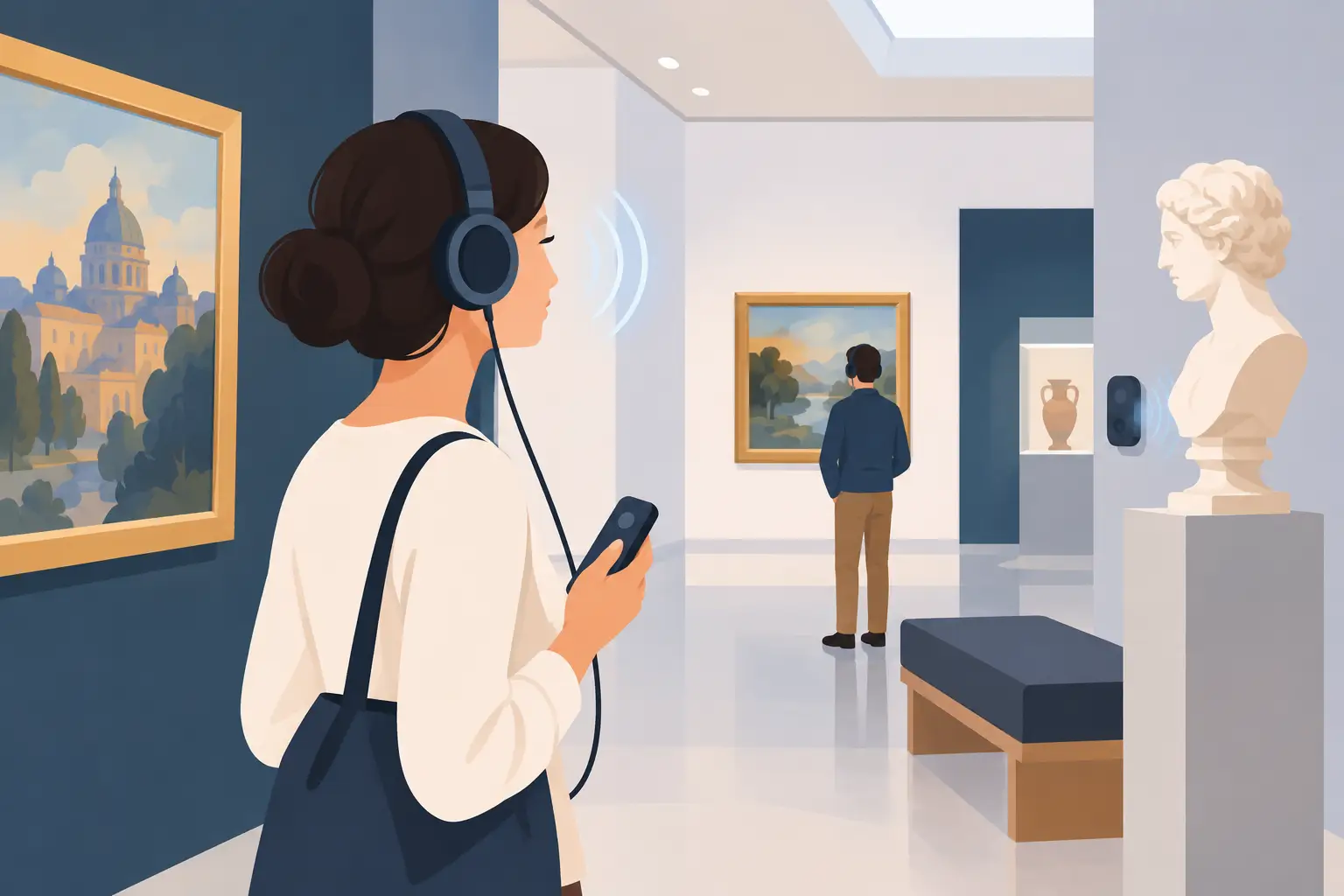
A visitor pausing in front of an artwork, a monument or a display case is looking for more than information. They want a point of reference, a story and the freedom to explore at their own pace. Museum audio solutions can meet this need, provided they do not make work harder for teams or create barriers for visitors. The right audio tool for a museum or heritage site should therefore support interpretation first.
The decision is no longer simply about buying audio guides. It shapes how a venue welcomes people who speak different languages, makes content accessible, shares its collections and manages staff time and budgets. Smartphone solutions offer practical opportunities, but they need to be assessed against real visiting conditions.
Why museum audio solutions are changing
For a long time, an audio guide meant a device borrowed at reception. This model still has advantages in some settings, particularly when visitors do not use smartphones or the visit needs to be fully supervised. However, it requires a stock of devices, daily charging, cleaning, maintenance, handling losses and replacing equipment.
For small and medium-sized organisations, these tasks can take more effort than managing the content itself. An audio solution accessed on visitors' own phones removes much of this logistics work. A QR code at the entrance, in a gallery or beside a point of interest makes it easy to start. On an outdoor route, GPS can trigger the right commentary in the right place.
The change is not just technical. It frees up time for reception and interpretation teams. Translations, scholarly information and temporary tours can also be updated without replacing equipment. The aim is still to provide high-quality support: digital tools complement human contact where audio adds genuine value.
The criteria that matter in practice
A useful solution is judged less by the length of its feature list than by how well it works during actual visits. Limited connectivity, small teams, varied audiences, temporary exhibitions and changes to signage are everyday realities for many venues.
An easy start for visitors
Starting the tour should be straightforward. If visitors have to create an account, download several items or spend too long looking for the right content, some will give up. QR codes are particularly suitable where staff want to minimise the explanations needed at reception. They should lead clearly to the desired language and tour.
The interface matters too. Readable buttons, short instructions, consistent navigation and the ability to resume listening help visitors explore independently. People do not always follow the route planned by the institution: they may choose a gallery, linger or go back. A good experience makes room for that freedom.
A multilingual welcome
Offering several languages involves more than placing translations side by side. Cultural references, track length and vocabulary need adapting. A family version, for example, serves different needs from an in-depth version for knowledgeable enthusiasts.
Start with the languages most useful to your actual visitors, then expand the offer. Usage statistics can help decide which translations to develop or update. This gradual approach protects the budget without limiting the ambition to welcome more people.
Reliable access, including offline
Mobile reception cannot be taken for granted in a thick-walled castle, on a heritage trail or in an old building. Offline access is not a minor convenience: it can determine whether the visit runs smoothly. Visitors should be able to download content before setting off, or use a solution designed to cope with poor coverage.
Check this during the demonstration stage. Test the tool in galleries, gardens, outdoor routes and reception areas on different phones. A technical promise only matters if it holds up in the venue's own conditions.
Management tools that suit cultural teams
Collection managers, interpretation staff and reception teams should not need a provider's help to correct opening times, change an image or publish a new audio stop. A clear management interface lets teams stay in control of their content while respecting defined access permissions.
Simplicity does not mean doing without support. Creating an audio tour involves editorial decisions: choosing stops, writing for listening, recording, translating, selecting images and planning signage. Venues benefit from a partner who can help organise this work and maintain the solution over time.
Guideius addresses every digital cultural mediation challenge
Create a multilingual smartphone audio guide that is easy to deploy, accessible and tailored to your museum, heritage site or destination.
Plan accessibility from the start
An audio tour can improve inclusion, but it does not guarantee it. Some visitors need transcripts, video subtitles, image descriptions, simpler language or clearer navigation. Others benefit from audio because it reduces the effort of reading or supports a visit while moving around.
Considering these needs at the design stage improves the experience for everyone. Clear writing helps people unfamiliar with museum conventions. A suitable playback speed and short tracks make it easier to stay engaged. Clear visual cues help visitors find their way.
Accessibility also involves equipment. Using visitors' own phones is convenient for many people, but it must not exclude those without a smartphone, enough battery charge or headphones. Depending on visitor needs and the venue's mission, it may be appropriate to keep a few devices available to borrow, offer a printed alternative or provide shared listening at selected points. The most inclusive choice depends on the place and its visitors.
Create content people actually want to listen to
Reading an exhibit label aloud does not automatically make good audio commentary. Listening calls for writing with a stronger voice, a direct approach and a clear rhythm. Each track should have a purpose: draw attention to a detail, explain the context, share a personal account, connect an artwork to a place or encourage further exploration.
Length deserves particular attention. Tracks of one to three minutes often suit stops in front of artworks, while a gallery introduction may be slightly longer. It depends on background noise, how much there is to see and the audience. A tour with twenty very short commentaries can feel more engaging than a linear forty-five-minute visit.
Multimedia usefully complements audio when it clarifies the subject: an archive photograph, a map, an enlarged detail, a video demonstrating a craft or a quotation. It should not turn the visit into prolonged screen time. In a museum, visitors should still have time to look at objects, experience the spaces and meet people.
Measure usage to improve interpretation
Usage data is valuable when it helps teams make practical decisions. How many visitors started the tour? Which languages did they choose? Which stops attracted the most listening? When did visitors stop following the route? These indicators can guide changes to signage, track length or the order of stops.
Measurement should remain proportionate and respectful of visitors. Cultural institutions, particularly public and publicly supported ones, benefit from tools that explain how data is handled and collect only what is needed. Useful insights do not require tracking people individually.
Statistics do not replace observation. Feedback from reception staff, conversations with visitors and tests with particular audiences often reveal what a dashboard cannot: a confusing instruction, a badly placed QR code, a hard-to-reach stop or a translation that needs improving.
Choose a lasting solution, not just a promise
The cost of an audio solution goes beyond a subscription or licence. Consider the equipment no longer needed, staff time saved at reception, included maintenance, content creation, future development and the independence given to teams. Pricing that scales with the project often suits a venue starting with one tour before adding a temporary exhibition, a town walk or a second site.
Look at customisation too. An organisation seeking a strong visual identity may need a white-label experience, while a smaller venue may prioritise a quick launch. In either case, keep the technology focused: the tool should meet a clear interpretation need, not accumulate rarely used features.
Guideius follows this approach with multilingual smartphone audio tours that teams can manage without technical expertise, including QR codes, GPS, offline access, enriched content and accessibility features. For teams, the value lies in reducing equipment management while keeping control of the venue's own story.
The best choice is not the one that promises the most digital effects. It is the one that helps each visitor, in their own language and at their own pace, pay closer attention to what the place has to share.
Would you like to apply these ideas to your site?
Guideius helps deploy multilingual audio tours with QR codes, GPS, offline mode, multimedia content and privacy-friendly analytics.