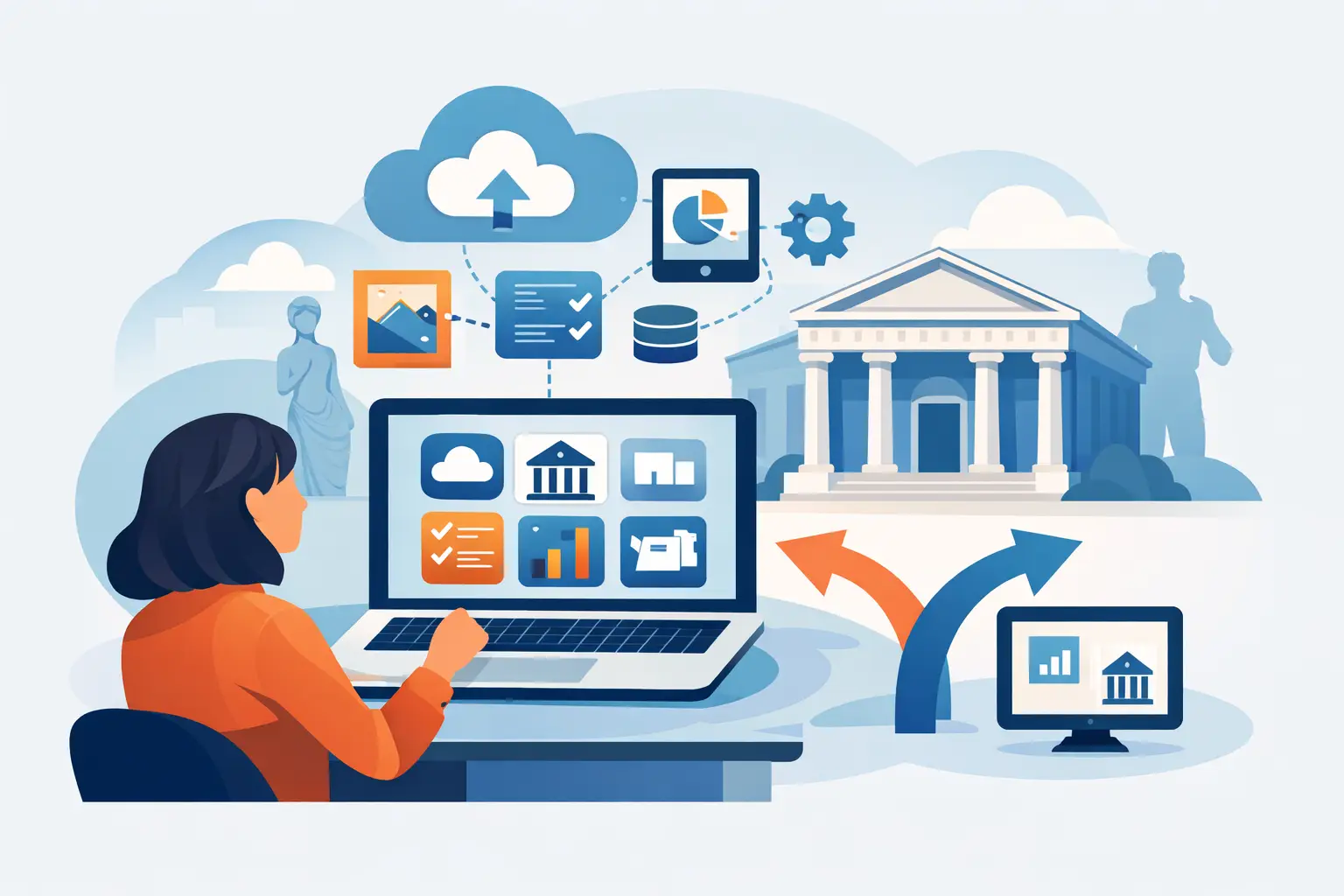
A visitor enters a room, scans a QR code and immediately accesses the correct comment, in their language, on their own phone. For the team, no distribution of devices, no helmets to disinfect, no stock to recharge between two slots. This is the concrete promise of a well-thought-out SaaS solution for museums: making digital mediation a useful, accessible and realistic service to use on a daily basis.
However, not all platforms meet the same needs. Between an application that is expensive to develop, a simple audio player and a complete route solution, the choice depends on attendance, audiences, available content and the human resources of the structure. The challenge is not to add digital technology for its own sake, but to strengthen the encounter between visitors, collections and stories of the territory.
Why the SaaS model responds to the realities of museums
SaaS, or software accessible online by subscription, prevents a museum from carrying the technical weight of a digital tool alone. The platform is maintained, updated and secured by its publisher. The cultural team can thus concentrate on what it knows best: selecting works, building a coherent itinerary, writing texts and recording quality content.
This approach responds to a common reality in museums, heritage sites and tourist offices: the teams are small and do not always have a dedicated IT department. A hosted solution limits initial investments, reduces maintenance needs and allows the offer to be adjusted as the project evolves. A temporary route, a new exhibition or a foreign language version can be added without starting from scratch.
However, the SaaS model is not an automatic answer to everything. An establishment with very specific integration constraints with a ticket office, a complex interactive scenography or a particularly restrictive IT policy will have to check the possibilities of interfacing, hosting and customization. Simplicity should never mean lack of control.
The functions that really make the difference in the field
An effective mediation platform is judged less by the length of its technical sheet than by its ability to accompany a real visit. In a museum, the network may be weak in certain rooms, visitors do not all have the same digital uses and reception staff need to explain the system in a few words.
Immediate access, without hardware to manage
The QR code is often the simplest starting point. Placed at reception, on a card or in a tour support, it gives access to the course without the need to download physical equipment. The visitor uses his smartphone, a gesture now familiar to a large part of the public.
GPS triggering usefully complements this device for outdoor routes, historic centers, gardens or memorial routes. It allows you to associate content with a place and offer a more independent experience. In a closed museum, however, GPS alone will rarely be sufficient: the QR code remains more precise and easier to report.
The absence of audio guide park represents a tangible gain. It reduces the purchase of equipment, loan and return time, maintenance, cleaning and losses. It should not exclude people without a smartphone or without digital autonomy: inclusive mediation always provides support at reception, printed alternatives or a limited number of loan solutions depending on the audiences welcomed.
Offline mode, a condition of continuity
A visit should not depend on the quality of the mobile network. In ancient buildings, underground spaces, rural sites or monuments with thick walls, an unstable connection can interrupt the experience just when the visitor needs it.
Pre-downloading the contents or their offline availability secures the journey. This feature is particularly useful for international visitors, who may want to avoid using their mobile data. It also brings a form of sobriety: fewer network requests, less frustration, more continuity in listening.
Content adapted to the diversity of audiences
A good digital audio guide is not limited to a succession of sound tracks. It can combine audio, archive images, texts, short videos, maps or quizzes. Each media must have an editorial function. An old photograph can make an urban transformation visible. A detailed image can guide the eye towards an artistic technique. A quiz can maintain the attention of a family audience, without transforming the visit into an obligatory game.
Multilingualism is just as strategic. It broadens the reception of foreign visitors and makes it possible to better promote a territory to its tourist audiences. But translating is not always enough. The cultural references, the duration of the content and the level of language must be adapted to each audience to preserve the quality of the mediation.
Guideius addresses every digital cultural mediation challenge
Create a multilingual smartphone audio guide that is easy to deploy, accessible and tailored to your museum, heritage site or destination.
Accessibility: the feature that changes the scope of the journey
Accessibility should not be treated as an option added at the end of the project. It transforms the ability of a museum to welcome visitors with varied needs, including people who are hearing impaired, visually impaired, dyslexic, neuroatypical or those who are less comfortable with reading.
Subtitles, transcriptions, enhanced contrast, adapted character sizes, content in sign language, simplified reading or easy-to-use controls: these choices often improve the experience for everyone. A transcription allows, for example, to consult a comment in a noisy space. A readable interface helps an elderly person as much as a visitor in a hurry.
However, technical accessibility must be distinguished from cultural accessibility. A compliant interface will not replace clear content, contextualized explanations and routes that respect the visiting rhythms. Technology can facilitate access, but it does not eliminate the need for real mediation work.
How to choose a SaaS solution for museums
The right choice starts with simple questions: What problem do you want to solve? Is it a question of replacing aging audio guides, of offering a first digital offer, of better welcoming foreign visitors or of making an outdoor route autonomous? The answer determines priorities.
A small seasonal structure will often look for quick handling, understandable pricing and included maintenance. A municipal museum with several exhibitions may need a more structured administration, separate access rights and comparable statistics. An expanded heritage site will give more weight to GPS and offline.
Before signing, it is useful to evaluate the solution according to four concrete criteria: ease of administration, visitor experience, data guarantees and quality of support. An intuitive interface is essential if content must be updated by non-technical teams. A demonstration should not only show the screens: it must allow the route to be tested under real visit conditions.
The issue of data deserves particular attention for public and parapublic structures. Where are they hosted? What visitor data is collected? Are they anonymized? Who can access it? Useful usage statistics can inform editorial choices, provided that the principles of minimization and transparency are respected.
Measure usage without reducing the visit to numbers
Course attendance data is valuable when it is used for mediation. The number of starts, the most consulted languages, the most listened to stages or abandonments can reveal a signage problem, excessive duration or the particular interest of a work.
However, these indicators do not tell the whole story. A poorly launched track can be poorly positioned, but it can also correspond to niche content essential to certain visitors. The figures must therefore be cross-referenced with feedback from agents, in-room observations and comments from the public. Data is a tool for improvement, not a verdict on the cultural value of content.
Deploy without burdening teams
The success of a project is often due to its editorial preparation. It is better to start with a narrow, clear and well-signposted route than with fifty pieces of content that are difficult to maintain. Define the visit objectives, the tone of the comments, the priority languages and the role of each media before opening the tool.
Support then counts as much as technology. Guideius, for example, combines an administration designed for cultural teams with support in creating courses. This approach helps structures move forward without depending on internal digital expertise, while maintaining control of their content.
A useful solution is one that is integrated into the daily gestures of reception, mediation and communication. When it remains simple to update, respects visitors and makes the stories more accessible, it becomes a natural extension of the museum rather than another screen between the work and the public.
Would you like to apply these ideas to your site?
Guideius helps deploy multilingual audio tours with QR codes, GPS, offline mode, multimedia content and privacy-friendly analytics.