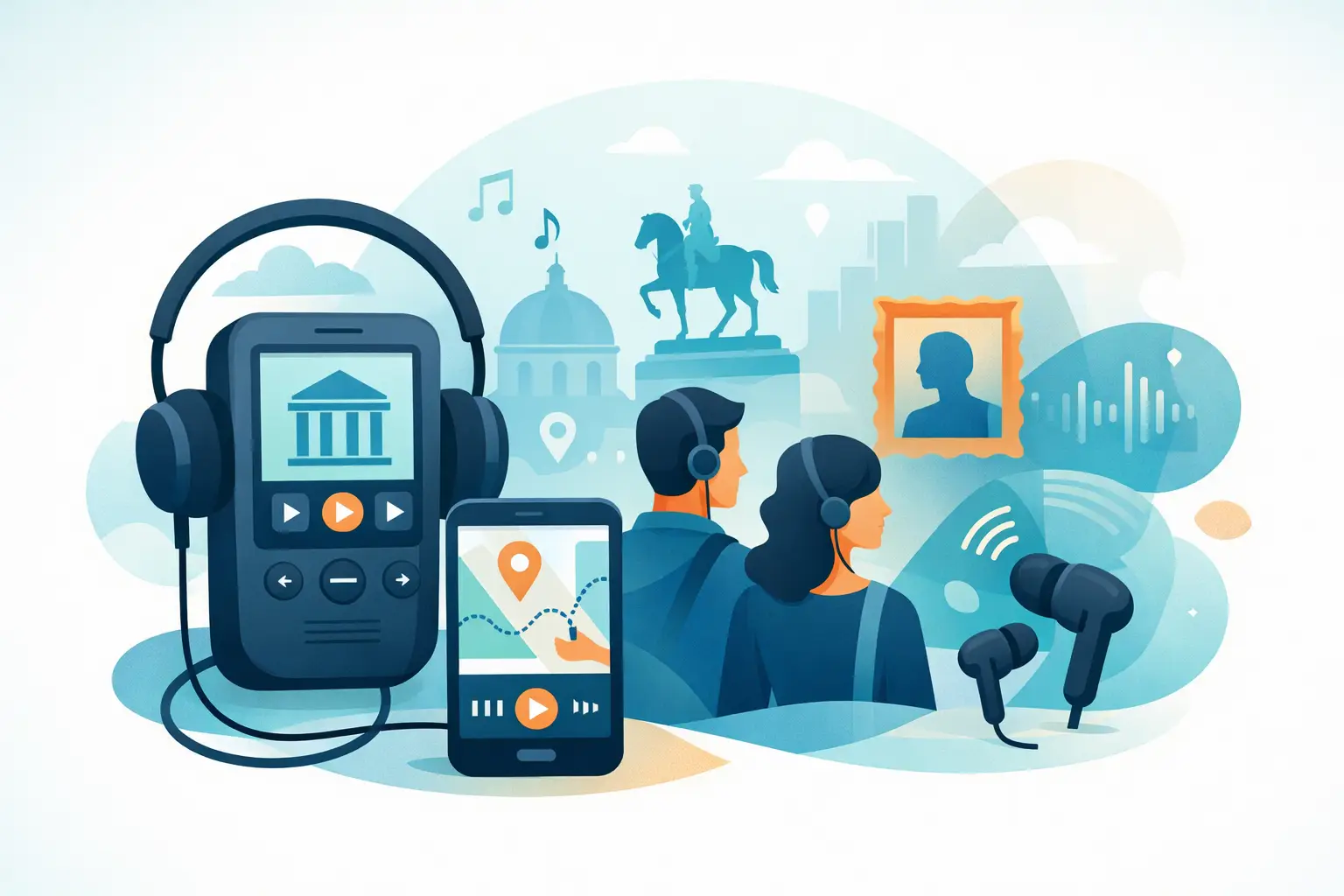
The visitor who stops in front of a work, a facade or a landscape is not just looking for information. He expects a story adapted to the place, his time of visit and sometimes his language. A tailor-made digital audio guide makes it possible to meet this expectation without requiring teams to manage a fleet of boxes, headsets or batteries on a daily basis.
For a museum, a monument, a tourist office or a community, the subject therefore goes beyond the simple choice of an audio medium. It is about designing a mediation that respects the identity of the site, broadens the audiences and remains realistic to administer. Digital is relevant when it serves this ambition, with sobriety and without adding a layer of complexity to already busy teams.
Why choose a tailor-made digital audio guide?
A standardized route transmits information. A tailor-made route creates a relationship between a place and its visitors. It takes into account the collection, local history, the points of view that we wish to highlight and the concrete conditions of the visit. In an abbey, we can focus on the rhythm of the stroll and the acoustics of the spaces. On an urban circuit, geolocation and orientation will take up more space. In a local museum, testimonies from residents or sound archives can give particular depth to the subject.
This personalization also concerns the public. A family, a school group, an international visitor and a person who already knows the site do not have the same expectations. It's not always necessary to create four entirely separate tours. On the other hand, offering content of varying lengths, several languages, visual supplements or a quiz can make the course more welcoming without making it confusing.
Tailor-made does not mean costly development or endless project either. It first consists of making the right editorial and functional choices: which stops are essential, what tone to use, which media really bring something, and when the visitor needs to be guided. A configurable solution then allows these choices to be implemented without depending on an internal technical team.
An experience designed for the visitor’s smartphone
The principle is simple: the visitor accesses the route from your own phone, generally by scanning a QR code at the reception point, on a panel or in a visitor support. They can then listen to the content at their own pace, select their language and consult the associated multimedia elements.
This operation reduces constraints well known to cultural sites: purchase of equipment, inventory, recharging, disinfection, maintenance and replacement of lost or damaged devices. It also limits queues at the counter and facilitates access to the visit for people who prefer to proceed independently.
However, the smartphone should not become a condition of exclusion. Responsible mediation provides for clear signage, very short instructions and alternatives when necessary. Some establishments will keep a few loan devices or human mediation to support visitors who are less comfortable with digital technology. This is not a step backwards: it is a coherent way of guaranteeing access to content for all.
QR code, GPS or free access: the correct trigger depends on the location
The QR code is particularly suitable for museums, exhibitions and sites where each point of interest is clearly identified. It gives the visitor immediate control: they choose to listen or not, without having to search through a long list.
GPS triggering is particularly useful for city routes, heritage trails or large-scale roaming. It accompanies walking and can invite you to look up in the right place. However, its accuracy varies depending on the environment: narrow streets, wooded areas or proximity to several points of interest require careful design and, sometimes, a complementary visual cue.
Free access to all stages can also be relevant for a temporary exhibition, a very short tour or visitors who wish to prepare for their visit. The right device is not the one that uses the most technology, but the one that remains the most natural in the context of the visit.
Guideius addresses every digital cultural mediation challenge
Create a multilingual smartphone audio guide that is easy to deploy, accessible and tailored to your museum, heritage site or destination.
Design content that makes you want to listen
The quality of an audio guide depends first of all on its writing. Text intended to be read on a carte does not necessarily produce a good audio sequence. When listening, the sentences must be more direct, the spatial cues more explicit and the rhythm more lively. A well-constructed two-minute narration is often better than a seven-minute commentary that tries to say everything.
Each step benefits from responding to a specific intention: pointing out a detail, restoring a vanished use, linking a work to a human story or explaining a transformation of the landscape. This intention helps to choose sources, voices and possible visuals. Audio can be enriched with old photographs, maps, short videos or archival documents, provided that these media facilitate understanding instead of dispersing attention.
The plurality of voices can also serve the purpose. A curator, a guide-lecturer, an artisan, a resident or a researcher do not provide the same perspective. This diversity is valuable when it is editorialized with rigor. It does not replace either verification of sources or a coherent narrative line.
Multilingualism and accessibility: mediation choices, not secondary options
Translating a course does not amount to juxtaposing linguistic versions. Certain references, certain puns or certain practical information must be adapted to remain understandable. It is better to plan priority languages from the design phase in order to anticipate the length of content, the navigation structure and proofreading needs.
Accessibility deserves the same attention. Transcriptions, subtitles for videos, content adapted to different needs and readable navigation improve the experience for many visitors, well beyond just those with disabilities. Insufficient contrast, a button that is too small or an ambiguous instruction can be enough to interrupt a visit.
Inclusion is also played out in the stories proposed. A tailor-made audio guide can make visible memories, professions, uses and inhabitants usually less present on the routes. For heritage structures, it is a concrete opportunity to enrich the interpretation of the place without renouncing scientific requirements.
Prepare the project without burdening the teams’ daily lives
An effective project starts with a clear scope. Before recording the first voice, it is useful to identify the priority route, the realistic number of steps, the languages needed, the resources available and the person who will provide updates. This step avoids accumulating content over the course of meetings, to the point of creating a course that is difficult to finish and even more difficult to listen to.
The issue of connectivity needs to be addressed early on. In a church with thick walls, a large archaeological site or a rural area, the mobile network can be irregular. A offline mode allows the visitor to download content before departure and maintains the continuity of the visit. It is a discreet function, but decisive in the field.
The administration must remain accessible to cultural teams. Correcting a schedule, adding news, replacing a visual or updating a translation should not require the systematic intervention of a service provider. A clear interface and support for getting started allow you to maintain this autonomy, while securing the consistency of content.
Usage statistics then provide useful elements to decide. They can show which steps are most visited, where visitors stop the journey, or which language is most requested. They do not say everything about the emotion or understanding of a visit, but they offer concrete benchmarks for adjusting content, signage or the duration of a tour. Their collection must remain proportionate, transparent and respectful of visitor data.
Making digital a sustainable tool for valorization
An audio guide on a smartphone reduces the need for dedicated equipment, but its simplicity is not limited to that. It also depends on design choices: properly compressed audio files, lightweight interface, useful content, ongoing maintenance and lifespan of the course. Creating fewer superfluous effects to better tell the story of a site is often the most relevant decision, both editorially and technically.
The budget must be evaluated over the entire life cycle: design, content production, translation, deployment, maintenance and developments. A scalable offer is particularly suitable for small and medium-sized structures that wish to start with a priority route before gradually expanding their system. With Guideius, this logic can be based on a complete solution, designed to remain manageable by teams and adapted to the identity of each institution.
The best starting point often remains a very concrete question: what moment of visit deserves to be better understood, better felt or better shared? It is from this response that the audio guide becomes a real transmission tool.
Would you like to apply these ideas to your site?
Guideius helps deploy multilingual audio tours with QR codes, GPS, offline mode, multimedia content and privacy-friendly analytics.