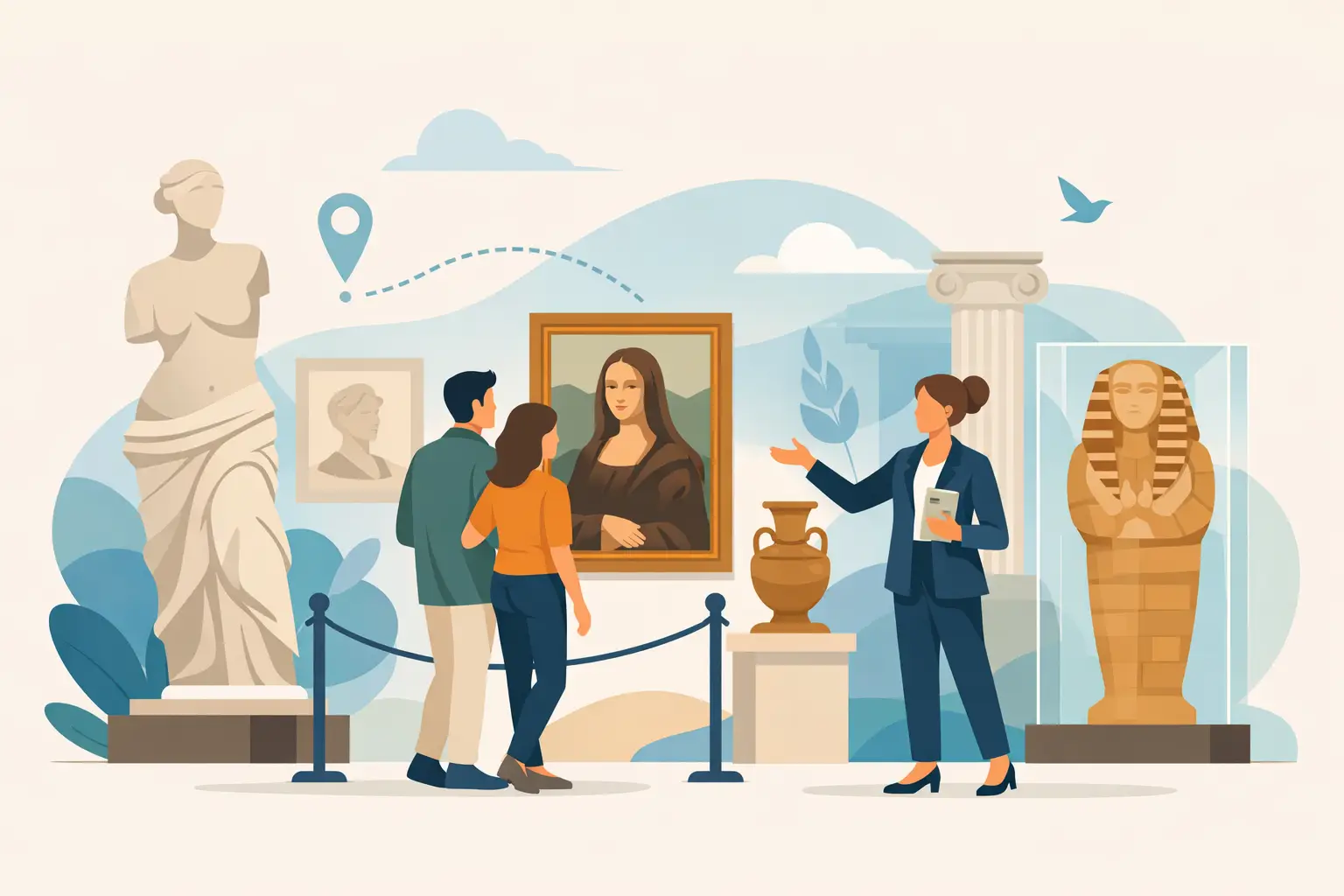
In a vaulted room, in the heart of a thick-walled monument or on a remote heritage trail, the mobile network is never a promise. However, for the visitor, an offline museum visit should not be a degraded version of the journey: it must remain fluid, rich and autonomous. For cultural teams, it is also a concrete condition of reliability, particularly when technical resources are limited.
Offline mode makes the content of a digital audio guide available without depending on an active connection during the visit. Texts, audio tracks, images, maps and sometimes quizzes are downloaded to the smartphone before the start of the journey. The visitor then retains access to mediation, even when Wi-Fi disappears and 4G becomes uncertain.
Why the offline museum visit remains essential
Digital mediation is often considered through its enrichment possibilities: additional languages, audio stories, visual content, games or practical information. But its first mission remains to transmit. If a loading screen replaces the audio commentary when the visitor is in front of a work or a panorama, the tool ceases to serve this mission.
White areas do not only concern rural areas. They are common in cellars, churches, castles, museums installed in old buildings, extensive gardens or semi-buried spaces. The quality of the network also varies depending on the operators, traffic and season. Relying solely on a mobile connection therefore amounts to placing part of the technical risk on the visitor.
A course available offline also improves the reception of international audiences. Some visitors do not have a French or European plan, others voluntarily limit their mobile data. Asking them to consume data to access content creates a discreet, but real, barrier. The initial download, carried out at reception or before arrival, offers a simple and fairer response.
Finally, this approach reduces reliance on network infrastructure that is expensive to install and maintain. Quality visitor Wi-Fi can be useful, especially for initiating downloads, but it should not become the sole link in the entire visitor experience.
Offline does not mean unprepared
Offline mode is only effective if its triggering is clear. The visitor must understand, in a few seconds, that he can recover his route before entering spaces where the network is weak. A QR code placed in the right place, associated with short instructions, is often more effective than a long explanatory panel: “Scan, choose your language, download your visit, then leave at your own pace. »
The reception area is the best place for this step. Where possible, dedicated and properly sized Wi-Fi facilitates downloads, without requiring perfect coverage in all rooms. Reception agents must also be able to explain the essential gesture and reassure visitors who are less familiar with their smartphone.
This preparation must remain proportionate. Asking to create an account, provide a lot of information or download a cumbersome application before accessing a comment discourages some of the public. A relevant mediation solution limits friction: immediate access, clearly identified route, visible download and intuitive operation once on site.
What content should you plan for a journey without a network?
A good offline journey starts with an editorial choice. It is not a question of piling up all the available media, but of making each step useful for understanding the place. Audio is particularly suitable for the visit: it accompanies the gaze without monopolizing the screen and allows a more natural circulation in the spaces.
Archive images, details of works, plans or reconstructions can enrich the story, provided they are carefully selected. Their weight has a direct impact on the volume to download. For a small structure, the challenge is not to compete with very heavy audiovisual production, but to offer content that is fair, readable and adapted to the context of the visit.
It is useful to provide several depth levels. A short route caters to passing visitors or families; supplements allow curious audiences to go further. This prioritization improves the experience while controlling the total download weight.
Multilingual content must be integrated into the design of the course. Offline is particularly valuable for foreign visitors, but it loses some of its appeal if only one or two languages remain accessible without connection. Likewise, transcribed texts, subtitles and adapted descriptions enhance accessibility for people who are deaf, hard of hearing or have reading difficulties.
Guideius addresses every digital cultural mediation challenge
Create a multilingual smartphone audio guide that is easy to deploy, accessible and tailored to your museum, heritage site or destination.
QR code or GPS triggering: choose according to location
The QR code is a reliable solution in interior spaces. Placed near a work, a window or a point of interest, it gives the visitor a tangible reference point. It avoids geolocation errors and retains its usefulness when GPS does not pass through walls. Its main point of vigilance is the signage: a poorly placed or insufficiently explained code will be ignored.
GPS is very relevant for urban walks, landscape routes and extensive heritage sites. It can automatically trigger a step when the visitor approaches a location. This ease of use is appreciable, but it depends on the precision of the signal and the location authorization granted by the user. In certain environments, manual validation or a backup QR code remains preferable.
In practice, the best choice is often hybrid. GPS structures an outdoor route, while QR codes secure sensitive passages, building entrances or points where several stages overlap. The objective is not to multiply technologies, but to prevent technology from becoming the subject of the visit.
Administer offline without burdening teams
For a cultural structure, the quality of the course also depends on its ability to make it evolve. A temporary exhibition, a change in the direction of traffic, a comment to be corrected or a translation to be added should not require a long and costly technical intervention.
The administration interface must allow teams to manage steps, languages and media with autonomy. A content update must be prepared and then offered for download to new visitors. For routes already retrieved on a phone, we must accept a reality: the content is not instantly modified without connection. This limit is normal. It simply requires clear organization during urgent changes, with information at reception if necessary.
Usage statistics are also useful, even when the visit takes place off-grid. Data can be synchronized when the phone regains a connection. They make it possible to identify the languages chosen, the most visited stages, the average listening time or the moments when visitors abandon the route. These indications help improve mediation without monitoring people.
This requirement for sobriety in collection is essential, particularly for public establishments and communities. Measuring usage must serve to improve the service, with respect for visitors and with clear control of the data.
Test real conditions, not just the ideal course
A route cannot be declared operational because it operates in a connected office. It must be tested in real visit conditions: in each room, at different times, with a recent telephone but also with an older device, in French as in the languages offered.
Tests must verify downloading, audio playback, opening media, triggering steps and understanding signage. It is also relevant to observe a test visitor without giving them too many instructions. If he hesitates when downloading or doesn't know how to continue, the problem is rarely with him.
Guideius supports this field logic with routes designed to work on visitors' smartphones, both online and offline, without requiring the management of a dedicated audio guide fleet. For teams, this means less equipment to load, disinfect, distribute and maintain, while still maintaining a demanding mediation experience.
A successful offline visit is almost unnoticeable: the visitor listens, looks, understands and moves forward without wondering if the network is available. It is precisely this technical discretion that leaves room for works, stories and territories.
Would you like to apply these ideas to your site?
Guideius helps deploy multilingual audio tours with QR codes, GPS, offline mode, multimedia content and privacy-friendly analytics.