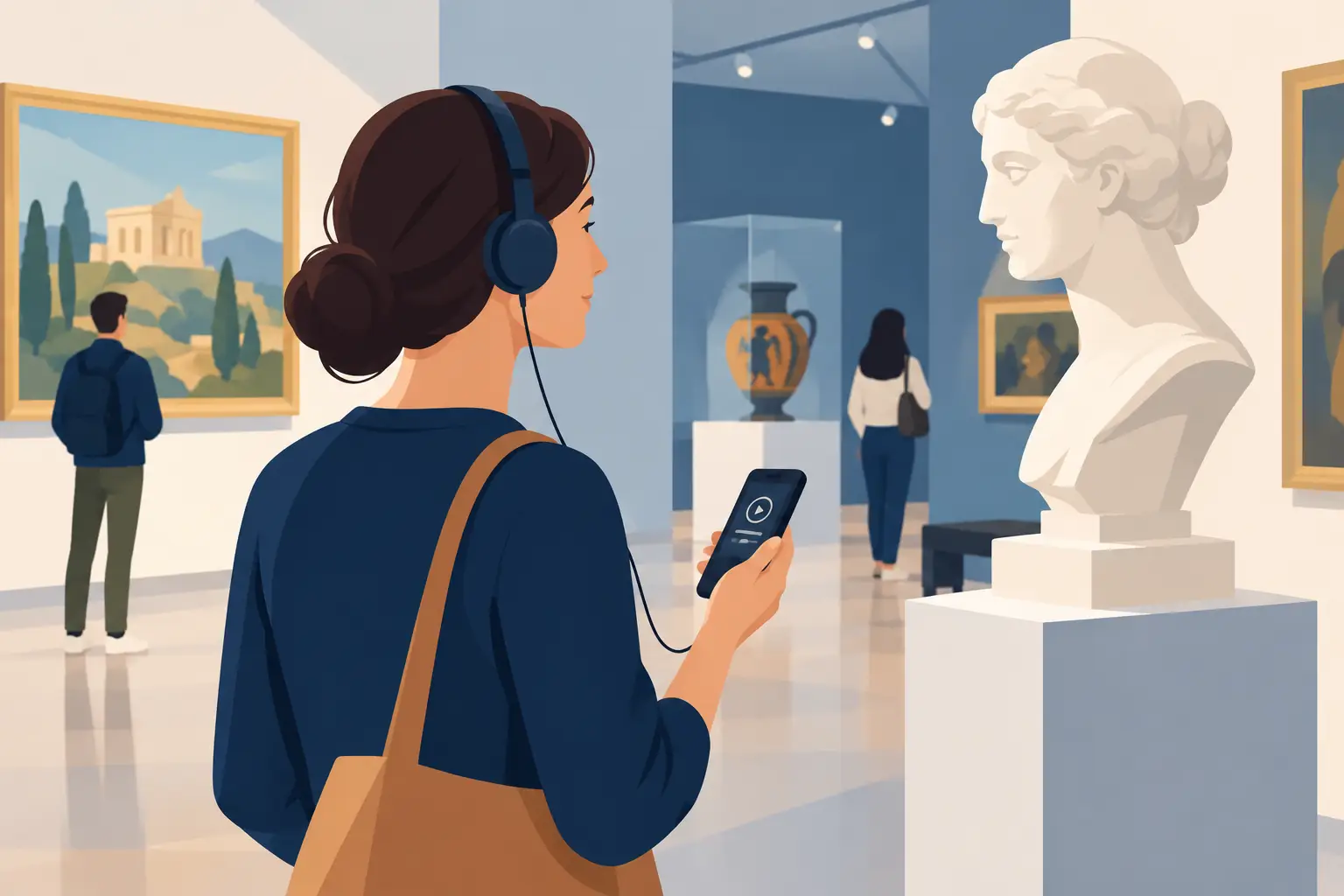
A visitor stops in front of a work, a vestige or a facade. He wants to understand what he is looking at, without waiting for a guided tour to start or handling a device distributed at reception. A museum audio guide solution responds to this precise moment: it makes the content accessible in the right place, at the right pace and in the visitor's language.
For cultural teams, the subject goes far beyond the recording of audio comments. This involves choosing a mediation tool that respects the realities on the ground: limited time, controlled budget, diversity of audiences, buildings sometimes poorly covered by the network and the need to develop content without depending on a technical service provider for each modification.
Start from uses before choosing technology
A relevant audio guide is not the one that combines the most functions. It is the one that really accompanies the journey imagined by the establishment. In a fine arts museum, the visitor may wish to select a few works from a dense collection. On an archaeological site or in an ancient center, it is more likely to follow a geolocated route. In a writer's house, a chronological and embodied story will give meaning to successive spaces.
The first question to ask is therefore simple: what visitor experience do you want to make possible? A 30-minute self-guided tour, a family tour with quiz, an in-depth discovery in several languages or an outdoor itinerary are different formats. They do not involve the same writing, nor the same triggering mode, nor the same accessibility needs.
The objective is not to digitize all cartels. Audio provides specific value when it contextualizes, tells a story, makes a voice, a soundscape or a testimony heard. It must extend the look, not replace it. A short, editorialized and well-hierarchized path will often be more consulted than a succession of overly long contents.
An audio guide solution for museums without dedicated hardware
The use of the visitor's smartphone concretely transforms daily operations. With access by QR code, the public opens the route in a few seconds from your browser or an application, without waiting in line to borrow and then return a device. The reception team can devote more time to orientation, advice and relations with visitors.
This choice also reduces the often underestimated constraints of traditional audio guides: purchase of terminals, recharging, disinfection, inventory, maintenance, losses and renewal of the fleet. For a modest-sized structure, these operations can absorb a significant portion of the budget and available time.
However, the personal telephone model does not exempt us from anticipating certain needs. Not all visitors have a smartphone, headphones or sufficient battery power. Inclusive mediation provides alternatives: listening on loudspeaker when the context allows it, limited loan of headsets or terminals, content available in several formats and clear signage. Digital technology must broaden access to the visit, never create a new barrier.
QR code, GPS and offline: choose according to location
The QR code is particularly suitable for exhibition halls and places where each point of interest is precisely identified. It gives the visitor the freedom to choose their own pace and facilitates access to targeted content. It also works for temporary routes, provided that the codes are integrated into the scenography without hindering the reading of the works or the space.
GPS comes into its own in historic city centers, gardens, memory trails and extensive sites. It can offer content as you travel, guide you towards a next step and structure a stroll. However, its accuracy depends on the environment: narrow streets, dense vegetation, relief or thick buildings can disrupt localization. In these cases, a combination of GPS, map and visual cues remains more reassuring than systematic automatic triggering.
Offline mode is a determining criterion. In underground sites, old buildings and rural territories, the quality of the mobile network cannot be assumed. Allowing content to be downloaded in advance prevents a visit from being interrupted due to lack of connection. It is also a concrete attention paid to visitors who have a limited package or come from abroad.
Guideius addresses every digital cultural mediation challenge
Create a multilingual smartphone audio guide that is easy to deploy, accessible and tailored to your museum, heritage site or destination.
Accessibility must be part of the editorial project
A digital solution does not become inclusive simply by the presence of a language button. Accessibility is worked on from the design of the routes, with the mediation teams and, when possible, with the audiences concerned.
Transcription of audio tracks benefits deaf or hard of hearing people, but also visitors who prefer to read or cannot listen on site. Subtitles for videos, readable navigation, appropriate contrasts and a clear hierarchy of information make it easier for everyone to use. Versions in sign language, audio description or courses designed for audiences with specific cognitive needs require dedicated editorial work. They should not be considered as simple options added at the end of the project.
The language used matters just as much. A demanding mediation can remain understandable without impoverishing the content. She explains the technical terms, locates the references and leaves the visitor the choice to explore further. This gradation is particularly useful when the same place welcomes regulars, families, school groups and international tourists.
Give teams control over content
An audio guide is a living tool. An exhibition changes, a schedule evolves, a translation must be corrected, a new stage is created for a local event. If each update becomes time-consuming or expensive, the course risks aging quickly.
An administration interface accessible to non-technical teams allows texts, media, languages and visit sequences to be modified independently. This simplicity does not mean sacrificing quality. On the contrary, it allows you to test a format, correct information and improve content after feedback from the public.
Creation nevertheless requires a method. Time must be allowed for the synopsis, writing, scientific validation, translation, voice recording and on-site testing. Listening quality depends as much on the rhythm of a text as on the sound quality. A natural voice, short sentences and well-placed silences make the experience more pleasant than a comment that is too dense or read without intention.
Measuring usage without losing sight of ethics
Usage statistics provide valuable information: number of launches, languages chosen, most listened to stages, average duration of the journey or completion rate. They help identify inconspicuous signage, content that is too long or a route abandoned before its end.
These data do not replace field observation or exchanges with visitors. A rarely consulted stop may reflect a technical problem, but also an assumed editorial choice or a room that is often closed. Data should inform decisions, not dictate mediation.
For public and parapublic institutions, data control is also a matter of trust. It is best to clearly verify what information is collected, for what purpose, for how long and by whom it is processed. An ethical solution limits collection to what is necessary and does not use the visit as a pretext to capture personal data.
Evaluate the real cost, not just the subscription
Comparing offers solely on their displayed price often leads to an incomplete vision. The total cost includes the initial creation of content, translations, support, maintenance, functional developments, hosting and, where applicable, the equipment to manage. We must also consider the time saved by reception and the autonomy acquired by the teams.
Scalable pricing is often preferable for small and medium-sized structures: it allows you to start with a priority route, then enrich the offer according to uses and available resources. The white label can, for its part, respond to communities or networks that wish to deploy a coherent experience under their own visual identity.
Guideius is part of this logic with a solution designed to offer multilingual audio tours, accessible on smartphones, administered without technical expertise and adapted to the realities of cultural sites.
The right choice is not to add a digital layer to the visit. It consists of giving visitors an additional opportunity to understand, listen and locate themselves in a place. When it remains simple for the team, accessible for the public and faithful to the identity of the site, audio mediation becomes a sustainable transmission tool.
Would you like to apply these ideas to your site?
Guideius helps deploy multilingual audio tours with QR codes, GPS, offline mode, multimedia content and privacy-friendly analytics.