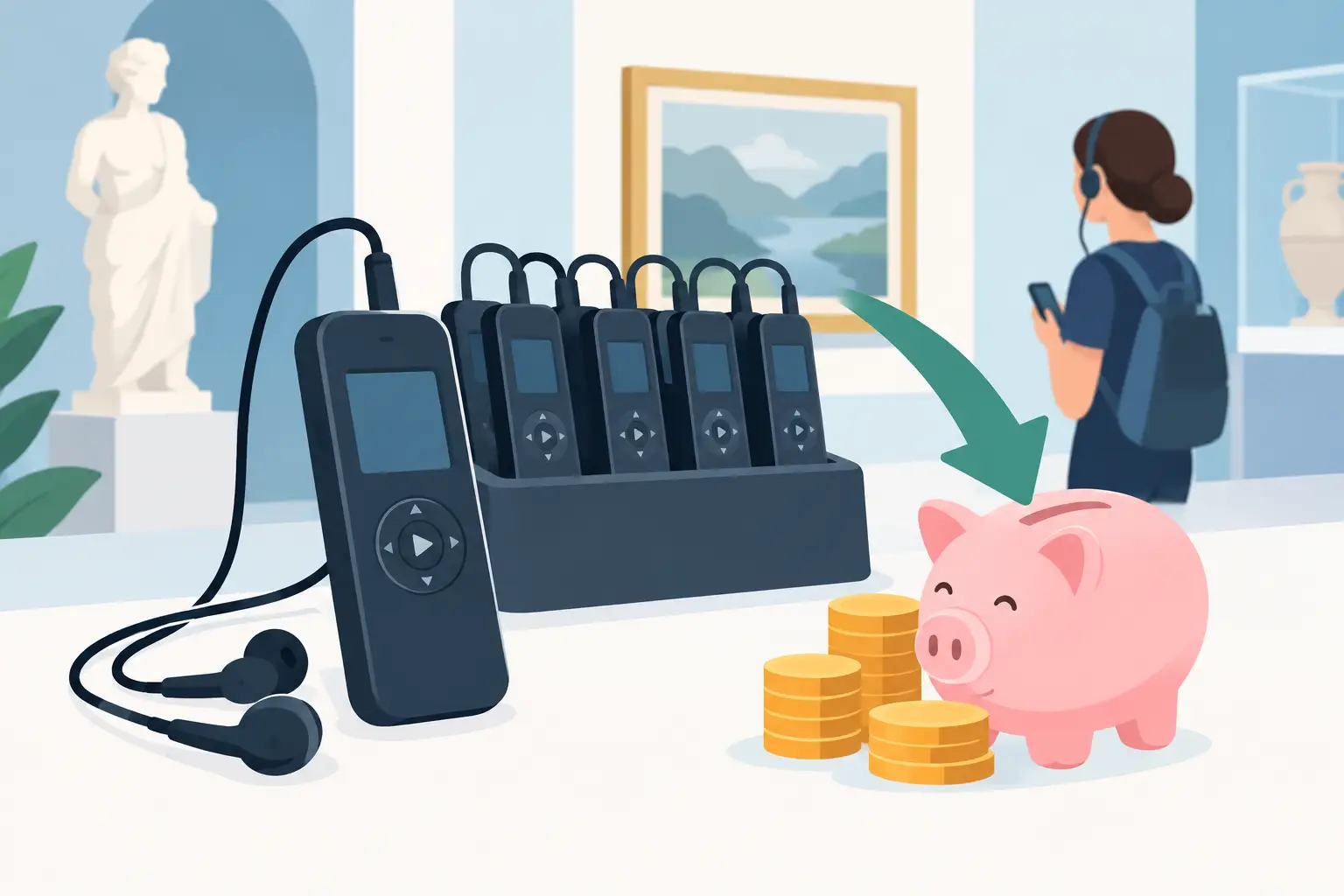
The cost of a stock of audio guide devices never stops at the purchase price. To reduce equipment costs, museums, heritage sites and tourist offices also need to consider what adds up over the seasons: maintenance, cleaning, charging, replacement headphones, losses, faults, storage and staff time. These less visible costs can be substantial, particularly for organisations seeking to improve interpretation without expanding their technical resources.
Moving to smartphone audio guides addresses this practical challenge. It is not simply a matter of replacing one device with another, but of changing how the service operates: visitors use their own equipment, while the venue takes control of its content, updates and the quality of the tour.
Why audio guide equipment costs more than expected
The initial purchase is the most visible part of the budget. The real cost, however, spans the entire life of the equipment. Devices need to be inventoried, handed out, collected, checked and charged. Teams must plan for faults, keep spare units and manage accessories that often wear out first.
At a busy venue, hygiene is also part of everyday operations. Earphones and headphones need cleaning or replacing between uses. Seasonal venues must bring equipment back into service after storage and cope with peak visitor numbers without buying large quantities for just a few weeks.
These demands affect more than the budget. They reduce the time available for welcoming visitors, interpretation and sharing collections. When a small team spends part of its day managing devices, every fault or incomplete return disrupts both the visitor experience and the venue's organisation.
Reduce equipment costs with smartphone audio guides
The “bring your own device” model changes the equation. Visitors open the tour on their phones, usually through a QR code at reception, on visitor materials or at the start of a stop. Depending on the route, content may also be triggered by location.
The venue no longer needs to buy enough devices for its maximum visitor capacity. It also avoids a substantial share of charging, lending, cleaning and replacement costs. Teams can concentrate on what matters: offering good interpretation and helping the visitors who need guidance.
This approach is particularly suited to places with fluctuating visitor numbers: seasonally open monuments, town walks, natural sites, tourist offices and temporary exhibitions. More visitors can be welcomed without every increase in attendance immediately requiring more equipment.
Lower costs without lower standards
Reducing equipment should not mean reducing the quality of the experience. A good digital audio guide should offer comfortable listening, multilingual content, images or videos where they aid understanding, and clear navigation. Offline access also matters in thick-walled buildings, remote sites and outdoor routes with uneven mobile coverage.
Quality therefore depends less on the borrowed device than on the design of the tour. A well-written story, suitable track lengths, clear directions and reliable content activation directly influence visitor satisfaction. Equipment savings can be reinvested in content, translation, images or accessibility.
Assess the total cost before choosing
Comparing a dedicated audio guide with a digital solution means looking at the total cost of ownership. An estimate covering several years is more useful than focusing on the first invoice.
For dedicated devices, include headphones and charging stations as well as damage, theft, consumables, storage, maintenance and staff time. Plan for equipment replacement too: older devices may become harder to repair or no longer meet visitors' expectations.
With a smartphone solution, the cost categories change. Spending shifts towards content creation, tour setup, staff support and the service subscription. Costs are often more predictable because there is no stock of devices to replace through occasional large purchases. Content updates are easier too: a correction, translation or new stop does not require reprogramming or handling dozens of devices.
The choice still depends on the audience. Venues regularly welcoming very young school groups, visitors without smartphones or people less comfortable with digital tools may keep a few loan devices. The aim is inclusion: provide backup equipment according to actual needs rather than building the whole service around an expensive stock of devices.
Guideius addresses every digital cultural mediation challenge
Create a multilingual smartphone audio guide that is easy to deploy, accessible and tailored to your museum, heritage site or destination.
Keep tours inclusive without dedicated devices
Using visitors' own smartphones works well when the launch is carefully prepared. Readable signage, well-placed QR codes and short instructions reduce requests for help. At reception, a brief explanation is often enough to show how to start, find the tour and use headphones.
Accessibility goes beyond opening the tool. Content needs a clear structure, appropriate contrast, transcripts where relevant and alternatives for visitors who cannot or prefer not to listen. Multiple languages, simple navigation and content suited to different levels of knowledge also make the venue more welcoming.
Encourage visitors to bring their own headphones while keeping a few backup options. This is much less demanding than managing hundreds of headphones every day. It also respects different preferences: some visitors choose low-volume listening, written text or exploring the media at their own pace.
Shift maintenance towards content and functionality
With dedicated devices, maintenance is mainly physical. With a digital audio guide, it becomes primarily about content and functionality. It does not disappear: content still needs checking, practical information updating and the tour testing regularly on different phones.
This work, however, brings more direct benefits to visitors. Teams can update opening times, correct directions, add a recently restored artwork or remove a stop that has become inaccessible. The tour stays up to date without taking devices out of service or waiting for equipment replacement.
Usage statistics offer another practical benefit. They show which stops are accessed, which languages are chosen and where visitors leave the tour. Interpreted carefully and with respect for privacy, these insights help improve interpretation based on actual use rather than intuition alone.
Plan a straightforward, reliable launch
A successful move to digital rarely depends on technology alone. It needs a well-planned tour: a clear starting point, a number of stops that fits the visit length, content downloaded in advance where connectivity is weak, and helpful signage that does not clutter the heritage setting.
Before launch, test the tour with different people: reception staff, volunteers, digitally confident visitors and those less comfortable with technology. Their feedback often highlights simple improvements, such as a QR code that is hard to notice, an instruction that is too long or a stop that is difficult to find. Testing helps avoid leaving reception staff to deal with these problems on opening day.
A solution such as Guideius lets venues offer these tours on visitors' phones, with features designed for cultural settings: QR codes, GPS, multimedia content, offline access, language options, accessibility and management tools usable by non-technical teams.
Reducing equipment ultimately frees up staff time and resources for content. When thoughtfully designed, digital interpretation takes nothing away from a visit: it makes knowledge more available, the tour more adaptable and staff better able to support people who need their help.
Would you like to apply these ideas to your site?
Guideius helps deploy multilingual audio tours with QR codes, GPS, offline mode, multimedia content and privacy-friendly analytics.