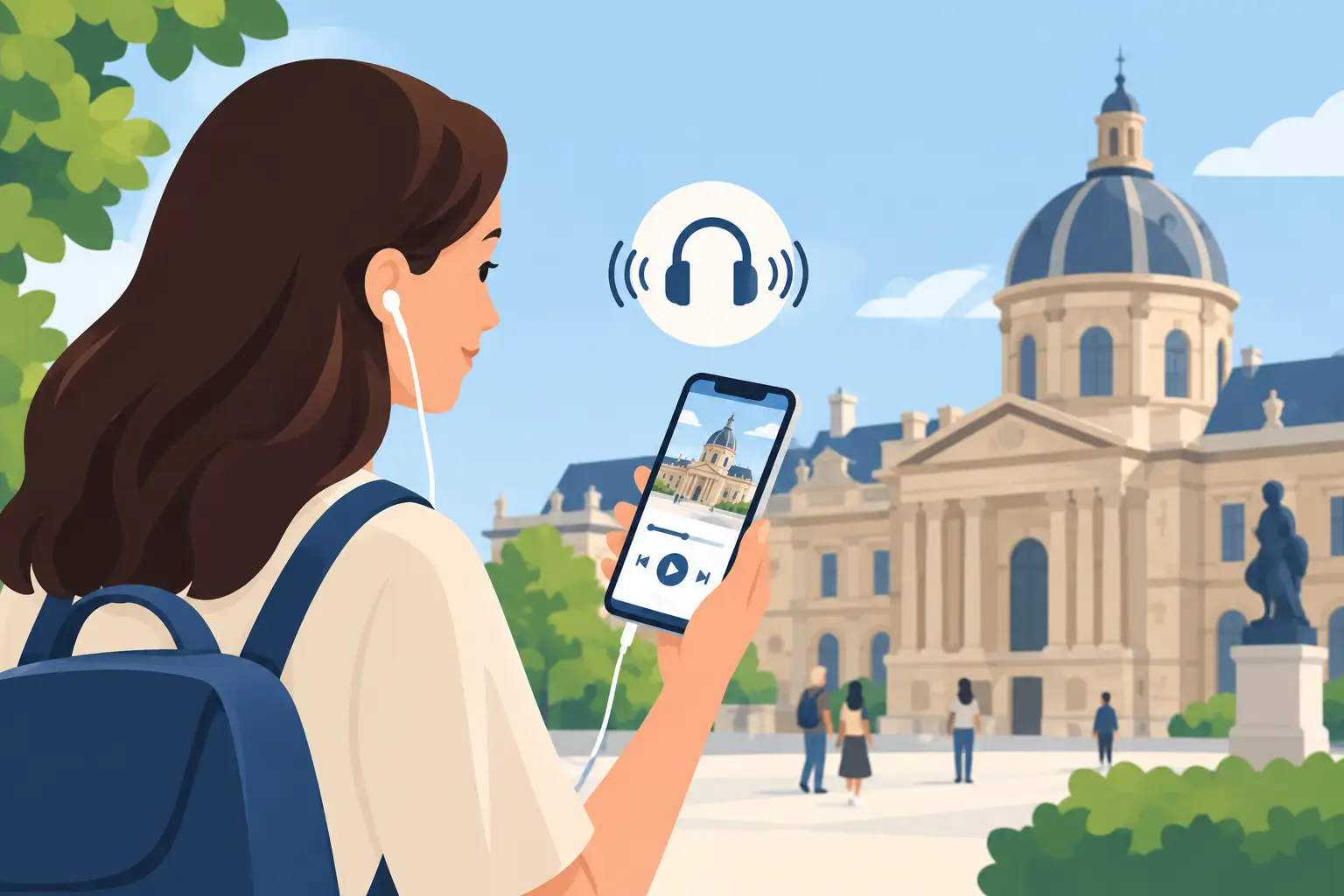
A visitor stops in front of a work, a panorama or the facade of a monument. He scans a QR code, listens to a story in his language, looks at an archive image, then resumes his journey at his own pace. This is the concrete promise of a well-designed smartphone audio guide: enriching the mediation without adding material to distribute, recharge, disinfect or collect at the end of the visit.
For museums, heritage sites and tourist offices, this choice is not only a technical development. It changes the organization of teams, the ability to bring content to life and the quality of reception offered to very different audiences. As long as you think of the tool as a mediation service, and not as a simple succession of audio files.
The audio guide on a smartphone responds to the real uses of visitors
The smartphone already accompanies visitors before their arrival, during the visit and after their departure. They use it to orient themselves, take photos, search for information or share a discovery. Offering an audio tour on this device avoids a break in use: access is immediate, familiar and autonomous.
This autonomy is particularly valuable in places where reception must remain fluid. A family can begin the visit without waiting at the counter. A group can choose different languages. A visitor in a hurry can listen only to the steps that interest them, while an enthusiast can delve deeper into certain content. The course is no longer imposed as a single format: it adapts to everyone’s availability and curiosity.
The smartphone also allows you to combine sound with other media. An old photograph can shed light on the transformation of a neighborhood, a map places a building in its territory, a short video shows an artisanal gesture. Audio remains the common thread, but mediation gains in precision and evocative capacity.
Reduce logistics without reducing cultural ambition
Traditional audio guides require constant organization. You have to buy a fleet of devices, anticipate breakdowns, ensure cleaning, manage charging, replace headsets and plan for losses. These constraints weigh more heavily on small and medium-sized structures, often mobilized on numerous missions with small teams.
A smartphone device greatly reduces this burden. The teams focus on reception, content and improving the experience rather than on the circulation of material. This simplicity can also facilitate the opening of courses out of season, during one-off events or on sites with few staff.
However, the gain should not be reduced to economic logic. The absence of dedicated equipment frees up resources which can be reinvested in editorial quality: writing, translation, voice, iconography, adaptation to audiences or creation of new routes. In cultural mediation, good content remains the first condition for a memorable visit.
QR code, GPS or manual selection: choose according to the terrain
Access to content must correspond to where and how visitors browse it. In a museum or monument, the QR code placed near a work or a stage is often the most direct solution. It gives the visitor the choice of triggering listening and facilitates location.
On an urban route, a heritage trail or an extended territory, GPS triggering provides another form of comfort. Content can be offered as you approach a point of interest, which supports wandering and limits consultation of a map. However, it is advisable to provide for manual selection of the stages: the signal may vary depending on the zone, and some visitors prefer to keep control of the triggering.
The best experience often combines several access modes. The principle is simple: the technology must guide without imposing, and remain discreet when the visitor wishes to observe, exchange or simply walk.
Plan for offline when designing the course
A digital audio guide sometimes depends on an unfavorable environment: thick walls, basements, rural areas, extensive gardens or historic centers where network coverage is uneven. Basing the experience solely on the mobile connection exposes visitors to loading times or even interruption of the journey.
Offline mode therefore constitutes a mediation function in its own right. When a visitor can download content before starting, they access audio tracks and media without consuming their package or depending on the local network. This is an important point of reassurance for international audiences as well as for locals who do not all have a comfortable connection.
This preparation should remain very simple. Clear information at the entrance, a visible QR code and a few short instructions are generally sufficient. The objective is not to ask the visitor to master a complex application, but to allow them to get started in just a few steps.
Guideius addresses every digital cultural mediation challenge
Create a multilingual smartphone audio guide that is easy to deploy, accessible and tailored to your museum, heritage site or destination.
Design a truly accessible audio guide
A smartphone audio guide can improve accessibility, provided you don't consider audio as a universal answer. Not all visitors listen the same way, read with the same ease, or use their phones with the same ease.
Transcriptions meet the needs of people who are deaf or hard of hearing, but they also serve those who visit in a noisy environment or who prefer to read. Well-structured texts, sufficient contrast, readable navigation and easy-to-activate buttons improve usability for all audiences. Content in sign language, image descriptions or routes adapted to certain disabilities can complete the system depending on the nature of the site and the audiences welcomed.
Accessibility is also about understanding. A plain language version, a family journey, short formats or adapted vocabulary allow more people to enter the story. It is not a question of impoverishing the subject, but of offering several entry points to knowledge.
Multilingualism as a quality of welcome
In many territories, language directly conditions the visiting experience. Carefully translated content does not constitute a supplement: it demonstrates a desire to welcome and broadens the scope of local heritage.
It is better to prioritize a few languages consistent with actual attendance rather than multiply uneven translations. Consultation statistics can then help identify the most used languages and develop the offer. For heritage content, the quality of cultural adaptation matters as much as literal translation: proper names, historical references, measurements and narrative tone deserve specific editorial attention.
Measure usage to improve mediation, not to monitor
A digital journey offers useful information to teams: number of starts, most viewed stages, languages chosen, average listening time or completion rate. This data helps identify a hard-to-find step, content that is too long, or a topic of particular interest.
They do not replace field observation or exchanges with visitors. They complete them. A strong consultation can signal success, but also confusing signage which requires you to search for information. The figures take on their meaning when confronted with the reality of the place, the seasons and the objectives of the course.
For public and parapublic structures, data control is an essential selection criterion. A mediation tool must be transparent about the information collected, limit what is not necessary and respect visitors. Ethical technology is also technology that inspires confidence in teams and audiences alike.
What to check before deploying a course
The right tool is not the one that accumulates functions, but the one that your team can administer over time. Before choosing a solution, it is useful to evaluate the simplicity of the management interface, the possibility of modifying content without technical competence, the availability of support and the maintenance conditions.
Also question the personalization of the experience. Your visual identity, your editorial tone and your field constraints must be able to find their place in the system. An application or web app in white label can be relevant when a structure wishes to offer an experience fully integrated into its universe, while a lighter solution will be suitable for a rapid launch or for a limited budget.
Finally, plan mediation around the tool. Clear signage, an informed team and a visible access point often do more for adoption than an additional feature. Some structures also choose to keep a few loan devices for visitors without a smartphone or whose battery is insufficient. This complementary solution prevents digital from becoming a factor of exclusion.
Guideius supports this approach by offering multilingual audio tours that can be easily administered, with access by QR code or GPS, offline mode, enriched media, usage statistics and accessibility options adapted to the realities of cultural places.
An audio guide on a smartphone takes on its full value when it leaves more room for heritage, stories and visitors. Start with a concrete question: what moment of your visit deserves to be better understood, better heard or better shared? This is often where the fairest route is born.
Would you like to apply these ideas to your site?
Guideius helps deploy multilingual audio tours with QR codes, GPS, offline mode, multimedia content and privacy-friendly analytics.