A thick-walled crypt, a coastal path, an ancient village or a basement exhibition room have one thing in common: mobile coverage is often uncertain. The question “what solution can you visit without a network” is therefore not a matter of simple technical comfort. It conditions the continuity of mediation, the autonomy of visitors and the credibility of the proposed route.
For a museum, a heritage site or a tourist office, a digital visit should not be interrupted because a visitor loses 4G. The right device allows access to content at the right time, without requiring the management of a fleet of audio guides and without transforming the reception team into IT support.
Why network can't be a prerequisite
In a cultural journey, the quality of the network varies more quickly than we imagine. It depends on the thickness of the walls, the relief, the crowds, the visitor's operator and sometimes the weather. A solution that works in a test outside the office may fail in a tower, a quarry, a chapel or at the end of a hiking route.
The problem isn't just loading a page. Without a connection, audio tracks, high definition images, translations or quizzes may become inaccessible. The visitor then loses the thread of his experience, while the establishment gives the impression of having favored the digital effect to the detriment of transmission.
Planning for offline also responds to a broader reality of use. Some visitors limit their mobile data, travel from abroad, or voluntarily choose not to go online. A truly accessible mediation should not reserve its content for those who have the right package and the right signal.
Which network-free visit solution is really reliable?
The answer has less to do with the name of a technology than with how it actually works on the ground. A reliable solution must allow the content to be downloaded in advance, played locally on the smartphone and triggered without an active connection during the visit.
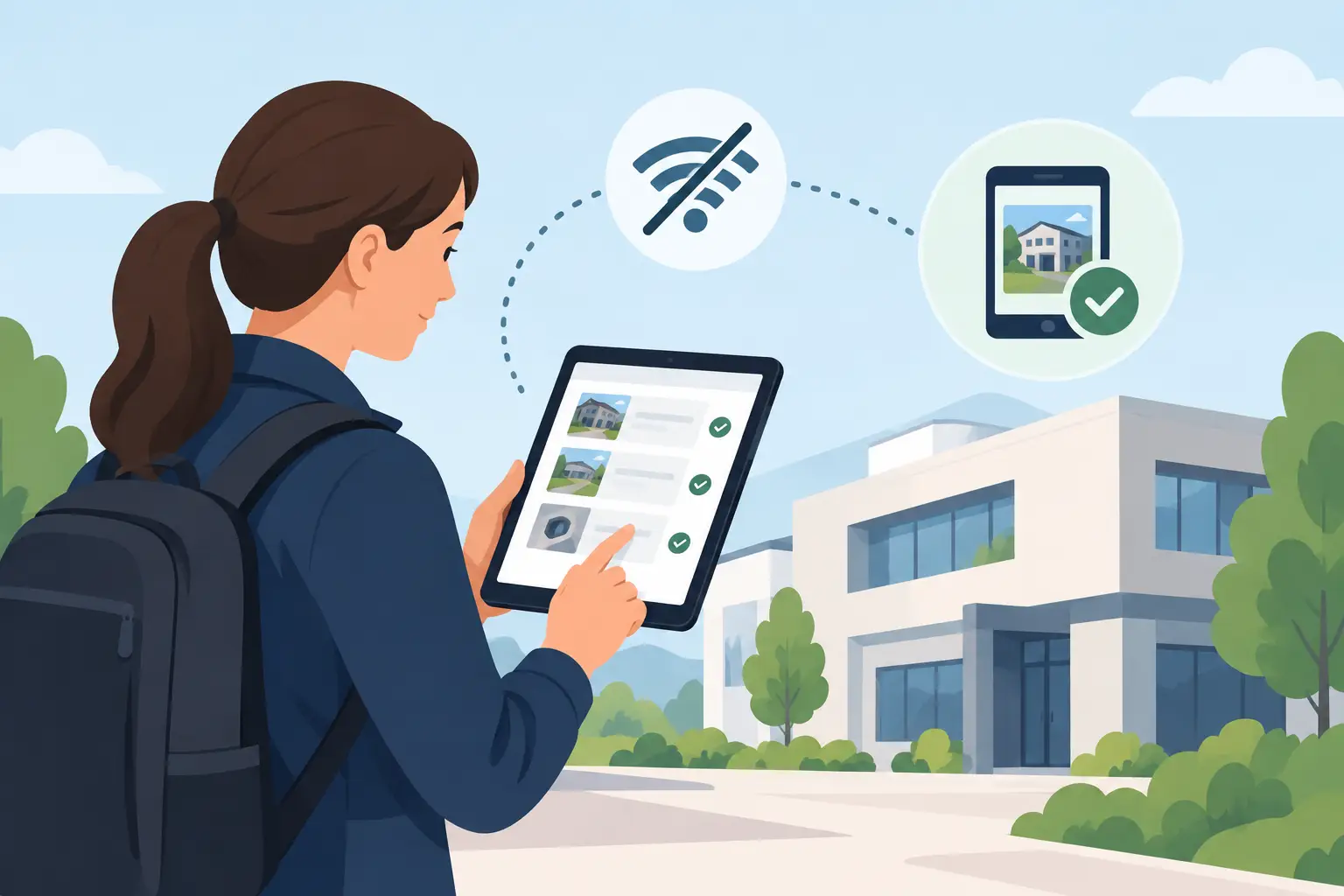
The principle is simple: before entering the white zone, the visitor retrieves the route on Wi-Fi or with your own network. The necessary audio, visual, text and language files are saved on their device. Once the download is complete, the content remains available without mobile data.
This approach differs from a simple mobile site. A typical web page generally requires a connection to view its media and information. Even when an interface resembles an application, offline must be planned by design: explicitly cached content, verifiable availability on the device and clear behaviors in the event of network loss.
The QR code: useful, but not sufficient alone
The QR code remains an excellent gateway. It avoids searches in an application store, facilitates access to a route and can precisely identify a point of interest. But it does not alone solve the lack of network. If their scan returns to a page that should load online, the visitor finds themselves stuck where the experience should begin.
In a well-designed offline system, the QR code is used to start the route or trigger a step already downloaded. It can be positioned at reception, where Wi-Fi is available, then supplemented by on-site markers. This organization limits friction and gives the visitor time to prepare their experience.
GPS works without a network, with limits
A smartphone's GPS picks up satellite signals: it does not need a mobile network to locate the device. It is therefore particularly relevant for outdoor routes, independent circuits and territorial discovery routes.
However, it is necessary to distinguish between geolocation and cartography. If a map or media needs to be loaded from the internet, the experience is not entirely offline. In addition, GPS can be imprecise in dense forests, in enclosed urban areas or near buildings. It rarely becomes relevant inside a museum or monument with thick walls.
For these spaces, triggering by QR code or visual cue remains more reliable. The best route often combines the two approaches: GPS outside, QR codes in areas where precision matters.
Guideius addresses every digital cultural mediation challenge
Create a multilingual smartphone audio guide that is easy to deploy, accessible and tailored to your museum, heritage site or destination.
Criteria to consider before choosing
A network-free visitation solution must be evaluated based on actual site conditions, not just its commercial demonstration. Four criteria deserve particular attention.
- Downloading before the visit: visitors must be able to easily retrieve content from reception, an identified Wi-Fi point or before their arrival. The interface must unambiguously indicate that the course is ready for offline use.
- The weight of the media: a visit rich in videos can take a long time to download and saturate the storage of certain phones. Well-compressed audio files, optimized images and videos reserved for content that warrants it improve the experience without impoverishing it.
- The initiation of the stages: an outdoor route will benefit from relying on GPS, while an indoor site will favor visible QR codes well integrated into the signage. Manual access must always be provided at each stage if automatic triggering fails.
- Maintenance for teams: offline should not make updating complex. Teams must be able to correct text, replace audio, add language, or publish a new step without heavy technical intervention.
Accessibility must also be treated as a design element, and not as an option added at the end of the project. Transcriptions of audio tracks, readable texts, sufficient contrasts, simple controls and content adapted to several audiences reinforce the usefulness of the course for everyone. Offline, these resources must remain available in the same way as the main content.
Organize an offline tour without making the welcome more burdensome
The success of a visit without a network is decided from the first minutes. At reception, clear instructions may be enough: scan a QR code, choose your language, download the route, then check that it is available. This step should take a short time and be able to be explained in one sentence by reception staff or volunteers.
A simple display is more effective than a succession of instructions. It can specify the approximate duration of the download, invite visitors to use the site's Wi-Fi and remind them to bring headphones. For visitors who do not have a smartphone, it remains useful to maintain an alternative: paper booklet, one-off equipment loan or human support depending on the structure's resources.
Field testing is essential. The entire route should be covered with several phone models, in airplane mode after downloading. This check quickly reveals forgotten media, imprecise GPS zones, misplaced QR codes or ambiguous instructions. It must be renewed after each significant change in the route.
Preserving data and digital sobriety
Offline is also of ethical and environmental interest. By limiting repeated calls to servers during the visit, it reduces unnecessary data exchange. It does not exempt you from careful design: downloading heavy videos that will never be seen is neither simple nor favorable to visitors with little storage space.
For public and parapublic structures, data control constitutes another challenge. Usage statistics can help understand which points of interest are consulted, which languages are chosen or where visitors stop their journey. They must remain proportionate, anonymized where possible and explainable to the public.
A solution like Guideius combines offline downloading, QR code and GPS triggers, multilingual content and usage statistics, in order to meet these constraints without requiring internal technical expertise. The challenge is not to add a digital layer to the site, but to give teams a tool that they can administer over the long term.
Think of the breakdown as a normal situation
The missing network is not an anomaly to be corrected at all costs. In many heritage places, it is part of the physical reality of the site. Taking it into account from the design stage allows you to create a more reliable, more inclusive and often more peaceful visit.
The right choice is one that lets the visitor listen, understand and move around without monitoring their screen or looking for a signal. When technology knows how to fade away, the monument, the collections and the stories of the territory find their place again.
Would you like to apply these ideas to your site?
Guideius helps deploy multilingual audio tours with QR codes, GPS, offline mode, multimedia content and privacy-friendly analytics.