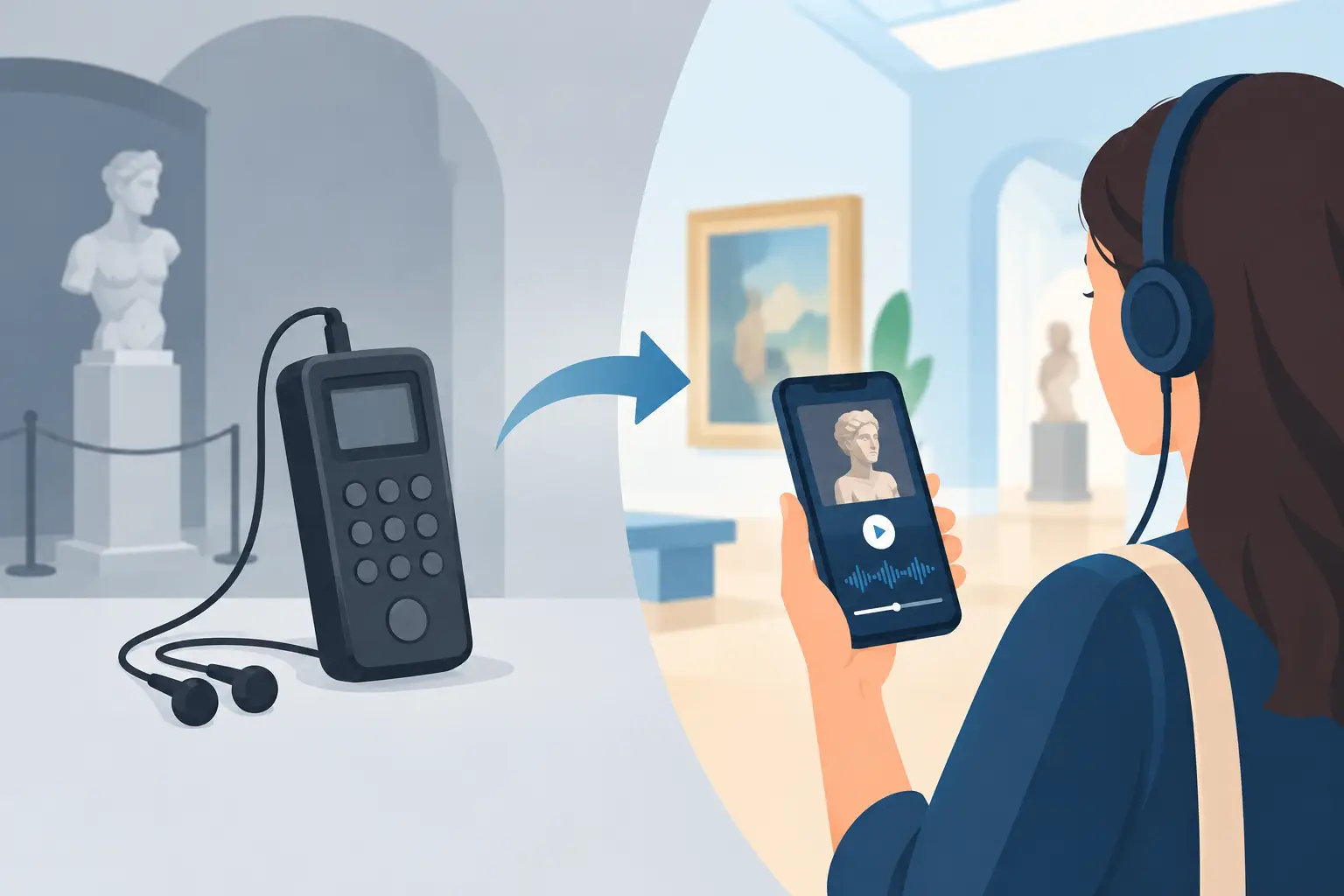
An audio guide designed in 2016 can still provide an exact commentary on a work or monument. But does it meet the expectations of visitors in 2026, the new uses of smartphones, the accessibility needs and the attendance objectives of your structure? This is the whole question behind “why an audio guide should no longer be a frozen tool for 10 years”. A mediation system is not a simple collection of audio tracks: it is a living service, in contact with a territory, its audiences and its teams.
For museums, heritage sites and tourist offices, developing the audio guide does not mean giving in to a race for new things. Rather, it is about maintaining the ability to transmit, accurately, as audiences, content and context change. This capacity has become an operational as well as a cultural issue.
A cultural journey evolves with its place
A temporary exhibition is renewed, a closed space for work, a new acquisition enters the collections, a visit itinerary is modified or an archaeological discovery sheds new light. In each of these cases, a frozen audio guide creates a break between the proposed discourse and the reality of the place.
This break is not always spectacular. It can take the form of an instruction that has become useless, a step number that cannot be found, a comment that ignores a new development or content that no longer reflects the available knowledge. For the visitor, this weakens the confidence placed in the route. For the team, this generates additional explanations at reception and the feeling of having to deal with a tool that no longer follows the life of the site.
On the contrary, a manageable digital audio guide allows you to adjust text, replace media, add a step or suspend content. This flexibility is not intended to encourage permanent changes. It simply gives professionals control over their speech, without depending on a long and costly hardware replacement cycle.
Preserve editorial quality, without immobilizing content
Evolving does not mean publishing in a hurry. Cultural mediation requires scientific, editorial and sometimes institutional validation. Sensitive content, particularly when it deals with history, memory or living heritage, requires time and rigor.
The challenge is therefore to distinguish editorial stability from technical immobility. A commentary can remain relevant for several years while being enriched by a sign language version, a transcription, a comparative image or a new sequence intended for young audiences. A well-designed platform makes it possible to organize these developments, validate them and publish them when the team is ready.
Why an audio guide should no longer be a frozen tool for 10 years
For a long time, the audio guide was associated with a fleet of boxes: large initial purchase, recording of content, configuration, then use over a long period. This model responded to real technical constraints. It also imposed a logic of depreciation: since the equipment had been acquired, it had to be kept for as long as possible.
The visitor's smartphone changes this equation. With access by QR code or geolocation, the route can be broadcast without distributing, cleaning, recharging, inventorying or replacing dedicated devices. The budget and energy of the teams can better serve the mediation itself: quality of the stories, languages offered, accessibility, updating of information and analysis of uses.
This development does not mean that everything must be dematerialized without support. Some visitors do not have a smartphone, do not wish to use their plan or encounter difficulties with digital technology. An inclusive strategy provides for clear signage, reception capable of helping with getting started and, depending on the context, alternative solutions. Technology should expand access, never create a new barrier.
Not all visitors expect the same visit
A school group, a local resident, a family on vacation, a visually impaired person, an architecture enthusiast or a foreign visitor do not approach the place with the same expectations. A single linear route, designed for an average audience, struggles to respond to this diversity.
An evolving audio guide can offer several entry points without complicating the visit. A short version for visitors in a hurry, an in-depth tour for curious audiences, content suitable for children, several languages or thematic modules allow everyone to build a fairer experience. The principle remains simple: offer a useful choice, without transforming the visit into a confusing catalog.
Accessibility deserves special attention. Transcriptions, content in sign language, enhanced contrast, readable navigation, audio descriptions or adaptation of the consultation pace are not marginal options. They participate directly in the public service mission and the dissemination of knowledge. They can also improve the experience of many visitors who do not necessarily define themselves as having a disability.
Guideius addresses every digital cultural mediation challenge
Create a multilingual smartphone audio guide that is easy to deploy, accessible and tailored to your museum, heritage site or destination.
Data to decide, not to monitor
When an audio guide remains unchanged for a decade, it becomes difficult to know what really works. What content is most listened to? When do visitors leave the course? Which language is most in demand? Are the outdoor stages visited as much as those in the main rooms?
Anonymized usage statistics provide concrete benchmarks. They do not replace field observation or discussion with mediators, but they help to objectify certain decisions. Rarely launched content is not necessarily bad: it may be poorly marked, too long, placed in the wrong place or poorly adapted to the actual journey. Conversely, a highly consulted step can reveal a strong point to develop in communication or programming.
This approach must remain ethical. Cultural structures are responsible for protecting visitor data and only collecting what is useful for managing the service. Measuring usage does not imply tracking people. A respectful tool makes it possible to understand the routes without sacrificing public trust.
Maintenance that protects the investment
The cost of an audio guide is not limited to its installation. You have to consider devices, helmets, repairs, hygiene, storage, team training, updates and time spent on incidents. In a small structure, these tasks quickly weigh on teams that are already very busy.
A digital service with maintenance included transforms this relationship with time. Technical updates, compatibility developments and continuity of service no longer rely entirely on the establishment. The gain is not only financial. It is also organizational: the team can focus on reception, programming and the quality of mediation.
However, we must look at the conditions of this scalability. Who can modify the content? Are changes easy to publish? Does the data remain under the control of the structure? Does the course work in low connectivity areas with an offline mode? A solution adapted to the field must provide clear answers to these questions, and not add a technical dependency that is difficult to manage.
Making the audio guide a sustainable transmission tool
The lifespan of a good audio guide is not measured by the number of years its files remain unchanged. It is measured by its ability to remain useful, fair and welcoming. An evolving route can preserve solid heritage content while integrating the transformations of the place and the needs of new audiences.
To initiate this process, it is often relevant to start modestly: update the most sensitive steps, add a priority language, improve access to key content or analyze the first consultation data. A simple-to-administer platform, like Guideius, makes these adjustments possible without requiring a dedicated technical team.
Heritage does not freeze when we protect it: it continues to be studied, told and shared. Your audio guide should follow the same movement, with sobriety, rigor and attention paid to each visitor.
Would you like to apply these ideas to your site?
Guideius helps deploy multilingual audio tours with QR codes, GPS, offline mode, multimedia content and privacy-friendly analytics.