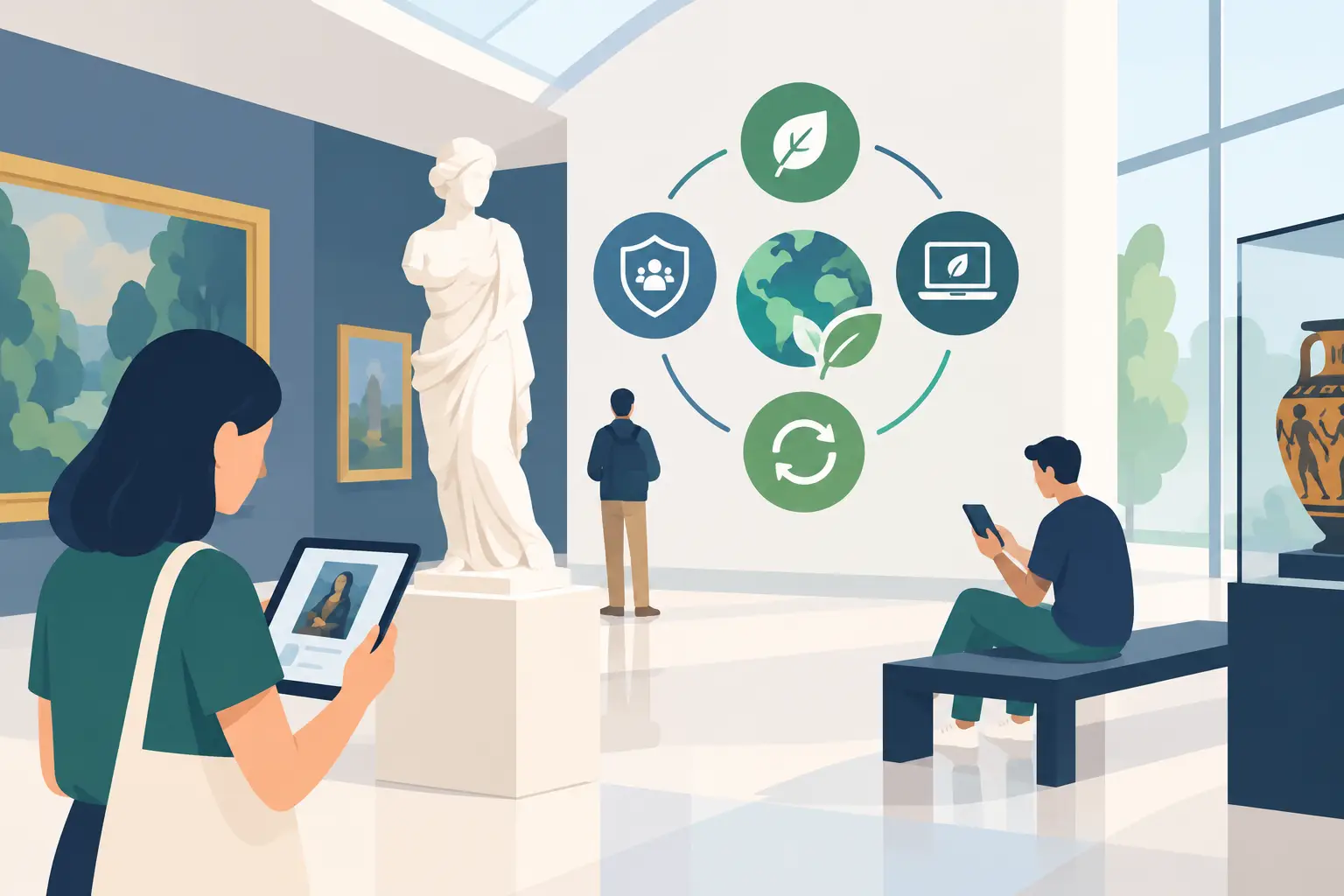
A visitor scans a QR code at the entrance to a museum, listens to a commentary in their language, activates subtitles, then continues the visit without a network in a vaulted room. Behind this simple gesture lies a fundamental choice: that of ethical digital technology for cultural places, thought of as a transmission tool rather than as an imposed technical layer.
For a museum, a monument, a tourist office or a community, the challenge is not to add digital technology because it is expected. It consists of choosing uses that truly serve the public, respect teams and preserve resources. A solution can be innovative without being intrusive, accessible without being complex to administer and efficient without multiplying equipment.
What does ethical digital mean for cultural places?
Digital ethics is not just about data protection. In the cultural sector, it concerns the way in which the tool transforms the visiting experience, working conditions and the relationship between the institution and its audiences.
An ethical system starts from a concrete question: who does it serve? If an application asks for too much personal information, requires a recent smartphone or requires a permanent connection, it risks excluding some visitors. Conversely, an audio tour that is easy to access, available in several languages and downloadable in advance can strengthen autonomy without creating an additional barrier.
This requirement also applies to teams. Many small and medium-sized cultural structures have neither an IT department nor the time necessary to maintain a succession of specialized tools. Responsible digital technology must therefore remain manageable by the people who operate the site on a daily basis: mediators, receptionists, collections managers or tourist office agents.
Finally, ethics is a matter of consistency. An establishment that defends conservation, memory and access to heritage has an interest in choosing sustainable solutions, sober in their uses and transparent in their operation.
Protect data without giving up understanding its uses
Consultation statistics are valuable. They make it possible to know which routes are followed the most, when visitors stop listening, what languages are used or which points of interest attract the most attention. This information helps improve mediation and justify choices to public partners.
But measuring does not mean monitoring. The data collected must be limited to what is useful, understandable for visitors and processed within a clear framework. For a digital audio guide, it is rarely necessary to request the creation of an account or to collect detailed personal data to offer a quality visit.
A healthy approach favors anonymized and aggregated usage data. It simply informs the public about what is being collected, why and for how long. It also allows the structure to maintain control of its data, rather than letting it fuel commercial uses far removed from its cultural mission.
When choosing a solution, teams should examine the location and security of the hosting, the methods of access to the data, their retention period and the conditions of reversibility. This last point is often neglected: if the tool changes one day, the establishment must be able to recover its content and usage information without excessive dependence.
Accessibility should drive design, not be at the end
A digital journey does not become inclusive because it is offered on a smartphone. The personal telephone can reduce the need for equipment to be loaned, but it does not alone solve the difficulties linked to disability, language, age, reading or familiarity with digital technology.
Accessibility begins with editorial choices. Short sentences, readable navigation, adapted vocabulary and well-structured audio content make it easier for everyone to understand. transcriptions and subtitles make audio more accessible to people who are deaf or hard of hearing, while still being useful in a noisy space. Image descriptions, sufficient contrasts and compatibility with support tools further expand access.
We must also think about visitors who are poorly equipped or uncomfortable with their phone. Clear signage, direct access by QR code, an interface without compulsory registration and human support at reception avoid transforming entry into the course into a technical test. Depending on the audiences welcomed, the one-off loan of a few devices or the conservation of non-digital alternatives may remain necessary.
The goal is not to digitize everything. It’s about offering several paths to content, so that no visitor is left at the door.
Guideius addresses every digital cultural mediation challenge
Create a multilingual smartphone audio guide that is easy to deploy, accessible and tailored to your museum, heritage site or destination.
Digital sobriety is also an operational decision
In a cultural place, sobriety does not mean impoverishing the experience. It consists of concentrating resources on what provides real mediation value. A relevant audio commentary, an archive photograph or a well-designed map are sometimes more useful than a heavy animation, difficult to load and expensive to renew.
The choice of material has a direct impact. Dedicated audio guides involve purchasing, recharging, cleaning, storing, maintaining and replacing. A solution accessible on visitor's smartphone can greatly alleviate these logistics, provided that all the constraints are not transferred to the public. The right balance depends on the context: attendance, age of visitors, quality of the network, seasonality and configuration of the site.
Offline mode is particularly relevant in monuments with thick walls, rural spaces or outdoor routes. It improves visit continuity while limiting dependence on unstable network coverage. Content can be prepared in advance, rather than constantly requested from a server.
Sobriety also involves the editorial lifespan. An easy-to-update platform makes it possible to correct information, add a translation or create a temporary route without starting the entire project again. This ability to evolve protects the initial investment and encourages lively content, anchored in current events of the place.
Choosing a digital solution based on the field
A convincing demonstration is not enough. Before deploying a tool, it is useful to confront it with the realities of the site: quality of the connection, inaccessible areas, group flow, linguistic diversity, level of autonomy of visitors and actual availability of the team.
Four criteria make it possible to concretely evaluate a solution:
- simplicity of access for the visitor, with no downloading or account creation required when this is not necessary;
- the autonomy of the team to create, correct and publish without advanced technical skills content;
- accessibility features and the possibility of offering adapted multilingual courses;
- transparency on data, costs, maintenance and content recovery possibilities.
It is also wise to test the route in real visit conditions. A QR code placed in bright light, a GPS trigger near a building or an audio file downloaded over a weak network do not always behave as expected on a presentation screen. Inviting a few visitors, volunteers or reception staff to test the experience often provides more useful feedback than a long specification.
Making digital an extension of mediation
A good tool does not replace the words of mediators, the look at a work or the encounter with a territory. It gives everyone more freedom to choose their pace, their language and their level of depth. It also allows you to extend a story outside of visiting hours, for example on a heritage circuit or in an old center.
It is in this logic that solutions like Guideius favor multilingual audio tours accessible by QR code or GPS, usable offline and administered without technical expertise. Digital technology then becomes a concrete support for transmission, and not an additional constraint for structures.
The good project rarely begins with the question “which technology to choose?” ". It begins with another, more useful one: what story do we want to make accessible, to whom, and under what conditions?
Would you like to apply these ideas to your site?
Guideius helps deploy multilingual audio tours with QR codes, GPS, offline mode, multimedia content and privacy-friendly analytics.