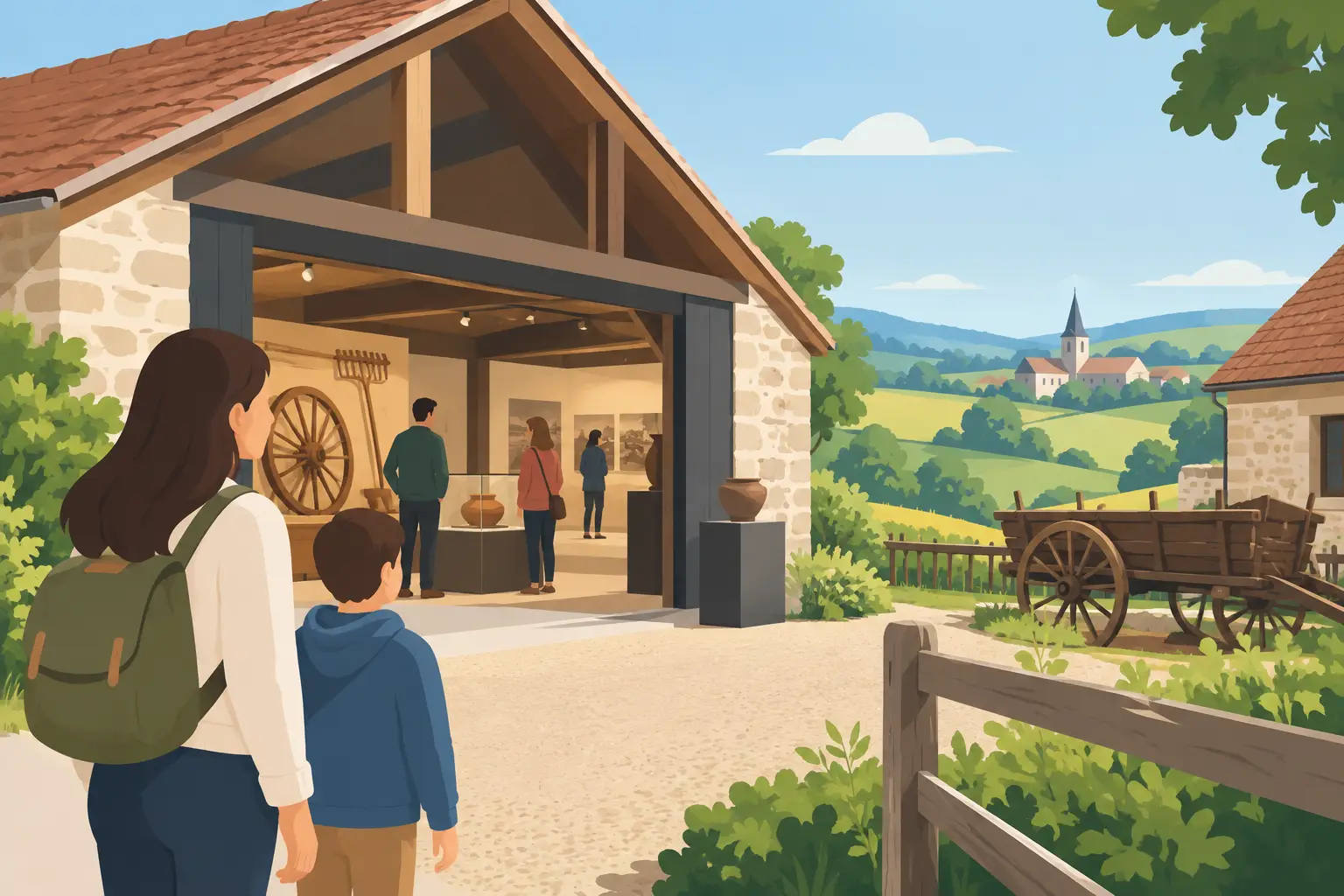
In rural museums, a visit often begins before the entrance door. It begins in a village square, at the edge of a path, in front of an old barn or in a landscape which gives meaning to the collections. This proximity to the territory is a considerable strength. It also poses a very concrete question to the teams: how can we enrich the interpretation without burdening the reception, the budget or the daily organization?
Digital mediation can respond to this, provided it is not thought of as a technological layer added at the last moment. For a small structure, it must serve the story of the place, respect the realities of connection, facilitate the work of teams and welcome visitors with very diverse expectations. A good device does not replace either the mediator or the emotion of an object kept locally. It gives more keys to understanding them.
Rural museums have very specific constraints
A museum located outside the major tourist centers does not always have a digital service, a permanent ticket office or a budget dedicated to renewing equipment. The team can bring together a few employees, seasonal workers and volunteers. It simultaneously ensures reception, conservation, programming, communication and sometimes the opening of several sites.
In this context, traditional audio guides often create more tasks than they solve: purchasing equipment, recharging, disinfection, storage, maintenance, loss management and visitor support. Their cost is never limited to the purchase price. It includes the time spent each week to prepare them and put them back into service.
The territory adds its own constraints. Mobile coverage can be patchy, routes extend into streets or landscapes, and opening hours vary depending on the season. Some visitors arrive without reservation, others seek an independent visit outside periods of high human presence. The relevant solution is therefore one which remains reliable without imposing a disproportionate infrastructure.
Make the smartphone a transmission tool, not a barrier
The visitor's personal telephone makes it possible to offer rich mediation without distributing material. A simple QR code, placed at reception or at the start of a route, can open an audio tour on an application or web app. In an outdoor route, GPS can trigger content when approaching a point of interest.
This approach is particularly suited to sites where the experience is built between collections, architecture and environment. A voice can accompany the observation of an agricultural tool, make a resident's testimony heard, explain the history of a know-how or invite us to look at an element of the landscape in the distance. Audio leaves the hands and eyes available, which is important in places that are often dense with objects or details.
Simplicity on the visitor side remains essential. Requesting the creation of an account, the downloading of a large file or a succession of manipulations can discourage part of the public. Immediate access, visible instructions and the possibility of continuing the visit offline greatly reduce this friction.
However, one nuance must be kept: not all visitors want to or cannot use their smartphone. Inclusive mediation provides alternatives, for example editorialized signage, a paper booklet or occasional support from an agent. Digital technology must expand the possibilities of visiting, not create a new condition of access.
Offline is not a technicality
In a village, on an old farm or on a nature trail, the network cannot be taken for granted. Offline mode is therefore a choice of reception quality. It allows the visitor to download content before departure or at the point of entry, then continue their journey without interruption.
For the team, this feature avoids having to explain connection issues on each visit. It also secures outdoor routes and places with thick walls, where coverage may be poor despite the presence of a network in the town.
Design a story on the scale of the place
Technology does not compensate for an imprecise editorial journey. Before choosing the features, it is useful to define what the visitor should remember, feel or better understand when leaving. In a rural museum, the challenge is not to accumulate information. It often consists of linking a collection to gestures, families, a local economy and a landscape.
An effective journey can be based on a simple common thread: the transformation of a material, the history of a farm, the changes in a village, daily life at a given time or the transmission of a profession. This consistency gives value to each step and avoids encyclopedic commentary.
The duration must be chosen realistically. A main visit of forty-five minutes may be suitable for a museum structured in rooms, while a route of fifteen to twenty minutes will be better suited to passing visitors or a wandering stopover. It is often preferable to offer several reading levels rather than a single, overly long course: an essential selection, supplements for the curious and, if necessary, a version suitable for families.
Multimedia content has its place when it provides proof, an atmosphere or an explanation that is impossible to obtain otherwise. An archive photograph can show the use of a machine. A sound clip can recreate a regional language or a work environment. A short video can reveal an artisanal gesture. Conversely, adding media to occupy the screen risks distracting attention from the objects and the real location.
Guideius addresses every digital cultural mediation challenge
Create a multilingual smartphone audio guide that is easy to deploy, accessible and tailored to your museum, heritage site or destination.
Make the visit truly accessible
Accessibility should not occur at the last stage of the project. It improves the experience for all audiences, including foreign visitors, families, people unfamiliar with museums or audiences with specific needs.
Transcriptions associated with audio tracks allow everyone to choose their consultation mode. Structured texts, sufficient contrast, readable navigation and simple controls make it easier to use on a smartphone. Multilingual versions, for their part, are particularly useful in territories crossed by international tourists or located near a border.
The choice of languages, however, deserves to be driven by usage and not by the advertising effect. Translating a very long set into many languages can become expensive and difficult to maintain. It is better to start with the most relevant languages for the territory, guarantee their editorial quality, then develop the offer based on attendance data and feedback.
Accessibility also concerns tone. Overly specialized vocabulary can alienate a novice visitor, while oversimplification can frustrate an informed audience. Clear, precise and embodied content helps maintain this balance. They respect historical complexity without reserving its understanding to a few initiates.
Give teams a solution they can administer
The success of a project depends as much on its operation as on its launch. A mediation platform must allow a non-technical team to correct a text, replace an image, adjust a GPS point or publish a translation without systematically depending on a service provider.
This autonomy is valuable for rural museums, where temporary exhibitions, local festivals and associative partnerships change the programming. It also allows content to be updated when a search progresses, when an object is restored or when a circuit is modified by work.
It is useful to designate an editorial referent, even if several people contribute to the content. Its role is not to master all the technique, but to guarantee the consistency of tone, the reliability of information and the continuity of updates. Initial support in creating a course can save considerable time, particularly in structuring the stages and preparing the media.
Guideius responds to this logic with an administration designed for cultural teams, routes accessible by QR code or GPS, offline operation and integrated accessibility options. The objective is not to make mediation more complex, but to make a quality experience possible without a dedicated equipment fleet.
Measure to improve, without losing the sense of public service
Finally, usage statistics provide information that is often difficult to obtain in small establishments. They can show which languages are chosen, which stopping points are most visited, how many visits are started or completed, and when the route is most used.
This data should not lead to judging content solely on its click rate. A short but essential sequence for understanding the place may be less consulted than a family quiz. On the other hand, they help to identify a poorly signposted stage, content that is too long, a language that is not in high demand or an underused outdoor route.
For public and associative structures, data control is a criterion of trust. Priority should be given to tools that are transparent about the data collected, limiting monitoring to what is necessary and respecting applicable obligations. Ethical mediation protects visitors while giving teams useful benchmarks to progress.
A well-sized digital mediation project can thus extend the human welcome, make the territory more readable and give a second life to sometimes little-known stories. For rural museums, the right choice is not the most spectacular solution: it is the one which allows, over time, to better convey the singularity of the place to each visitor.
Would you like to apply these ideas to your site?
Guideius helps deploy multilingual audio tours with QR codes, GPS, offline mode, multimedia content and privacy-friendly analytics.