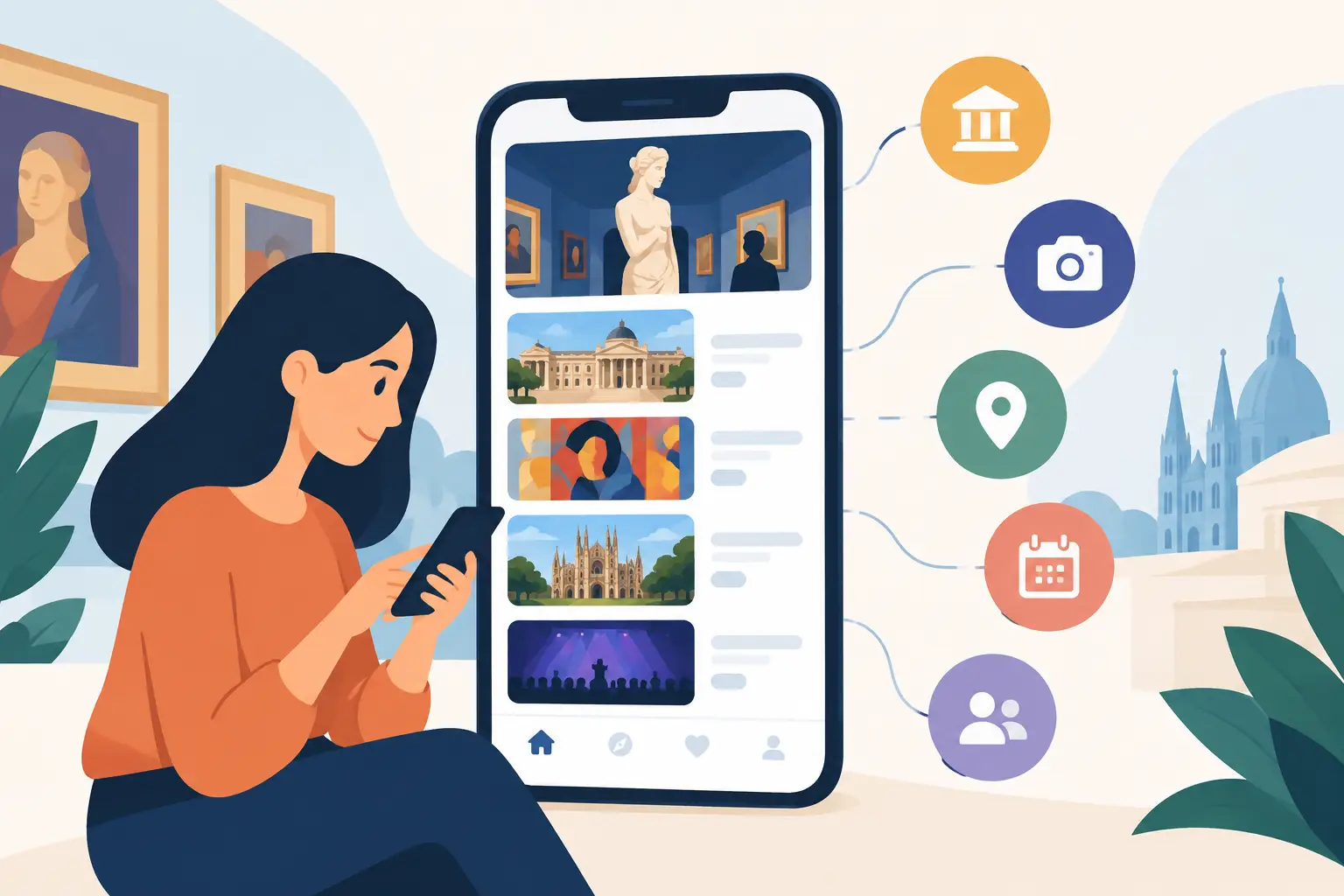
A visitor stops in front of a Romanesque chapel, a painting or a historical marker. He wants to understand what he is looking at, without waiting, without downloading a complicated route and without depending on an uncertain network. For the teams, the challenge is just as concrete: offering quality mediation without adding a technical or logistical burden that is difficult to maintain. The best features of a cultural application meet this dual requirement: enriching the visit, while remaining simple to deploy and administer.
The right tool is therefore not just about broadcasting an audio file on a smartphone. It must be integrated into the realities of a museum, a monument, an interpretation center or a tourist office: diversity of audiences, renewal of content, poorly covered areas, budgetary constraints and the need to respect visitor data.
The best features of a cultural application in the field
Immediate access by QR code or direct link
Entry into the course often conditions the rest of the experience. If the visitor has to create an account, search for an application on a store or follow several instructions, some of them will give up. The QR code, displayed at reception, on a label or in a leaflet, gives direct access to the route from the visitor's personal phone.
This simplicity should not be confused with limited experience. A QR code can direct you to a rich web app, personalized in the colors of the location and designed to be used without installation. For an external site, a direct link can also be shared before the visit, in a confirmation email or on printed media. The key is to reduce friction, especially for casual audiences and independent groups.
GPS triggering to tell the story of a territory
In a museum, the visitor often follows a clear spatial progression. On an urban route, a memory circuit or a natural site, the situation is different: the content must appear in the right place. GPS triggering allows each step to be associated with a position and to accompany the walk without imposing a rigid route.
This function is particularly useful for tourist offices and communities wishing to promote an old center, a village, a heritage route or a landscape. It facilitates autonomy and gives rhythm to the visit. However, it requires real editorial work: the GPS must serve the story, not transform the walk into a succession of notifications. In dense areas or when geographic precision is insufficient, the QR code remains a relevant complement.
A true offline mode
Connectivity should never decide the quality of a visit. Thick walls, cellars, remote gardens, monuments located in rural areas: contexts of low coverage are common in heritage. A cultural application capable of offering pre-downloading of content allows the visitor to continue their journey without interruption.
For the team, offline reduces field hazards and limits requests to reception. However, explicit signage should be provided inviting visitors to download the route before starting. This precaution is simple, but it makes the difference between a digital promise and a truly reliable tool.
Multimedia content at the service of interpretation
Audio remains the heart of an effective audio guide: it leaves the eyes available to observe the work, the architecture or the landscape. But it benefits from being accompanied, when it makes sense, by archive photographs, enlarged details, maps, short videos or contextualizing texts.
Multimedia should not overload the screen. A comparative image can explain a restoration; a map can locate an ancient rampart; a photograph can make a disappeared building visible. Each format must respond to a specific mediation intention. A successful application is one that helps you look better, not one that seeks to keep the visitor on their phone.
Multilingualism, thought of from the design
A translation added late often produces an uneven journey. Multilingualism deserves to be anticipated from the writing stage: length of tracks, cultural references, tone of voice, readability of practical information and ability to update each version. For a site frequented by international audiences, this is a direct lever for reception and attractiveness.
It is not necessary to offer all possible languages. It is better to start with the languages that really correspond to the frequentation of the place and ensure constant editorial quality. The interface must allow the visitor to easily choose their language, without restarting the entire process or losing their progress.
Guideius addresses every digital cultural mediation challenge
Create a multilingual smartphone audio guide that is easy to deploy, accessible and tailored to your museum, heritage site or destination.
Features that make mediation more inclusive
Accessibility cannot be an option added at the end of the project. A cultural application must offer several ways to access the same content, in order to respect everyone's needs and uses. Subtitles and transcriptions support people who are deaf or hard of hearing, but also visitors who prefer to read. Structured texts, sufficient contrast and navigation compatible with assistive technologies improve the experience for many audiences.
Content in sign language, audio description or courses adapted for people with comprehension difficulties represent a more specific editorial investment. They are not required in all projects at the same level, but they must be possible without changing tools. The flexibility of the platform is decisive: it allows you to move forward in stages, according to the priorities of the site and the resources available.
Inclusion also concerns families and audiences unfamiliar with cultural institutions. A well-designed quiz, observation questions or a children’s tour can encourage an active visit. These formats work provided they do not infantilize the content. They must extend the story of the place, with appropriate difficulty and tone.
Simple administration to keep control of content
For a small or medium-sized structure, an application is only useful if the team can bring it to life. Hours change, a room temporarily closes, an exhibition evolves, a translation must be corrected. A clear administration area allows you to modify texts, media, order of steps and practical information without systematically depending on a technical service provider.
This autonomy does not exclude support. Creating a good course requires a method: define the audiences, prioritize the messages, write for the audience, choose the right media and test the course on site. A solution like Guideius combines this simplicity of administration with support adapted to field teams, without requiring the management of a dedicated fleet of audio guides.
Visual personalization also matters, especially for museum networks, communities or sites with a strong identity. A white label offer can meet this need. However, it must remain proportionate: for a place that opens seasonally or starts in digital mediation, the priority remains the quality of the route and its ease of access.
Measure usage without monitoring visitors
Usage statistics help guide a cultural journey. Number of starts, selected languages, most viewed steps, average duration or completion rate: this data reveals what attracts attention and what needs improvement. They can also inform choices regarding layout, signage or programming.
These indicators are only valuable if they are understandable and respectful of privacy. For public and parapublic structures, control of data is a condition of trust. We must prioritize statistics that are useful for improving the experience, without transforming the visit into an individual monitoring system. Digital sobriety is also there: collect less, but collect better.
Choose according to your project, not according to a list of promises
Not all features are required out of the box. A small museum may first need QR code access, multilingual audio tracks and simple administration. A large territory will favor GPS and offline. An establishment committed to an accessibility approach will look for suitable formats and an inclusive interface. The right choice always starts from the visit route, the target audiences and the real capacity of the team to update the content.
A successful cultural application is almost forgotten: it replaces neither the works, nor the landscapes, nor the words of the mediators. It creates the conditions so that each visitor can understand, choose their own pace and keep a more vivid trace of their encounter with heritage.
Would you like to apply these ideas to your site?
Guideius helps deploy multilingual audio tours with QR codes, GPS, offline mode, multimedia content and privacy-friendly analytics.