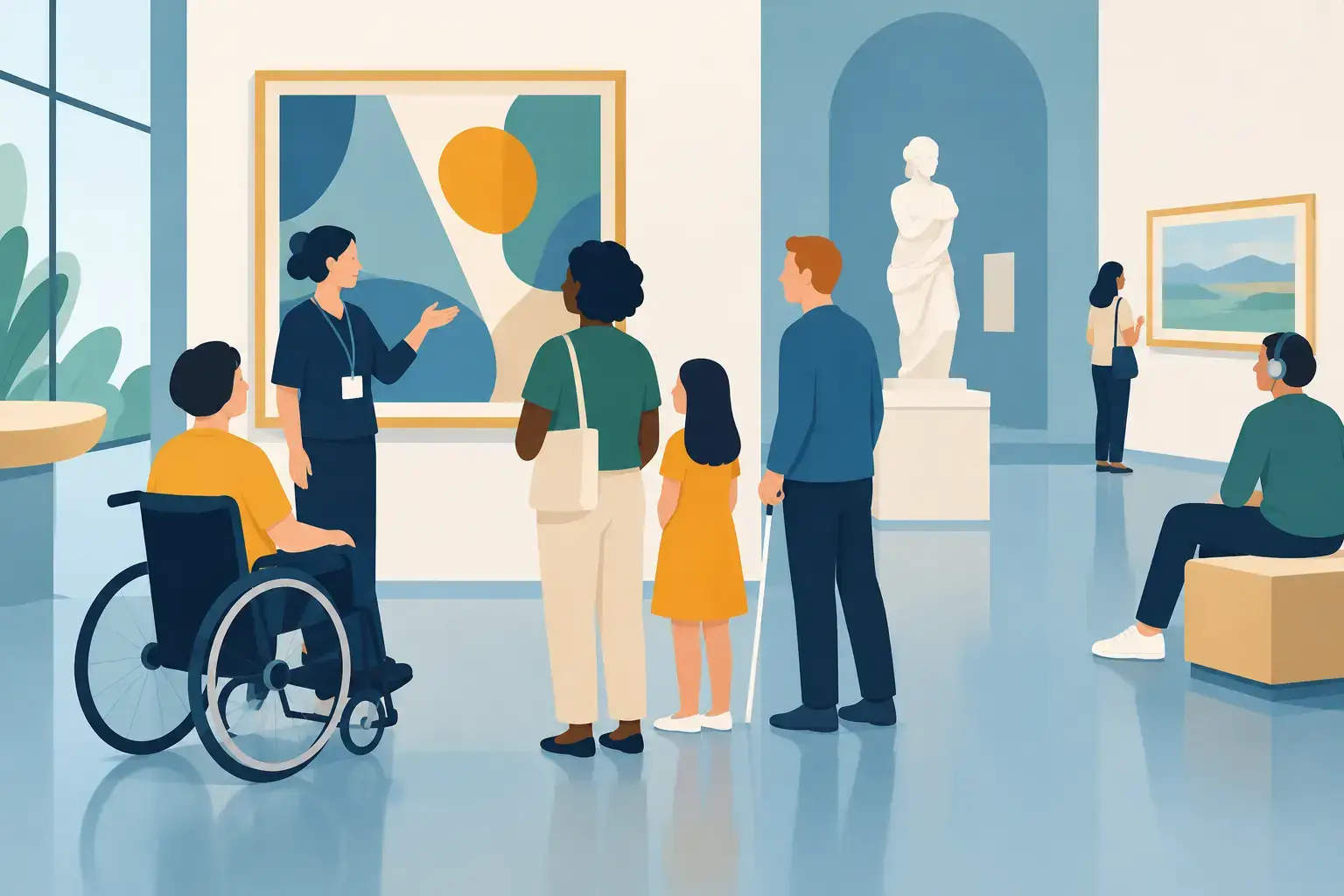
A label that is too high, an audio without transcription, a visit only in French or a QR code placed in an area without a network can be enough to exclude part of the public. Inclusive mediation responds to this concrete reality: allowing as many people as possible to understand, feel and explore a cultural place in good conditions, without making accessibility a peripheral option.
For a museum, a heritage site or a tourist office, the issue goes beyond respecting an obligation. Mediation designed for a variety of audiences improves the quality of reception for everyone: families, foreign visitors, people unfamiliar with cultural codes, seniors, people with temporary or lasting disabilities. It also makes content more readable for the teams who design and update it.
Inclusive mediation is not just about disability
Inclusion consists of recognizing that visitors have neither the same sensory capacities, nor the same language, nor the same available time, nor the same comfort with digital technology. A hearing-impaired person, a dyslexic visitor, a family with a stroller, a tourist who does not speak French or a teenager who prefers a brief format do not have the same relationship with the route. However, everyone must be able to understand the meaning of the visit.
This approach avoids designing a standard course, then adding adaptations at the margins. Rather, it invites you to offer several entry points from the start: listen, read, look, choose your level of detail, move forward at your own pace. The diversity of formats does not dilute the scientific content. When it is well editorialized, it makes it fairer and more available.
Physical accessibility remains essential: pathways, seating, signage, lighting, height of supports. But mediation plays an equally decisive role. A space that is difficult to access can, for example, be interpreted using images, an audio description or a digital restitution. This does not replace the necessary work on the building, but it limits immediate exclusion and honestly explains the constraints of the place.
Design inclusive mediation from the writing stage
The first lever is editorial. Accessible content is not necessarily oversimplified. It is structured, contextualized and expressed in clear language. Short sentences, explicit chronological markers and the definition of specialized terms facilitate understanding without sacrificing historical or artistic precision.
It is useful to distinguish between several reading depths. A visitor in a hurry can listen to a one-minute commentary and retain the essentials. A passionate person can continue with a supplement on the restoration of a work, the history of a building or archaeological sources. This progression respects real practices: no one visits in the same way at ten in the morning, with a school group, in busy times or at the end of a day of travel.
Descriptions of images and objects constitute another point of vigilance. Saying that a work is beautiful, imposing or moving is not enough to make it perceptible. You must name the shapes, materials, colors, dimensions, characters, composition and details that support the interpretation. This work benefits visually impaired people, but also everyone who wants to see better.
Language must also be considered as a condition of access. The translation of courses into the languages most useful to visitors to the site naturally broadens the audience. The choice depends on the territory, the seasonality and the audiences welcomed. It is better to offer a few truly reread and adapted versions than a multiplication of approximate translations, which would weaken the quality of the visit.
Adapt formats without increasing obstacles
A digital audio guide can become a very inclusive tool if it combines several media around the same content. Audio is suitable for many visitors, especially when traveling or in front of a monument. Its transcription allows you to follow without sound, in a noisy environment or for deaf and hard of hearing people. Captioned visuals, easy-to-navigate texts and, depending on the project, subtitled videos usefully complete the experience.
Compatibility with screen readers, readability of contrasts, character size and simplicity of buttons are not graphic details. These are conditions of autonomy. An overloaded interface can discourage a visitor from the first seconds, even if the content is excellent. Conversely, clear navigation reduces requests to reception and secures use in the field.
Using a personal smartphone has a concrete advantage: the visitor often finds their own accessibility settings, such as character enlargement, volume or assistance functions. This solution should, however, not exclude people without equipment, without batteries or who are uncomfortable with digital technology. Inclusive mediation therefore provides for a human welcome, explicit signage and, when necessary, non-digital alternatives or loaner equipment.
Accessibility
Give visitors personalised reading settings—including font, size, colour and spacing—to make the experience more inclusive.
Think about the route in real visit conditions
Inclusive quality happens outside the office. Is a QR code easily identifiable and accessible? Are the instructions understandable in a few seconds? Can content be downloaded before entering a poorly covered area? Do GPS triggers remain reliable in an old center, a park or a large site? Each response has a direct effect on the fluidity of the experience.
The offline mode is particularly useful in monuments with thick walls, rural territories and outdoor courses. It prevents access to content from depending on a mobile plan or uneven network coverage. For teams, this also reduces frustrating situations at reception: a visit should not be interrupted because a visitor does not have a connection.
Inclusion also requires rhythm. Planning short stages, indicating an approximate duration and allowing you to freely choose the order of certain content promotes a less prescriptive visit. On a long route, break points or family-friendly sequences can make a considerable difference. It is not a question of imposing a universal itinerary, but of giving everyone more control over their journey.
Involve audiences and teams in the project
The best choices don’t just come from specifications. Testing a prototype with visitors with different profiles allows you to spot what designers no longer see: ambiguous vocabulary, a poorly named button, a sound that is too weak, a step that is too long or content that is difficult to locate.
Local associations, medico-social establishments, groups of regular visitors and tourism partners can contribute to these tests. Their participation must be prepared and recognized. Asking for specific feedback on a version that is already advanced is more useful than asking for general advice on inclusion. This approach anchors the project in real uses, rather than in hypotheses.
Reception agents, mediators and guides also know the recurring difficulties: language questions, hesitations regarding the QR code, mobility constraints, needs for content adapted to groups. Involving them in the design improves the journey and facilitates its internal appropriation. A solution, even simple to administer, is only sustainable if the teams understand its usefulness and know how to guide visitors with confidence.
Measuring to improve inclusive mediation
The usage statistics should not only be used to count triggers. They help to understand what content is actually viewed, when visitors abandon a journey and which languages are most in demand. Crossed with feedback from the field, they guide concrete improvements: shorten a sequence, clarify an instruction, reinforce a signage point or enrich a linguistic version.
This data must remain proportionate, transparent and respectful of privacy. For public or parapublic structures, data control is consistent with an inclusive approach: welcoming everyone does not mean following everyone. Anonymized indicators that are useful for management are often enough to manage the evolution of a course.
Guideius supports this logic by offering courses that can be administered without technical expertise, with multilingual content, access by QR code or GPS, offline consultation and accessibility functions. The objective is not to add a technological layer to the cultural place, but to put digital technology at the service of more autonomous and attentive mediation.
Making inclusion a design criterion permanently changes the relationship between a place and its visitors. Each improvement, even modest, sends the same message: here, knowledge is not reserved for those who have already mastered the codes of the visit.
Would you like to apply these ideas to your site?
Guideius helps deploy multilingual audio tours with QR codes, GPS, offline mode, multimedia content and privacy-friendly analytics.