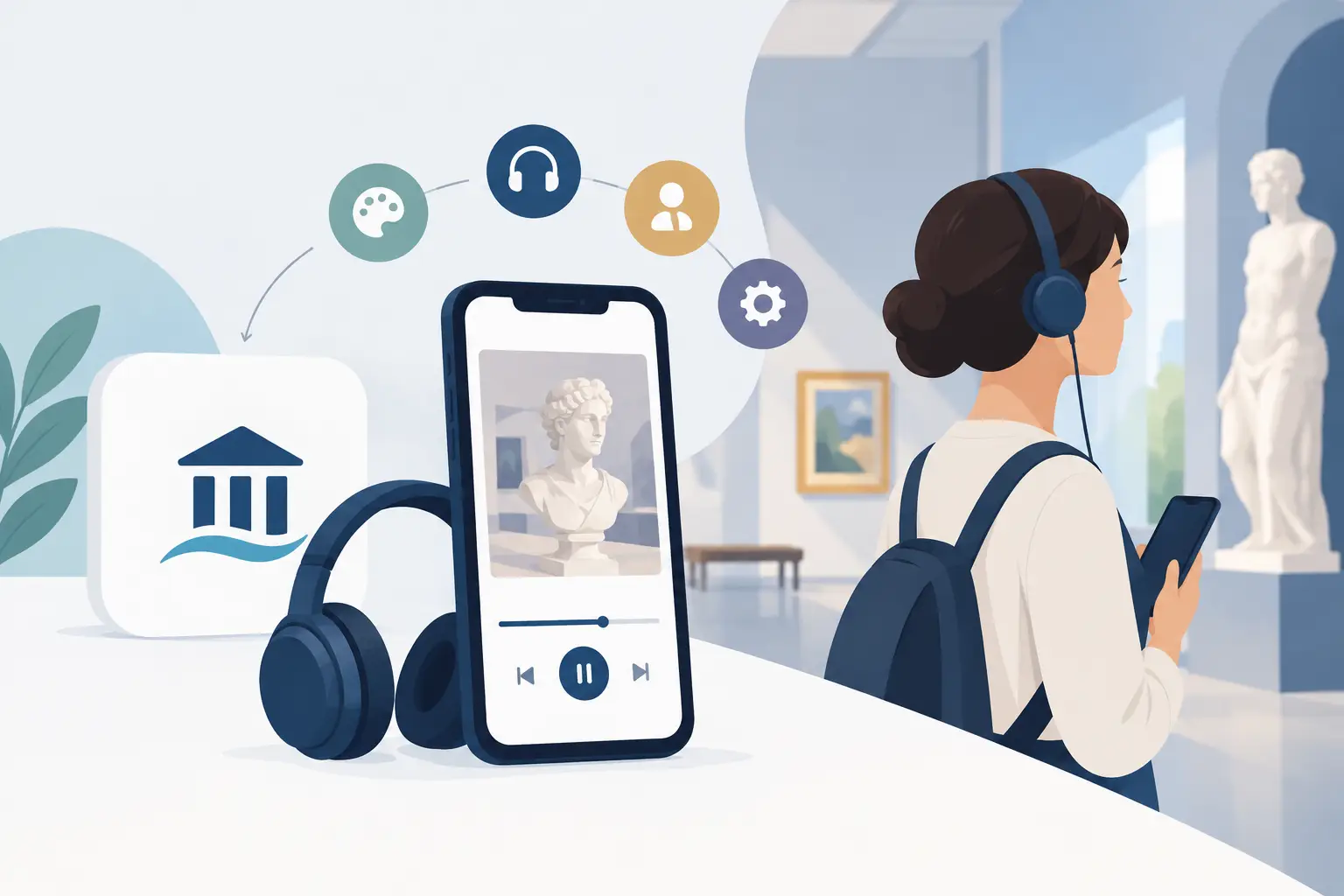
A visitor scans a QR code at the entrance to a museum, a historic garden or an urban route. In a few seconds, he accesses a visit which bears the name, colors and tone of the place. This is the whole promise of the white label: to offer a digital experience fully linked to your institution, without having to design and maintain a technical solution alone.
For culture and tourism professionals, the issue goes beyond aesthetics. A coherent digital identity strengthens trust, extends mediation work and gives a more visible place to the territory. This personalization must still remain compatible with the realities on the ground: small teams, constrained budgets, varied audiences and strong requirements in terms of accessibility.
What is a white label solution?
A white label solution is a service designed and maintained by a service provider, but presented under the identity of the organization using it. In the case of a digital audio guide, the visitor finds your universe: name of the site, graphic charter, visuals, editorial content and, depending on the scope chosen, a personalized application or web app.
The principle is simple: you do not start with blank software and you do not have to finance the complete development of a tailor-made tool. You benefit from a proven technical base - audio playback, maps, GPS or QR code triggering, multilingualism, statistics, offline operation - adapted to your identity and your uses.
This distinction is essential. A fully custom-developed project gives great freedom, but requires significant time, skills and a maintenance budget. Conversely, a generic offer can be quickly deployed, but sometimes leaves little room for the expression of your brand. The white label falls between these two options: it combines visible personalization and shared infrastructure.
Why white labeling matters for the visitor experience
In a cultural place, every detail contributes to the welcome. The signage, the mediation discourse, the printed media and the visual identity create a common thread. An audio guide displaying an external identity can break this continuity, even if its content is of quality.
With a white label experience, digital becomes a natural extension of the visit. The visitor clearly identifies who is speaking to him. For a municipal museum, this can strengthen the link with the collection and service to the public. For a tourist office, this makes it possible to bring together several routes around a destination. For an associative heritage site, it is a way of promoting local history without adopting the codes of an impersonal platform.
This consistency also has a practical effect. When the name of the place is present in the route, in the welcome messages and in the communication materials, the teams can explain the service to visitors more simply. Digital mediation is better understood as an offer from the site, and not as an additional application to download without reference.
Personalize without making the journey heavier
Useful customization does not consist of multiplying screens or graphic effects. It must serve understanding and comfort of use. A clear home page, readable colors, a hierarchy adapted to content and intuitive navigation are more valuable than a busy interface.
The right level of customization therefore depends on your project. A temporary exhibition can favor a web app accessible immediately by QR code. A network of sites or a tourist destination may benefit from deploying a dedicated application, designed to support several visits and encourage return. In both cases, ease of access remains decisive: a visitor should not waste time creating an account before listening to the first content.
Operational benefits for teams
Choosing a custom solution shouldn't mean becoming a software company. Cultural establishments need autonomy over their content, but also a stable technical framework. This is precisely the advantage of a supported white label offer: the team keeps control of the process, while the infrastructure, updates and maintenance remain taken care of.
This organization allows efforts to be concentrated where they are most useful: the quality of texts, recordings, translations, images and scriptwriting. It also facilitates developments. Modifying a step, adding a language or updating the timetables of a route should not require heavy development intervention.
For small and medium-sized structures, the absence of dedicated equipment is another concrete advantage. No inventory of audio guides to buy, clean, recharge, distribute or replace. Visitors use their smartphone, with their headphones or those offered at reception. This approach reduces logistics while limiting recurring costs related to equipment.
Usage statistics finally provide valuable insight. They can show the most visited languages, the most listened to stages or the times when the route is used. These data are not intended to reduce a visit to numbers. They help teams adjust mediation, identify content that arouses interest and better document the impact of a project with partners or funders.
Guideius addresses every digital cultural mediation challenge
Create a multilingual smartphone audio guide that is easy to deploy, accessible and tailored to your museum, heritage site or destination.
Points to check before choosing an offer
Not all white label offers offer the same degree of customization or the same operational guarantees. Before committing, it helps to clarify the needs of the venue rather than just comparing demo screens.
Here are four questions that usefully structure the decision:
- Which identity can be personalized? Check the presence of your name, your graphic charter, your visuals and, if necessary, a domain name or a dedicated application.
- How do visitors access content? QR codes, GPS, map navigation, offline mode and compatibility with common devices must correspond to the actual configuration of the site.
- Who can administer the courses? An interface designed for non-specialists allows content to be updated without constantly depending on a service provider.
- What framework is provided for data and maintenance? Transparency on hosting, statistics collected, updates and support is particularly important for public and parapublic structures.
Accessibility deserves specific attention. Subtitles, transcriptions, navigation compatible with screen readers, easy-to-read content or suitable settings are not secondary options. They allow more people to participate in the tour. A successful custom solution should incorporate these requirements by design, not treat them as a late addition.
A strong identity, without excessive technical dependence
The white label can give rise to a legitimate concern: that of losing control of your tool by entrusting the technology to a third party. This concern is healthy. It invites us to distinguish technical dependence from necessary support.
A structure must remain the owner of its content, be able to retrieve it and know the conditions for developing the solution. It must also be able to rely on a service provider who takes care of maintenance and clearly explains the limits of the service. Trust is not based on the promise of total autonomy, often unrealistic for a small team, but on a clear sharing of responsibilities.
It’s also a question of sobriety. Developing an entirely new application for each site may seem attractive, but it often involves replicating existing functions and financing their maintenance over time. Shared technology, properly personalized, limits this dispersion while leaving the cultural place what makes it unique: its stories, its collections, its voices and its territory.
Make personalization a mediation choice
A white label offer does not replace an editorial project. She gives it a framework. Before choosing the colors of the interface, you must determine what the visit should allow: understanding a monument, listening to testimonies, exploring a neighborhood at your own pace, preparing a family discovery or making a collection accessible to audiences far from the cultural offering.
The fairest route is not always the longest or the most technological. He is the one who respects the visitor's time, the constraints of the place and the words of the people who carry its history. From this perspective, personalization takes on its full meaning: it does not only consist of displaying a logo, but of offering digital mediation faithful to the cultural identity that you wish to transmit.
For structures that want to combine editorial autonomy, budgetary control and a coherent visitor experience, a solution like Guideius makes it possible to place this ambition within a realistic operational framework. The right project then begins with a simple question: what story does your place want to tell, and to whom?
Would you like to apply these ideas to your site?
Guideius helps deploy multilingual audio tours with QR codes, GPS, offline mode, multimedia content and privacy-friendly analytics.