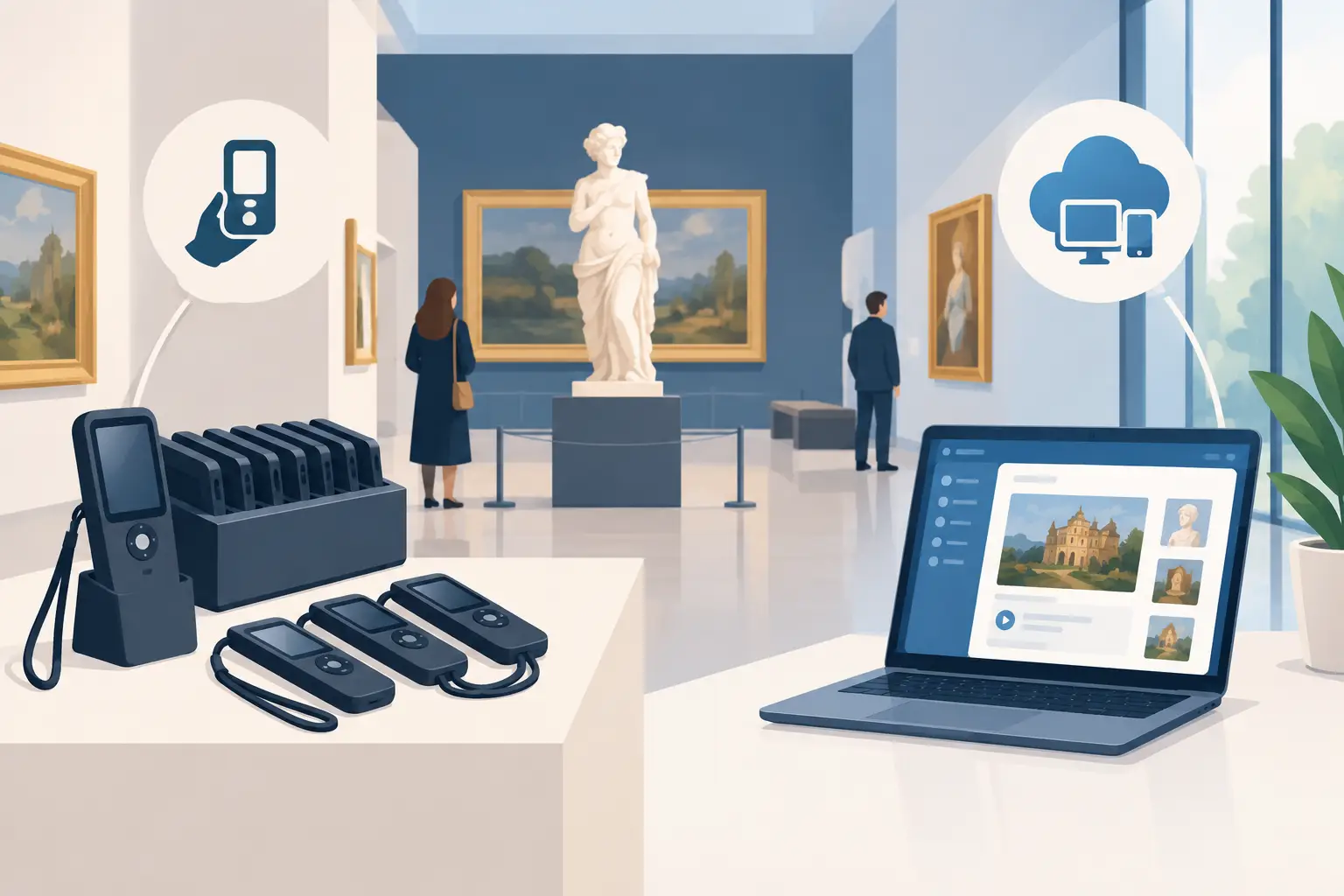
An unavailable audio guide at reception, a dead battery or headphones that need to be disinfected can be enough to spoil a carefully designed visit. Behind the search for “equipment rental or SaaS solution”, cultural establishments do not only choose a technology: they define a reception organization, a budget and a way of making their content accessible.
For a museum, a monument, a tourist office or an outdoor trail, the right answer depends on the location, the public and the human resources available. Box rental remains relevant in certain configurations. But a SaaS solution, used on the visitor's smartphone, often responds more directly to the challenges of simplicity, multilingualism and cost control encountered by small and medium-sized structures.
Equipment rental or SaaS solution: what really changes
Equipment rental consists of providing dedicated audio guides, generally accompanied by headsets, chargers and sometimes a management solution. This model is reassuring: the establishment controls the device offered and the visitor does not have to install or use anything on their own phone. It can be particularly suited to a poorly equipped audience, a very linear visit or a one-off event welcoming large groups.
This apparent simplicity, however, relies on daily logistics. The teams must receive, count, load, clean, distribute and then recover the devices. They must also anticipate breakdowns, losses and periods of high traffic. If the equipment is rented, these constraints do not disappear: they change form and are added to the cost of the service.
A SaaS solution works differently. The route is broadcast by an application or a web app, accessible by QR code, link or geolocation. Visitors use their own smartphone and headphones. The establishment manages content from an online interface, without having to acquire, store or maintain a fleet of boxes.
The change is concrete for the teams. Instead of managing devices, they can devote more time to reception, mediation and improving the journey. For visitors, listening can start immediately, continue at their own pace and, depending on the solution chosen, work even in limited coverage areas thanks to offline downloading.
Compare the full cost, not just the price of entry
The rental price for an audio guide may seem readable: a cost per device, per day, per month or per season. However, the real expense also includes preparation time, staff mobilized at reception, consumables, hygiene, transport and incidents. To this can be added the costs linked to the creation or updating of content, often necessary as soon as the exhibition evolves or a translation must be added.
A SaaS solution is most often based on a subscription and deployment support. This approach transforms part of the variable and logistics costs into a predictable service budget. In particular, it avoids oversizing a fleet of equipment for a few weeks of high season, then leaving it unused for the rest of the year.
The calculation nevertheless depends on the context. For a very short-term temporary exhibition, without the desire to reuse the contents, rental may remain a pragmatic option. Conversely, a site open over a long season, an area offering several itineraries or a museum that regularly renews its mediation will generally benefit more from a platform that can be edited over time.
We also have to look at what the budget makes possible. A rented box gives access to an audio tour. A digital solution can bring together audio, images, text, videos, quizzes and content tailored to different audiences. This wealth only has value if it serves the visit story. It should not transform the smartphone into a screen that distracts the eye from the collections or the landscape.
Guideius addresses every digital cultural mediation challenge
Create a multilingual smartphone audio guide that is easy to deploy, accessible and tailored to your museum, heritage site or destination.
The visitor experience is not just about a device
Dedicated hardware provides a seamless experience. For people who don't have a smartphone, don't want to use their data or prefer a very guided device, this is a real advantage. It also limits certain difficulties of appropriation, provided that the handling is immediate and that the team can support the visitors.
The personal smartphone has other advantages. The visitor already knows their device, can choose their headphones, adjust the volume, enlarge a text or resume listening later. A QR code at the entrance, on a card or at a stopover point reduces handling at the counter. On an outdoor route, GPS triggering can accompany the discovery without imposing a succession of physical terminals.
Accessibility must guide the decision, rather than correcting the project after the fact. A quality digital mediation provides readable texts, sufficient contrast, subtitles, transcriptions and, where relevant, content in sign language or audio description. It must also allow an understandable journey without permanent connection and without requiring advanced digital skills.
The risk of the all-smartphone approach is real: certain visitors may be excluded if no alternative is provided. The answer is not necessarily to maintain a complete fleet of audio guides. A few loan devices, essential printed materials and trained reception can ensure continuity of service, while retaining the benefits of a predominantly dematerialized model.
Think about daily operations before choosing
Before comparing offers, it is useful to observe an actual day of visit. How many people arrive at the same time? Does the site have a permanent reception desk? Do teams have time to manage loans and returns? Are certain areas poorly covered by the mobile network? Do the routes often change depending on the season, work or cultural news?
These questions often reveal that the subject is not technical, but operational. In a small museum run by a multi-functional team, every minute spent charging and disinfecting devices is a minute taken away from interacting with visitors. In a large historic center, the difficulty may rather be the quality of connection. A web app with offline mode will then respond better to the terrain than a route that is permanently dependent on the network.
The editorial management deserves the same attention. A useful tool allows you to add a language, correct information, modify a point of interest or update an image without launching a disproportionate technical project. This autonomy is valuable for communities and associations which bring content to life through discoveries, seasons and local partnerships.
Usage statistics also provide concrete insight. Knowing which content is most listened to, when a journey is interrupted or which languages are used helps to adjust mediation. This data must be collected with measurement, transparency and respect for privacy. For public and heritage structures, data control is not a contractual detail: it contributes to the trust placed in the service.
A hybrid approach is often the most inclusive
Strictly opposing hardware and SaaS can lead to a false choice. Many sites benefit from adopting a hybrid model: digital mediation accessible on visitors' phones, supplemented by a limited number of loan devices for people who need them. This organization greatly reduces the logistical burden without sacrificing welcoming all audiences.
It is also a way to gradually deploy a new service. The establishment can start with a flagship route, test the uses, collect feedback from teams and visitors, then enrich the offer. The content produced can then be used for a family visit, a school version, a foreign language course or an off-site discovery.
Guideius is part of this logic: offering cultural venues mediation on smartphones that remains simple to administer, usable offline and designed for accessibility, without imposing the daily management of a fleet of equipment. The objective is not to digitize for the sake of digitizing, but to give teams concrete means to transmit better.
The right choice is the one that leaves more room for heritage than for logistics. Based on real uses, the audiences to be welcomed and the capabilities of the team, each structure can build a mediation that remains lively, inclusive and faithful to its territory.
Would you like to apply these ideas to your site?
Guideius helps deploy multilingual audio tours with QR codes, GPS, offline mode, multimedia content and privacy-friendly analytics.