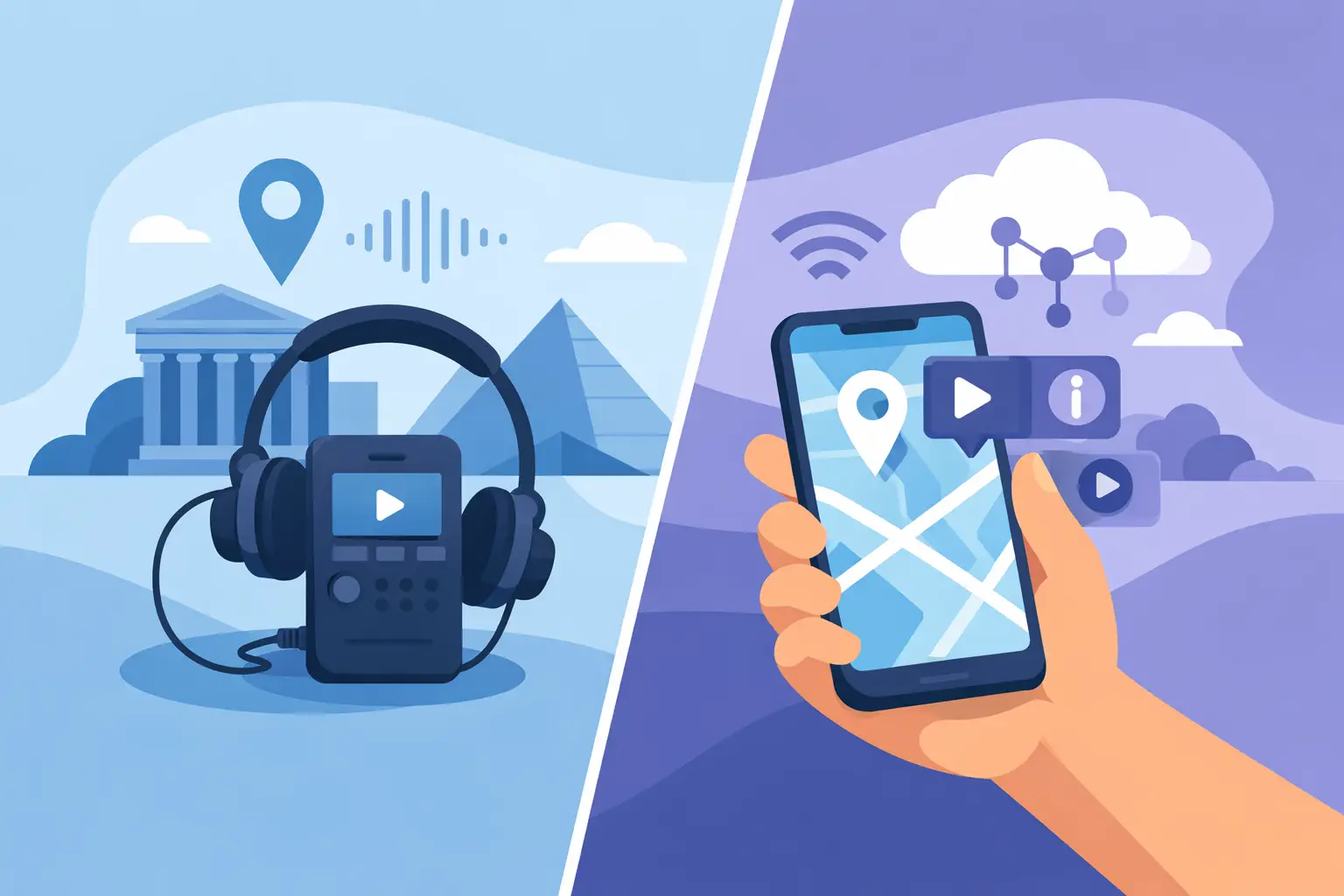
When a cultural site wishes to enrich the visit, the question of rental of audio guides or SaaS solution often arises as a season, an exhibition or a new route approaches. The choice isn't just about an audio streaming tool. It involves the organization of the teams, the budget over several years, the accessibility of the route and the quality of the link created with visitors.
The rental of dedicated devices can meet a one-off need or very supervised attendance. A SaaS solution, accessible on a smartphone via an application or a web app, responds more to a logic of sustainable deployment and autonomy. No model is universally preferable: the challenge is to choose the one that really corresponds to the visiting conditions and the resources of the structure.
Audio guide rental or SaaS solution: two logics
Audio guide rental is based on the provision of dedicated boxes, generally accompanied by headsets, a charging station and sometimes a maintenance or assistance service. For the visitor, the route is immediately identified: they borrow a device from reception, return it at the exit and do not use their personal phone. This formula remains relevant when an establishment welcomes large groups for a limited time, when it wishes to equip a temporary exhibition or when smartphone use is difficult in the place.
But a fleet of devices involves concrete logistics. The teams must manage the loan, any deposits, recharging, cleaning of equipment, breakdowns, losses and renewal of equipment. During busy periods, a few extra minutes at reception can affect the smoothness of the visit. The announced rental cost therefore does not always reflect the real operating cost: it is necessary to include the time involved, consumables and the hazards of the terrain.
A SaaS solution reverses this logic. The content is accessible on the visitor's smartphone, most often thanks to a QR code placed at reception, on a visitor support or directly in the route. Depending on the solution chosen, GPS can also trigger content near a point of interest. The institution administers the courses from an online interface, while the platform ensures technical updates, hosting and maintenance.
This model does not eliminate all hosting needs, but it removes the burden linked to the daily management of dedicated equipment. It also allows you to extend the mediation before and after the visit: preparation of the route, discovery of additional content, sharing of a memory or return to a missed step.
Compare Cost Beyond Listed Price
Comparing a rental rate to a software subscription is not enough. The correct comparison concerns the overall cost, the expected duration of the project and the level of autonomy sought.
Renting can seem reassuring because it transforms an expense into a one-time cost. It is often suitable for an event lasting a few days, an experiment or a very seasonal need. On the other hand, for a permanent or regularly renewed route, the repetition of rental, transport and operating costs can become more expensive than a lasting digital solution.
A SaaS solution generally involves an initial cost of setting up, creating or integrating content, then a subscription which covers access to the platform and its maintenance. It also requires planning for editorial production: writing, recording, translations, iconography and possible adaptation of content to accessibility. These investments also exist with rented audio guides, but digital technology makes them easier to update. Correcting a date, adding a language or changing a step does not require reprogramming a fleet of devices.
To establish a fair comparison, four elements deserve to be quantified: the cost of the service or subscription, the team time devoted to operation, hardware and maintenance expenses, as well as the capacity to develop the content. This last point is decisive for living places, whose collections, exhibitions or territorial stories transform over the years.
Guideius addresses every digital cultural mediation challenge
Create a multilingual smartphone audio guide that is easy to deploy, accessible and tailored to your museum, heritage site or destination.
The visitor experience is not limited to the support
The dedicated box has a simple advantage: it prevents the visitor from downloading an application, using their mobile data or using up their battery. It can reassure certain audiences, particularly when human support is provided at reception. However, borrowing a device creates an additional step and sometimes limits the freedom of the visitor, who must remember to return it before leaving.
With a SaaS solution, access is more immediate. A QR code allows you to get started without installation in the case of a web app, while the offline mode protects the experience in buildings with thick walls, gardens, archaeological sites or poorly covered rural roaming. The visitor advances at his own pace, listens with his own headphones if he wishes and finds the content on a device he already knows.
This simplicity nevertheless depends on clear signage. The QR code must be visible, the instructions must be short and access must not require the creation of an account. It is also useful to provide quick help for people who are not comfortable with digital technology. Successful mediation does not consist of shifting the difficulty onto the visitor: it must make entry into the content as obvious as possible.
Inclusion often calls for a hybrid approach
The personal smartphone must never become an implicit condition for access to knowledge. Some visitors do not have one, no longer have a battery, do not have headphones or are having difficulty using them. Conversely, a standard physical audio guide does not automatically meet the needs of a visitor who is visually impaired, hard of hearing, dyslexic or cognitively impaired.
Accessibility is first thought of in the content. Transcriptions, readable texts, media subtitling, audio description, sign language, font size settings, contrast and adapted paths can concretely expand access to the visit. A digital platform offers great flexibility to offer these formats without multiplying printed versions or specialized devices.
In some contexts, the most appropriate response is hybrid. A site can offer its route on a smartphone while keeping a few devices on loan for visitors who need them. This solution targets equipment where it is really useful, instead of placing the constraints of a complete fleet on the entire operation. It presupposes a clear reception policy, much more effective than a promise of inclusion left without concrete measures.
Administration, data and sobriety: long-term criteria
For small and medium-sized structures, the ability to administer the tool without depending on a service provider for each modification is decisive. An interface designed for non-technical teams allows you to update text, replace an image, publish a new translation or consult usage statistics. This data can inform editorial decisions: which steps are most listened to, where do visitors abandon the journey, which languages are most requested?
Collection must remain proportionate and transparent. In a public or parapublic context, controlling visitor data, limiting trackers and choosing tools that respect the regulatory framework is as much about ethics as it is about trust. Useful statistics do not necessarily require identifying every person.
Sobriety is also an operational criterion. Producing, transporting, recharging and renewing hundreds of boxes has a material cost. A SaaS solution does not become immaterial: it relies on servers and on visitors' smartphones. But it can reduce equipment to purchase and maintain, especially if content is thoughtfully designed, intelligently compressed and available offline.
Guideius is part of this approach by offering multilingual audio tours, easily administered, with QR codes, GPS, offline mode, multimedia content and accessibility options. For a cultural structure, the interest is not to add technology, but to have a reliable tool for transmission.
The right choice therefore begins with an honest observation of the field: duration of attendance, quality of connection, availability of teams, visitor profiles, editorial ambition and capacity for evolution of the route. When these answers are asked, technology ceases to be an abstract expense and becomes a concrete means of getting more stories heard, to more audiences.
Would you like to apply these ideas to your site?
Guideius helps deploy multilingual audio tours with QR codes, GPS, offline mode, multimedia content and privacy-friendly analytics.