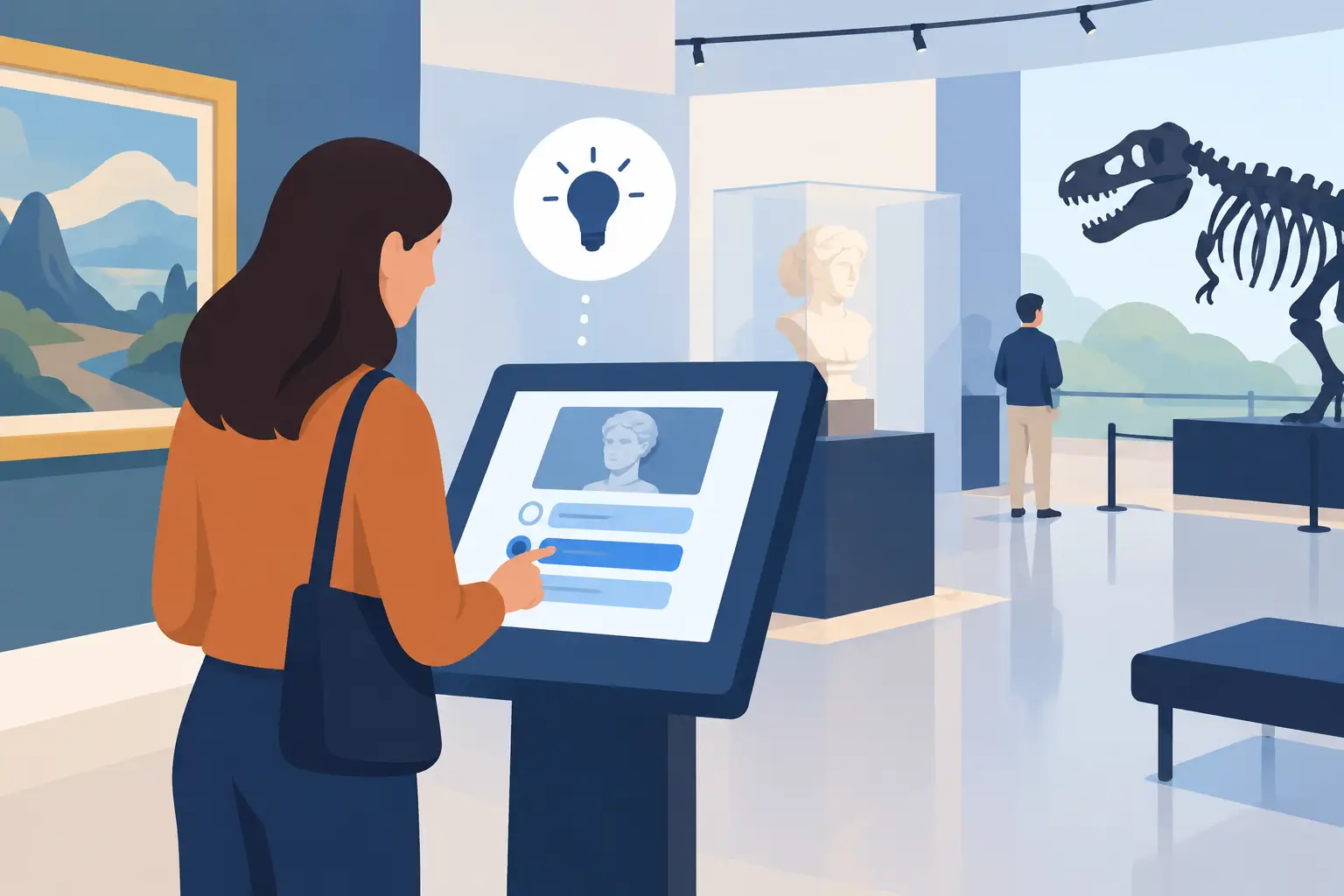
A display label read too quickly, a fact forgotten, a family unsure which gallery to visit next: these are familiar situations during a museum visit. Adding a quiz to an exhibition does not mean turning a museum into a game show. A well-designed quiz gives visitors moments to pause and focus, encourages closer observation and deepens their engagement with artworks, objects or local heritage.
For museum and heritage teams, a quiz can also meet a practical need: making a tour more engaging without adding expensive equipment or complicating interpretation. On visitors' smartphones, it fits naturally into an audio guide, a themed trail or a tour for children and young people. It should be designed as a learning tool, rather than an activity added at the last minute.
Why include a quiz in an exhibition?
A good quiz does more than check what visitors have just heard. It helps them observe, make connections and interpret what they see. A question about an architectural detail can encourage them to retrace their steps for another look. Another question, offered as they leave a gallery, can connect several artworks and bring the visit together.
This is particularly useful in exhibitions with a lot of information or at sites where visitors explore freely. Rather than imposing a fixed route, a quiz offers gentle guidance. Visitors remain free to choose their own way while being encouraged to engage actively with the experience.
The benefits vary by audience. Families gain opportunities to talk together rather than leaving children alone with a screen. School groups can put what they have learned into practice, complementing the teacher's or museum educator's explanations. Adults often appreciate a short question that reinforces a discovery or reveals an unexpected perspective.
For the institution, aggregated results can reveal how visitors use the tour: which stops they view, which questions receive the most responses and where they leave the route. These data do not replace observation on site or conversations with visitors. They do, however, provide useful insights for adjusting the content and organisation of the visit.
Start with a clear purpose for your exhibition quiz
Before writing a single question, define what you want the quiz to achieve. Should it help visitors remember three key ideas? Encourage teenagers to stop and look at particular objects? Make a scientific explanation easier to understand? Or offer a self-guided activity on an outdoor trail?
This purpose determines the right format. A discovery quiz draws on what visitors can observe in front of them. A comprehension quiz follows audio or multimedia content. A quiz at the end of the visit can connect several stops and help visitors remember the experience. Trying to achieve everything in one set of questions often has the opposite effect: visitors answer mechanically or give up.
It also helps to select a few key messages. An exhibition can present a complex story, with nuances, debates and uncertainties. A quiz should not reduce this to a series of isolated facts. Focus on the ideas worth remembering, then direct visitors to content that lets them explore those ideas in more depth.
Choose the right place along the route
Where a question appears matters as much as its wording. Before visitors view an artwork, it can build anticipation: which detail will they spot? Just afterwards, it can help them check what they noticed. Too many questions break up the visit and tire visitors out.
For most trails, one question every three or four stops is a reasonable pace. This depends on the length of the visit, the visitors' age and how much information is presented. For a forty-five-minute family tour, four to six interactions may be enough. In a longer temporary exhibition, optional quizzes in each section give visitors more freedom.
Accessing a question should be straightforward. A QR code at a gallery entrance, a prompt in the audio guide or a GPS trigger on an outdoor trail can present it at the right moment. Where connectivity is limited, offline mode prevents an activity designed to enrich the visit from becoming a source of frustration.
Guideius addresses every digital cultural mediation challenge
Create a multilingual smartphone audio guide that is easy to deploy, accessible and tailored to your museum, heritage site or destination.
Write questions that support learning and interpretation
The most effective question is rarely the hardest. It requires genuine attention without trying to catch visitors out. Instead of asking for an exact date printed on a label, invite visitors to compare two materials, identify an object's purpose or find a motif in the exhibition space.
Multiple-choice questions work well for self-guided tours, provided that the answer options are plausible. An absurdly wrong option suggests that the institution underestimates its audience. By contrast, three or four similar options can work if the audio or visual content gives visitors enough information to distinguish between them.
Feedback on answers is an essential part of the experience. It should do more than display a result. A correct answer offers an opportunity to add a detail, while feedback on an incorrect answer should be encouraging and provide a clear explanation. Tone matters: the aim is to support curiosity, not to hand out marks.
Question formats can vary without making the quiz harder to manage: identify an image, put two events in order, choose a soundscape or match an object to its function. This variety is useful when it supports the exhibition's message. It becomes merely decorative when it serves only to add more effects.
Preserve nuance in science and heritage interpretation
Heritage does not always lend itself to a single right or wrong answer. Dates can be disputed, interpretations evolve and historical accounts require sources to be placed in context. In these cases, a quiz can ask about the available evidence rather than present a supposedly definitive truth.
For example, ask which piece of evidence allows archaeologists to form a hypothesis, then explain the limits of that interpretation. This approach maintains scientific rigour while helping visitors understand how research works.
Make the quiz accessible to all visitors
An interactive activity is only inclusive if different audiences can use it. Use direct language and explain any unfamiliar terms. Keep instructions short and button labels easy to read. Provide text alternatives to visual content and make audio content available in a form that does not rely solely on listening.
Multilingual content deserves particular attention. Translating questions word for word is not enough: cultural references, sentence lengths and wordplay do not always carry across languages. Choose clear, straightforward wording that is easy to adapt to each language you offer.
Accessibility also involves pacing. Some visitors will want to answer every question; others will try only one or two. The quiz should remain optional and never block access to the main content. Preserving this freedom is particularly important in visits that already contain a lot of information or evoke strong emotions.
Plan a project your team can manage
A successful quiz also depends on work behind the scenes. An overly ambitious project can exhaust a small team and become difficult to update when an exhibition changes. It is often better to launch a short first version, test it with visitors and museum educators, then develop it further based on their feedback.
Assign clear responsibilities. The exhibition curator or collections manager checks the accuracy of the content. The learning and interpretation team ensures that it is understandable and educationally relevant. The communications team can check that the tone reflects how the venue welcomes visitors. Finally, whoever manages the digital tour should be able to edit a question, translation or image easily without relying on a service provider for every adjustment.
A solution such as Guideius combines quizzes, audio guides and multimedia content in a single tour that teams can manage without technical expertise. The main challenge is to maintain a reliable, understandable tour that works under real visiting conditions, rather than simply adding more features.
An on-site test is essential before launch. Check readability in natural light, loading times, whether the instructions are understood and how the quiz works with a weak connection. Observing a few visitors without immediately stepping in often reveals obstacles that the designers no longer notice.
Measure without reducing the experience to a score
Participation rates, response counts and the most frequently viewed questions are useful indicators. They can reveal a stop that visitors overlook, ambiguous wording or a topic that sparks particular curiosity. But they do not capture every aspect of the quality of a visit.
A low response count may mean that a quiz is poorly placed. It may also mean that visitors prefer to listen, reflect or talk together. Compare the data with feedback from front-of-house staff, museum educators and visitors. Interpreting the results together better reflects the venue's cultural mission.
A quiz works best when the technology fades into the background and visitors focus afresh on their surroundings. A good question encourages them to look up from the screen, listen in a different way and continue their visit with greater curiosity.
Would you like to apply these ideas to your site?
Guideius helps deploy multilingual audio tours with QR codes, GPS, offline mode, multimedia content and privacy-friendly analytics.