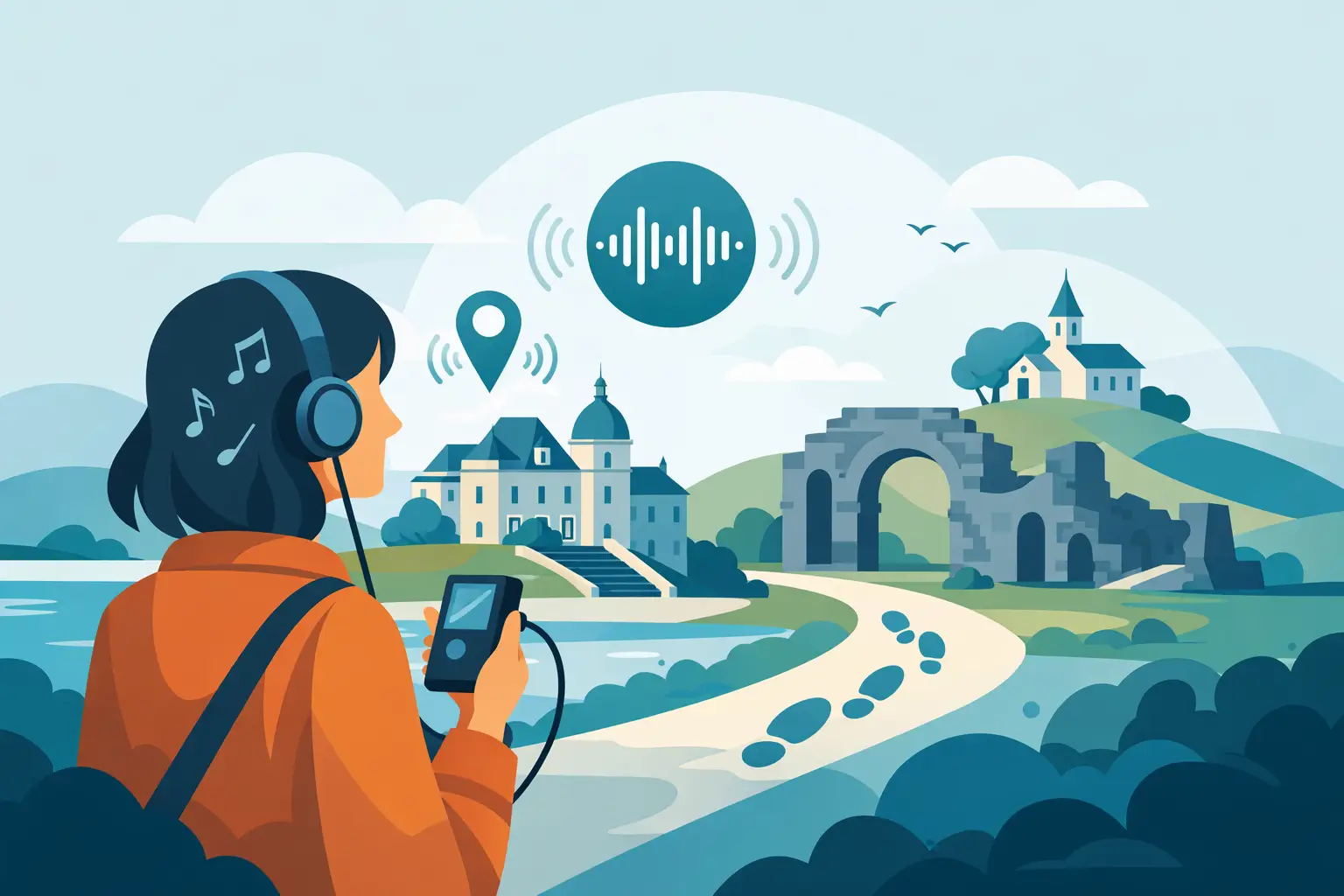
A sound tour guide for a heritage site is not just about recording a few comments and placing them throughout a visit. It gives a voice to the place, organizes the attention of visitors and makes accessible stories that would otherwise remain invisible: the history of a building, the gestures of a profession, the memory of the inhabitants or the transformations of a landscape. For cultural teams, the real challenge is to design an experience that is both sensitive, reliable in the field and simple to carry out over time.
The audio format responds particularly well to the realities of site museums, monuments, heritage villages, gardens, urban routes and outdoor trails. It accompanies the visit without imposing heavy signage, without constantly mobilizing staff and without forcing the structure to purchase, recharge, disinfect and maintain a fleet of devices. But technology doesn’t make up for a poorly thought-out course. Quality begins with a clear mediation intention.
Define the promise of the journey before choosing the tool
Before writing the first text, a simple question must be answered: what should the person who finishes the visit feel, understand or look differently? A tour of a fortress does not pursue the same objective as a walk in an old center or a former industrial site. In the first case, it can help read complex defensive architecture. In the second, it can reveal neighborhood stories. In the third, it can restore working atmospheres and testimonies.
This promise helps you make choices. It notably avoids the encyclopedic journey, where each stopping point accumulates dates, figures and details without hierarchy. An effective audio guide does not try to say everything. He selects what gives meaning to the stage and gives the visitor time to observe.
The expected audience should also guide the design. A family visit, a school group, international tourists and curious locals have neither the same time available nor the same points of reference. It is often more relevant to offer a main route of 30 to 45 minutes, supplemented by optional content, rather than a single route that is too long. The in-depth information can take the form of archive photos, testimonials, short notes or quizzes, accessible on demand.
Build a coherent heritage site sound trail guide
The coherence of a heritage site audio tour guide has less to do with the number of stations than with the quality of the links between them. Each stop must have a function: to situate, surprise, explain, make a voice heard, invite to compare the past and the present or prepare for the next step. If two pieces of content provide exactly the same information, one of them is probably superfluous.
Choose a narrative thread rather than a succession of comments
The narrative thread creates a progression. It can follow a historical figure, the successive uses of a place, a typical day at a given time or the materials that make up the monument. On a territorial route, it can rely on water, trade, know-how or borders. This choice gives unity to sometimes very different sites and helps visitors remember the essentials.
Tone deserves special attention. Too much professorial language can alienate part of the public, while excessive dramatization can betray historical complexity. The objective is to be precise without being opaque, lively without giving in to gratuitous anecdotes. When sources are uncertain, saying so reinforces confidence: we can distinguish what is documented, probable or from oral tradition.
Writing for the ear and for the place
A text intended to be read is not automatically a good text to listen to. When speaking, short sentences make it easier to understand. Dates and proper names should be introduced sparingly, then placed in a clear context. A duration of 1 minute 30 to 2 minutes per stage is often a good benchmark, but it depends on the location: in front of a panoramic view, the visitor can accept a longer commentary; in a narrow room or a passage area, you have to go to the essentials.
The audio must also dialogue with what is visible. Saying “look left” is only useful if the orientation is obvious and stable. It is more effective to draw attention to a concrete detail: a walled opening, a tool mark, a difference in stone, a line in the landscape. The commentary then becomes an aid to the eye, not an audio track detached from the site.
The sound work is as important as the writing. A well-recorded, calm and embodied voice immediately improves the perception of quality. Ambient sounds, an archive or a short musical creation can enrich the experience, provided they serve the story. Too many sound effects tire the listener and risk giving the heritage a spectacular treatment that does not always suit it.
Guideius addresses every digital cultural mediation challenge
Create a multilingual smartphone audio guide that is easy to deploy, accessible and tailored to your museum, heritage site or destination.
Design a truly inclusive visit
A smartphone tour alone does not guarantee accessibility. It is necessary to provide alternatives and settings that meet various needs. Transcribing audio tracks allows a deaf or hard of hearing person to follow the content and also benefits visitors who prefer to read. Audio descriptions of major visual elements are useful for people who are blind or visually impaired. Legible navigation, suitable contrasts and easy-to-use controls are just as decisive.
Accessibility also concerns content. Clear vocabulary, explanations of technical terms and a controlled duration make the visit easier for everyone, including people unfamiliar with heritage. For some audiences, simplified language versions or shorter courses can make a concrete difference. It is not a question of reducing scientific requirements, but of increasing the number of entry points to knowledge.
Multilingualism must be planned from the editorial phase. Translating text that is too dense at the end rarely produces a satisfying experience. Structured scripts, clearly identified references and a common terminological charter facilitate the work of translators. Depending on attendance, it may be wise to start with the most popular languages and then expand, based on usage data rather than hypotheses.
Anticipate actual visit conditions
On the ground, connectivity is patchy. In rural sites, underground spaces, buildings with thick walls or extensive routes, an offline mode is a guarantee of continuity. Visitors must be able to simply download content before departure or at reception, then listen to their visit without depending on the mobile network.
The triggering of content must correspond to the configuration of the location. QR codes are particularly suitable for fixed points, museum rooms and interpretation panels. GPS offers more freedom on an outdoor route or an urban route. A hybrid approach is often the most relevant: the GPS supports progress, while the QR code provides precise access to located content.
However, we must avoid making geolocation a constraint. A visitor can take another route, retrace their steps or decide to follow only part of the route. A good application allows you to consult the steps freely on a map or a list, without penalizing actual uses. Digital mediation must guide, not monitor.
Organize sustainable production for the team
Creating a route requires a variety of skills: documentary research, writing, scientific validation, translation, recording, choice of visuals and preparation of visiting points. In a small structure, all these missions cannot be carried out by a single person. A realistic schedule provides time for rereading and testing on site, where signal, orientation, noise or comprehension problems appear.
The administration must then remain within the reach of the teams. Correcting a schedule, replacing a photo, updating a translation or adding a temporary step should not require heavy technical intervention. This autonomy is essential to make the routes evolve with the seasons, exhibitions, works or new research.
A solution such as Guideius makes it possible to centralize this content in a customizable application or web app, without managing dedicated hardware. Teams can offer audio tours, additional media, quizzes and accessibility functions from the same interface, while maintaining concrete control of their project and its developments.
Test, measure and adjust without distorting the visit
A course should not be considered complete on the day it is launched. The first visitors reveal what the project committee cannot always anticipate: a difficult step to find, an ambiguous instruction, a comment that is too long or a break in rhythm. Having different profiles test the route, including people who do not know the site, allows obstacles to be corrected before they set in.
The usage statistics then provide valuable information. Startup rate, languages selected, most listened to steps or dropouts can guide improvements. This data must be interpreted with caution: a station with little access is not necessarily a failure, it may be poorly signalled, removed from the flow or reserved for a specific audience. They are useful when they fuel a mediation reflection, in a framework that respects visitors and their data.
The good sound journey does not seek to occupy every minute. It creates silences, leaves space for observation and makes you want to continue the relationship with the place. It is on this condition that a digital tool becomes a real gesture of welcome: discreet for the team, accessible for the public and sustainable for the heritage.
Would you like to apply these ideas to your site?
Guideius helps deploy multilingual audio tours with QR codes, GPS, offline mode, multimedia content and privacy-friendly analytics.