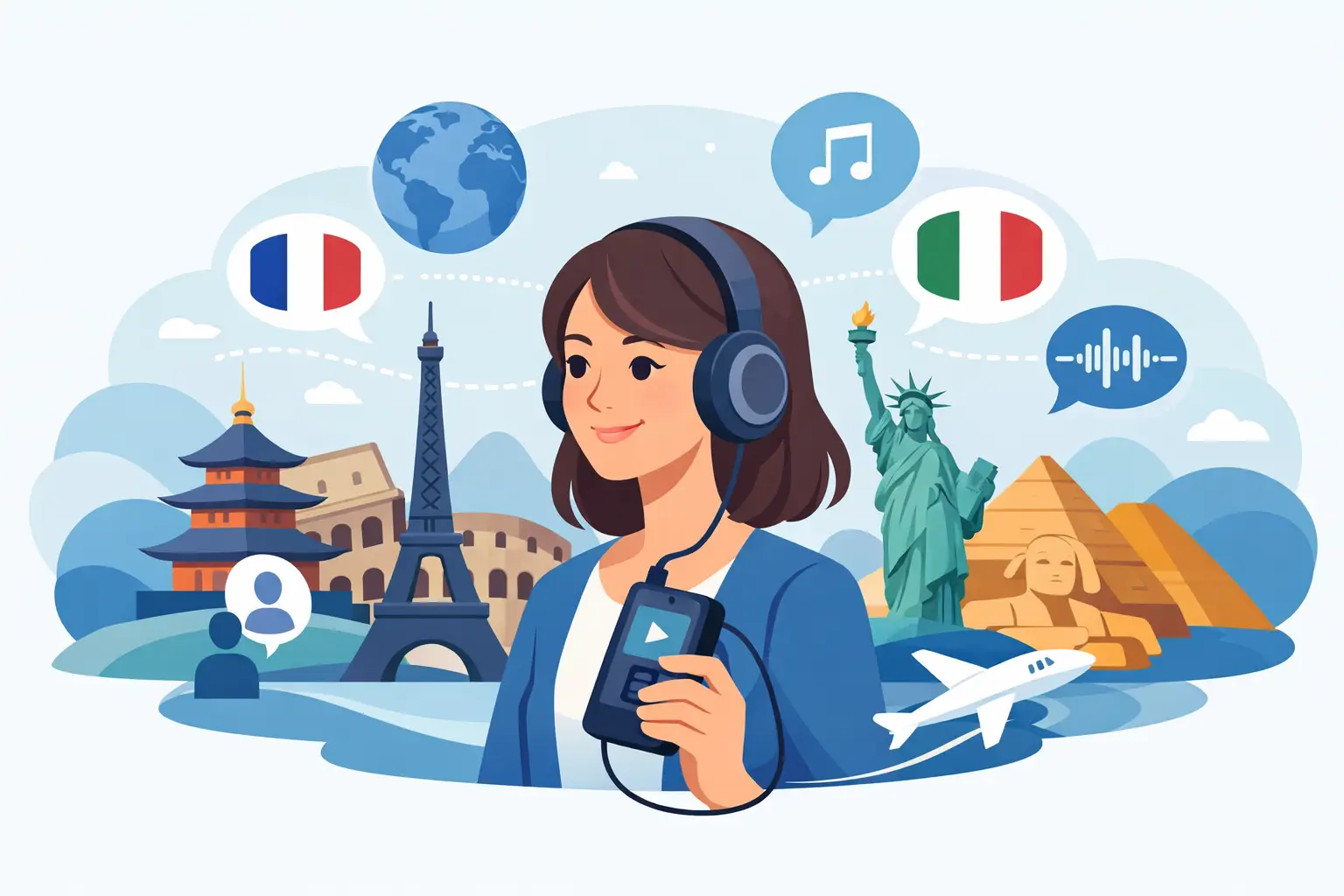
A German visitor in front of a Romanesque church, a Dutch family in a local museum, an English-speaking group on a heritage trail: all expect more than a translation displayed at reception. They want to understand the place, its history and its details, at their own pace. This is why choosing a multilingual audio guide responds to a concrete mediation challenge: making heritage truly accessible to audiences with varied languages, visiting habits and levels of knowledge.
For cultural and tourism teams, multilingual is not just an additional service. It is a way to better welcome, to promote a territory to its international visitors and to offer a coherent experience without burdening daily operations. As long as you design the content and the tool methodically.
A fairer welcome for each visitor
A visit does not begin in front of a work or a monument. It begins when the visitor understands, or does not understand, the information offered to him. When a route only exists in the local language, part of the public remains at a distance: they observe, but do not fully access the stories, contexts and mediation choices provided by the site.
A multilingual audio guide reduces this distance. It allows everyone to follow a course in a language they master, without depending on the availability of a mediator, a speaker guide or translated printed material. This autonomy is particularly important in sites with high seasonal traffic, small structures with restricted schedules and outdoor courses.
The audio also brings a particular quality of attention. A voice, a rhythm and a narration can transmit the nuances of a historical story, the vocabulary of know-how or the emotion linked to a landscape. For a non-French-speaking audience, this oral mediation is often more comfortable than a dense panel to read quickly.
Why choose a multilingual audio guide for your territory?
Cultural tourism is often built on the scale of a visitor base rather than a single facility. A museum, an interpretation center, a village of character or a memory trail all contribute to the image of a destination. Offering content in several languages makes it possible to better meet the expectations of local visitors and international tourists.
It is not a question of translating everything, everywhere, without discernment. The right choice of languages depends on the territory, attendance data, local partnerships and the nature of the course. A town close to a border will not have the same priorities as a site receiving a diverse European clientele or a place frequented mainly by French school groups.
This decision benefits from being based on simple elements: the languages requested at reception, the geographical origin of visitors, seasonality, data from tourist offices and feedback from field teams. Starting with two or three relevant languages is often more useful than announcing a very broad offer whose content is rarely consulted or insufficiently adapted.
Multilingual can also extend visit time. A visitor who understands better stays more willingly, explores more stages and retains essential messages more easily. For a region, this quality of experience encourages recommendations, positive opinions and the desire to discover other places nearby.
Easier to use digital mediation
Traditional audio guides often involve a fleet of equipment to purchase, distribute, clean, refill, inventory and replace. These constraints can weigh heavily on teams, particularly when they are small or visitor flows vary greatly depending on the period.
A digital audio guide accessible on the visitor’s smartphone changes the organization. A QR code at reception, on a tour support or at the start of a route allows you to start the tour without lending a device. On an outdoor route, GPS triggering can guide listening as you move. The visitor maintains his freedom of pace, while the team concentrates on welcoming and human mediation where it is most useful.
This approach does not exclude audiences without smartphones or without digital autonomy. On the contrary, it requires providing support solutions: clear signage, start-up assistance, some loaner devices if necessary or alternative support for people who need it. Digital technology is relevant when it broadens the possibilities of visiting, not when it becomes a condition of access.
The offline mode is also decisive. In a monument with thick walls, a rural site or a nature trail, network coverage may be irregular. Allowing content to be downloaded before departure avoids interruptions and protects the quality of the experience, even in areas with low connectivity.
Guideius addresses every digital cultural mediation challenge
Create a multilingual smartphone audio guide that is easy to deploy, accessible and tailored to your museum, heritage site or destination.
Translating is not just about transposing words
The quality of a multilingual audio guide depends first of all on the quality of its mediation. A literal translation may retain information while losing the tone, clarity, or cultural references of the original text. However, a good audio tour does not just state dates: it gives landmarks, creates a narrative thread and helps the visitor to look.
Each linguistic version must therefore be designed for listening. Sentences that are too long, specialized terms that are not explained and implicit references make it difficult to understand, even for visitors who have a perfect command of the language offered. Clear, embodied and structured writing facilitates the work of translation and the attention of the public.
The choice of voices deserves the same attention. Depending on the project, a professional voice, a local voice or a narration carried by several speakers do not produce the same effect. The main thing is to ensure pleasant diction, an appropriate rhythm and consistency between languages. A hastily recorded audio version can weaken otherwise solid content.
Multimedia content can complement listening: archive photographs, details of works, maps, illustrations or short videos. They are particularly useful when the story evokes an invisible, missing or difficult to observe element. But they must remain at the service of understanding, with reasonably light files and an interface that does not distract attention.
Accessibility strengthens the quality of the visit for everyone
A multilingual project naturally opens up reflection on other forms of accessibility. The diversity of languages reminds us that visitors do not receive information in the same way. Some people need to read at the same time as they listen, others need to adjust the font size, consult image descriptions or move forward in shorter sequences.
Offering transcriptions, subtitles for video content, easy-to-read text when relevant and readable navigation improves usability for many audiences. These options also serve visitors in a noisy environment, families, tired people or those who prefer to prepare their visit before coming.
Inclusion is not just a feature added at the end of the project. It must guide the design of the routes: vocabulary, duration of the trails, visual contrast, instructions, signage and on-site support. A solution like Guideius makes it possible to integrate these dimensions into a visit experience that can be administered by non-technical teams, without requiring the management of dedicated hardware.
Measuring usage to develop routes
Mediation decisions become more relevant when they are also based on the observation of uses. Which languages are the most selected? What stops do visitors stop at? What content is most listened to? Usage statistics provide valuable information for adjusting a route, prioritizing a new translation or improving a signage point.
This data does not replace exchanges with visitors and reception agents. They complete them. An abandonment rate at a stage could indicate a GPS problem, a track that is too long, a location that is difficult to locate, or a subject less suited to the expected audience. Conversely, a highly consulted stage can reveal a theme to be developed during an exhibition, a guided tour or an educational action.
This logic of progressive improvement is particularly suited to small-scale structures. It is not necessary to create a very large course from the start. It is better to launch a selection of strong stages, test uses, collect feedback and enrich the content over the seasons.
Choose a solution consistent with your means
A multilingual audio guide must remain proportionate to the site's resources. The question is not only that of the initial price, but also that of preparation time, maintenance, updating content and supporting the teams. A clear platform, scalable pricing and accessible administration prevent a useful tool from becoming a technical burden.
It is also necessary to examine data control, content conservation conditions, the assistance offered and the possibility of changing the visual identity of the course. For a community, an association or a public establishment, these criteria fully participate in responsible digital technology.
The good audio guide does not erase the human presence or the singularity of a place. It gives visitors the means to enter into its history, in their language and at their own pace. By starting from the languages actually spoken in your territory, then from the concrete conditions of visit, you will build a more hospitable and more lasting mediation.
Would you like to apply these ideas to your site?
Guideius helps deploy multilingual audio tours with QR codes, GPS, offline mode, multimedia content and privacy-friendly analytics.