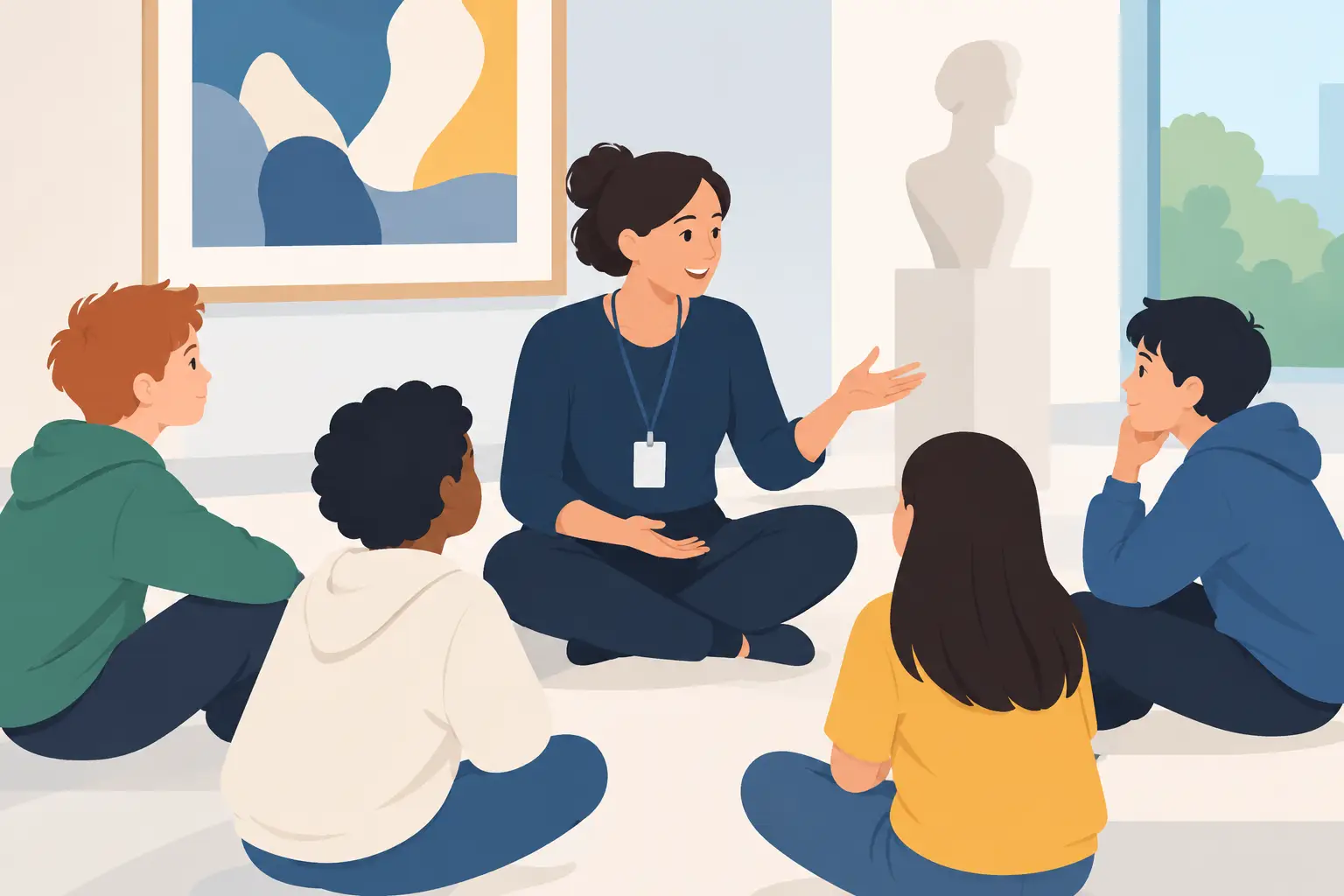
A child who loses interest at the second wall label is not necessarily lacking in curiosity. They may simply need a more suitable way in: a question, a story, a sound, an action to carry out or the freedom to observe at their own pace. This guide to cultural mediation for young audiences is intended for teams that want to create useful, intellectually demanding digital routes that are genuinely accessible in practice.
Mediation for children, teenagers and families is not about simplifying an adult visit. It calls for editorial, spatial and technical choices that match the attention span, autonomy and habits of each age group. For a museum, monument, tourist office or heritage site, the challenge is twofold: share knowledge without oversimplifying it, while offering an experience that is easy to deploy and maintain.
Why design mediation around visitors’ needs
“Young audiences” are not a homogeneous group. A five-year-old explores mainly through their body, imagination and interaction with the adult accompanying them. Between the ages of eight and twelve, puzzles, challenges and vivid stories can help sustain attention. Teenagers are more likely to look for a point of view, freedom to choose their route and content that does not address them as if they were very young children.
This distinction has direct consequences. A forty-five-minute route may work well for a planned school trip but be too long for an impromptu family visit. A quiz used throughout the visit may engage some visitors and tire those who want time to look. The aim is therefore not to pile on features, but to decide what serves the venue’s purpose and the circumstances of the visit.
The first question is not “What do we want to explain?” but “What do we want visitors to experience?” In an old fortress, the aim might be to understand how people lived there. In a fine-art museum, it might be to learn how to notice the details of a work. On an urban route, it might be to connect the history of a neighbourhood with what visitors see today. That intention then guides the choice of content and interactions.
Design a mediation guide that sparks curiosity
A good route starts with a clear narrative thread. Children remember a sequence of situations better than a series of isolated facts. An investigation into a missing object, the imaginary diary of a resident, the stages of a building project or the mission of a young curator can create continuity, provided the experience remains faithful to the site’s historical and scientific knowledge.
The story should not take over. Its role is to guide the visitor’s attention. After a short audio sequence, a simple prompt might invite visitors to look for a trace, compare two patterns, listen to the atmosphere of a place or imagine how an object was used. Visitors are no longer just receiving information: they become observers and interpreters.
Write for the ear, not the wall label
Audio is particularly well suited to young visitors because it leaves their eyes free and accompanies their movement. But written language read aloud is not the same as language designed for listening. Sentences should be short, concrete and rhythmic. It is better to say “Look at the black marks above the fireplace” than “Observe the visible signs of combustion on the fireplace surround”.
Each track should convey one main idea. One to three minutes is often enough for children, especially when a sequence alternates between story, question and time to observe. Longer tracks can work during a rest stop, in an immersive room or at a key moment in the route. The important thing is to avoid uninterrupted listening that turns the visit into a recorded lesson.
Tone deserves the same care. Speaking plainly does not mean speaking down to children. They quickly notice artificial wording and repeated commands. A warm, precise and lively voice, supported when useful by restrained sound effects or several characters, is often enough to create a sense of connection. Sound effects should aid understanding, not drown out the works, the place or the mediator’s voice.
Make digital a tool for the visit, not a distraction
A smartphone can enrich the experience as long as it does not become the main attraction. Archive images, a reconstruction, a short video or an enlarged detail are useful when they help visitors understand what is in front of them. Conversely, an animation that keeps drawing attention away from the collection or the landscape weakens the mediation.
The most effective interactions remain simple: answer an observation question, choose between two hypotheses, find a detail or collect clues along the way. A quiz can check understanding or revive attention, but it should not turn the visit into a string of right answers. Explanations for every answer, including incorrect ones, keep curiosity alive without creating a school-like assessment.
Guideius addresses every digital cultural mediation challenge
Create a multilingual smartphone audio guide that is easy to deploy, accessible and tailored to your museum, heritage site or destination.
Organise the route for families and groups
Families do not all move at the same pace. Some want to follow the whole route; others may have only twenty minutes before closing or between two activities. A main route with optional stops is better suited to this reality than a rigid circuit. It also lets accompanying adults choose the level of detail that suits their child.
Signage plays a decisive role. A clearly visible QR code with a simple instruction reduces hesitation at the entrance. On outdoor routes, GPS triggering can make the experience smoother, provided that there are visual landmarks and a manual way to open each stage. Inaccurate positioning, wooded areas and historic town centres call for a design that can cope with the realities of the terrain.
For school groups, a digital route does not automatically replace human mediation. It can prepare a visit, support an independent walk or extend a session with the teacher. Its format depends on the level of supervision: a class sharing one or two devices per group has different needs from a family using its own phone. Testing the route in real conditions with children and education professionals prevents many late adjustments.
Make the experience genuinely inclusive
Accessibility cannot be added at the end of a project. Audio content with a transcript, easy-to-read text where appropriate, sufficient contrast, clear navigation and simple controls improve the experience for many visitors, with or without a disability.
Children’s diversity should also be reflected in the stories, examples and voices selected. Inclusive mediation avoids assuming one family culture, perfect reading skills or a single relationship with heritage. It offers several ways into the content: listening, looking, handling, answering, skipping a stage or going back.
Multilingualism is also a practical reality, especially in tourist areas. It calls for genuine cultural adaptation rather than a word-for-word translation. For younger visitors, clear phrasing and high-quality voice-over matter just as much as accurate vocabulary.
Build an administration the team can sustain
A young-audience route keeps evolving: a room closes, an object is loaned, new research changes the interpretation or a seasonal activity is added. The technical solution must allow the team to correct content or add a stage without always relying on a service provider. This autonomy is especially valuable for small and medium-sized organisations, where the same people often handle reception, programming, communications and mediation.
Offline access also deserves attention. In historic buildings, underground spaces, rural sites and outdoor routes, mobile coverage cannot be taken for granted. Letting visitors download the route in advance protects the quality of the visit and reduces frustration for families.
Usage data can inform editorial decisions. Start rates, chosen languages, the most visited stages and points where visitors drop out show what really works. These data should be handled carefully and respectfully: the aim is to improve mediation, not to monitor people’s behaviour.
A solution such as Guideius brings QR-code or GPS triggers, multimedia content, offline access, quizzes and statistics together in an administration designed for cultural teams. Technology becomes a way to improve the visitor experience without imposing the costly management of a dedicated equipment fleet.
Evaluate and improve the route
Launching the route is not the end of the project. Observing a few families, listening to their comments and talking to front-of-house staff quickly reveals points of friction: a stage that is difficult to find, an audio track that is too long, a misunderstood word or an instruction that does not prompt the intended action. This qualitative feedback is as valuable as the figures.
Useful indicators are not limited to the number of plays. Teams can track the share of visitors who complete the route, the time spent on particular stages, the content used in each language and the moments when guides step in. Above all, a route should be improved in small increments. Successful mediation for young audiences is not about impressive effects; it is about making a child want to look again, ask questions and come back.
Would you like to apply these ideas to your site?
Guideius helps deploy multilingual audio tours with QR codes, GPS, offline mode, multimedia content and privacy-friendly analytics.