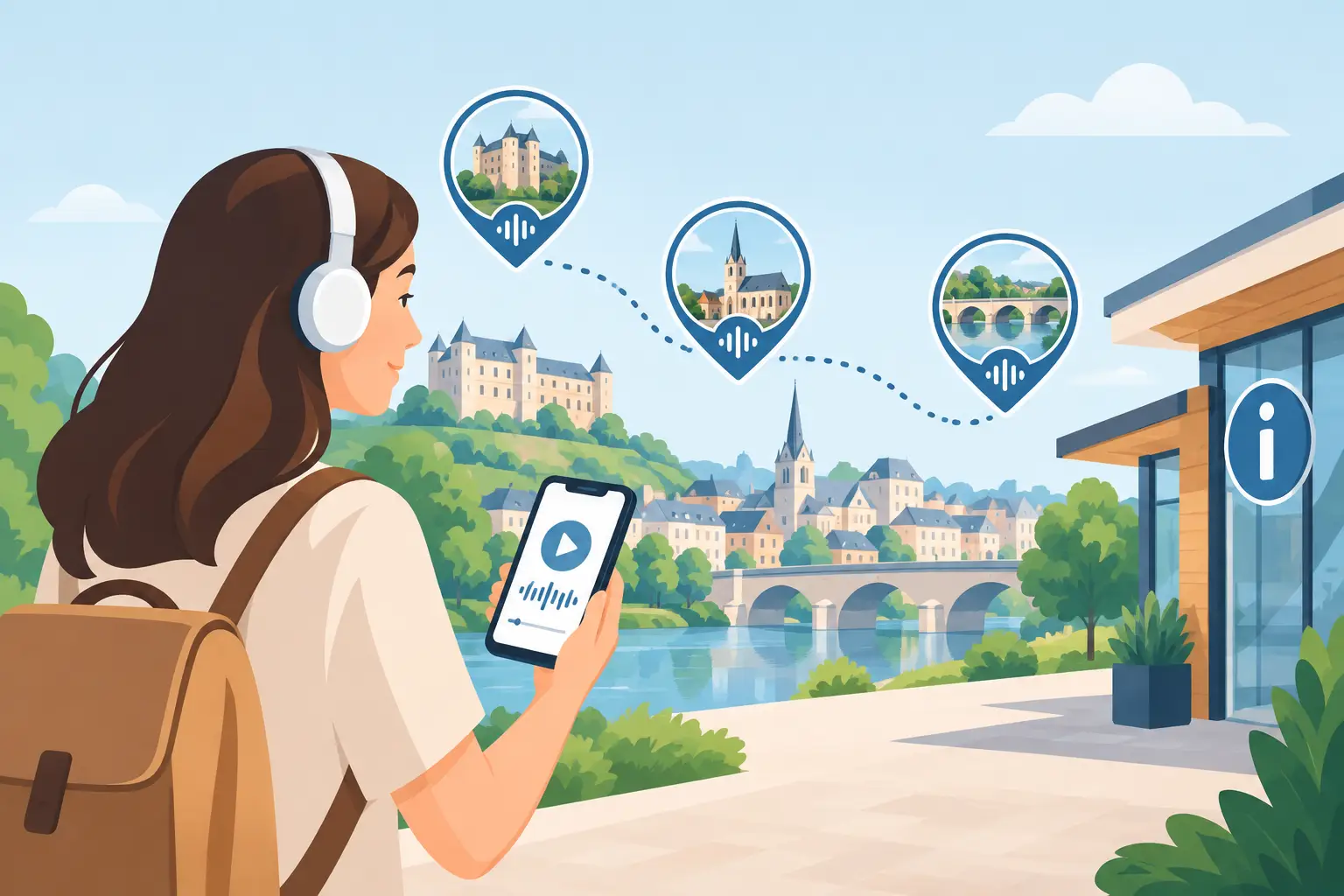
A visitor arrives outside the tourist office at 10 a.m., has two hours before lunch and wants to understand what gives the historic town centre its character. A search for an “example audio tour for a tourist office” often reflects this practical challenge: how can an independent walk become a coherent cultural experience without a guide for every departure or a fleet of devices to manage?
A good audio tour does more than add commentary beside each monument. It brings together a place, a story and a realistic pace of exploration. For the tourist office, it is also a year-round way to showcase the area, offer several languages, spread visitor flows and extend the welcome beyond its premises.
An example tourist office audio tour: the scenario
Imagine a town of 8,000 people, known for its old market hall, half-timbered houses, surviving ramparts and a former industrial site now put to new use. The tourist office wants to offer a family-friendly walk of around 1.8 kilometres, taking 60 to 75 minutes.
The trail starts outside the office. A QR code on the window and a small display at reception opens the tour on visitors' smartphones. They choose a language, download the content if they wish and start without creating an account. Getting started easily is crucial: if it takes too long, some visitors will give up before the first stop.
The first audio track does not attempt to tell the whole local history. It sets the scene: where visitors are, where they will go and what to notice. In ninety seconds, the voice might invite them to look at the street layout, inherited from an old trading route. They set off with a question in mind rather than a date to memorise.
At the second stop, beside the market hall, the commentary evokes the former market through its goods, trades and exchanges. An archive photograph or illustration can complement the audio. The aim is not to explain everything about the building, but to bring to life what can no longer be seen.
The third stop, at the foot of a surviving tower, explores the ramparts. GPS can automatically indicate that visitors are approaching the point of interest. QR codes remain useful in busy places, where GPS accuracy is limited or where stops need to be followed in a particular order. The two approaches complement each other according to the site's layout.
The trail continues into a less obvious alley. This is often where audio adds the most value: it draws attention to a heritage detail that conventional itineraries tend to overlook. A short account from a resident, read by an actor or recorded with the resident's permission, can connect history with local life. Interpretation becomes more personal, provided the material is carefully edited and easy to follow.
The final stop is at the former industrial site. Visitors discover how an economic activity shaped the landscape, housing and social life. The tour can end by suggesting two ways to explore further: a partner museum or a landscape trail. This should feel like an invitation, not a sales pitch, opening up possibilities for the rest of their stay.
Guideius addresses every digital cultural mediation challenge
Create a multilingual smartphone audio guide that is easy to deploy, accessible and tailored to your museum, heritage site or destination.
Plan a useful trail before producing the audio
Before writing, the team should sum up the tour's promise in one sentence. For example: “Understand how trade and industry shaped this small town.” This editorial focus keeps the story on track. It helps select stops and set aside interesting information that is secondary to the main theme.
The number of stops depends on the time available, the concentration of heritage features and the intended audience. Eight to ten stops are often enough for a first self-guided visit. Too many can turn a walk into a lecture. Estimate the full duration realistically, including walking, breaks and time to look around.
Each stop should ideally answer three questions: what can visitors see, why does this place matter, and what should they remember or feel before moving on? An audio track lasting ninety seconds to two and a half minutes is a useful starting point. Complex topics can be explored through optional additional content rather than overloading the main narrative.
Good content also depends on reliable sources. Municipal archives, local history societies, heritage departments, associations and residents can contribute. The tourist office remains responsible for consistency, usage rights and fact-checking. An appealing but unverified anecdote can undermine trust in the whole trail.
Allow for different visiting paces
Different audiences have different expectations of the same route. Families may enjoy a quiz or an observation challenge. International visitors need an adapted version, not always a word-for-word translation. Someone short of time might choose a thirty-minute version.
There is no need to produce three full tours at launch. A main trail with some optional content is often a better starting point. Usage statistics can then show which stops are opened most, which languages are requested and where visitors leave the trail.
Technical choices that make day-to-day operation easier
For a small or medium-sized organisation, technology should reduce operational demands, not shift them elsewhere. Using visitors' own smartphones avoids purchasing, charging, cleaning, lending and replacing a fleet of audio guide devices. It does, however, require clear signage at the start and an alternative for people without a phone or with a flat battery, such as staff-assisted access at reception.
Offline access is particularly useful in historic centres with thick walls, rural villages, natural areas and sites with patchy reception. Visitors download the media at the start and enjoy a consistent experience throughout their walk. The trail's quality is then less dependent on their mobile network provider.
Accessibility should be considered from the design stage. Audio transcripts help deaf and hard-of-hearing people, as well as those who prefer reading or are visiting in a noisy setting. Image descriptions, good contrast, simple navigation and clear language make the visit more accessible. Physical adaptations remain essential too: digital tools cannot make an impassable route usable.
A solution such as Guideius brings these functions together in an app or web app that non-technical teams can manage: QR codes, GPS, multimedia content, languages, offline access, quizzes and statistics. The aim is not to add features for their own sake, but to choose those that support the interpretation project and remain straightforward to maintain.
Measure without reducing the visit to numbers
Usage data is valuable when it answers practical questions. How many tours were started, and when? At which stops do people most often listen to the full track? Do they use French, English or another language? These insights can guide content updates, signage and promotion.
The figures do not tell the whole story. A less-used stop may be poorly signposted, too far away or simply located after an inviting café terrace. Compare the statistics with reception staff's feedback, on-site observations and visitors' comments. Responsible data management also means collecting only what is needed and clearly explaining how it is used.
The best audio trail is not necessarily the longest or most spectacular. It is the one that makes people want to pause, look at a place differently and perhaps explore more of the area. A short, well-researched, easy-to-use route builds trust before the offer is gradually expanded.
Would you like to apply these ideas to your site?
Guideius helps deploy multilingual audio tours with QR codes, GPS, offline mode, multimedia content and privacy-friendly analytics.