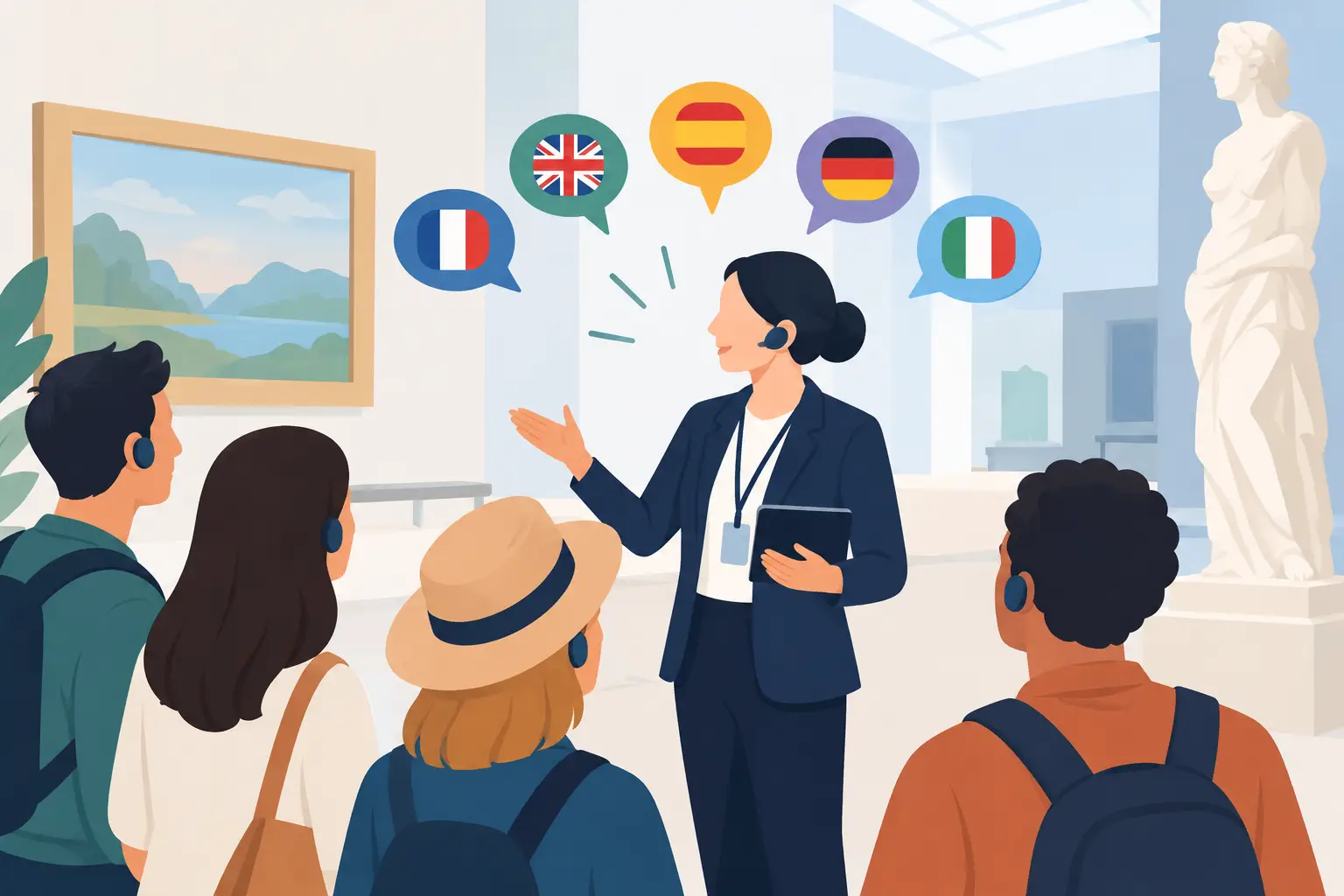
A German visitor in front of a Romanesque chapel, a Dutch family in a municipal museum, an English-speaking group on a heritage trail: everyone must be able to understand what they are looking at without waiting for a guided tour to start or looking for a brochure in their language. Broadcasting a multilingual visit responds to this concrete mediation issue, but also to a reality on the ground: cultural teams need a solution that is simple to administer, reliable on site and financially sustainable.
Multilingualism does not consist of juxtaposing translations. The aim is to offer a coherent, accessible route adapted to the real uses of visitors, including when the mobile connection is limited. Well designed, a digital audio guide makes the heritage more welcoming while avoiding the purchase, loan and maintenance of a fleet of dedicated boxes.
Why broadcast a multilingual tour?
For a museum, a monument or a tourist office, offering several languages naturally broadens access to content. International visitors better understand the history of a place, stay longer on the tour and are better able to recommend a visit. This attention is particularly useful in tourist areas, sites close to borders or establishments which welcome schools and international groups.
However, the interest goes beyond the translation. A tour in the visitor's language creates a more direct relationship with local collections, landscapes and stories. It makes it possible to explain a complex historical context, to make the voices of residents or researchers heard, and to restore the uniqueness of a territory without reducing the discourse to some general information.
For teams, digital technology also avoids the proliferation of printed media, which are often costly to update and difficult to store. When a label changes, a temporary exhibition is extended or a circuit evolves, the content can be corrected from an administration interface rather than reprinted in each language.
Choose the right delivery method
The visitor's smartphone has become the most pragmatic support for a multilingual visit. It limits reception constraints, reduces disinfection and recharging operations, and lets everyone follow the route at their own pace. Access must still be immediate: clear signage and a QR code placed in the right place should allow you to get started in a few seconds, without unnecessary account creation.
The QR code is particularly suitable for museum rooms, interpretation panels or well-identified stopping points. It gives the visitor the choice of opening specific content or starting a complete journey. On an outdoor route, GPS triggering provides another form of comfort: the application can signal the proximity of a stage and offer the right commentary at the right time.
These two approaches are complementary. An interpretation center can rely on QR codes for its collections, then offer a geolocated route in the village or around an archaeological site. The choice depends on the configuration of the premises, the duration of the visit and the degree of autonomy desired for the public.
Do not make the visit dependent on the mobile network
In a historic center with thick walls, on a mountain route or in an isolated monument, the network is never guaranteed. A visit that loads poorly when the visitor needs it immediately loses its use value. The offline mode must therefore be considered from the design stage: useful content is downloaded before departure, then can be consulted without depending on the quality of the coverage.
This precaution is also a gesture of inclusion. It avoids reserving the experience for people with a generous mobile plan or good control of their phone settings. Home Wi-Fi access can be useful, but it does not replace consultation that is truly possible offline.
Guideius addresses every digital cultural mediation challenge
Create a multilingual smartphone audio guide that is easy to deploy, accessible and tailored to your museum, heritage site or destination.
Design content that travels well from one language to another
The first error consists of treating the French version as an untouchable original and the other languages as simple annexes. A quality translation must preserve the meaning, tone and level of precision, while taking into account the cultural references of the target audience. Some heritage terms require an explanation, others a more natural adaptation than a literal translation.
It is often preferable to write short audio sequences, focused on an idea or an object. A two-minute commentary on a facade, a work or a landscape will be easier to listen to, translate and update than a long general speech. The visitor thus retains the freedom to delve deeper into what interests him without feeling captive to a continuous flow.
The voice, rhythm and sound quality are as important as the text. An English version read too quickly or a German translation lacking breathing space can detract from the experience, even if the substance is accurate. When the budget allows it, recording by voices who really master the language makes a significant difference. For more scalable content, a speech synthesis solution may be relevant, provided you check the pronunciation of proper names, places and specialized vocabulary.
Complementary media enrich the subject without weighing it down: archive photography, detail of a work that is difficult to see, plan, transcription or short video. However, they must remain useful to the story. Adding screens just because the technology allows it makes the consultation more cumbersome, especially for visitors who are not comfortable with digital technology.
Thinking about multilingualism and accessibility together
A truly open visit is not limited to foreign languages. Visitors who are deaf or hard of hearing need readable transcripts. Visually impaired people benefit from an interface compatible with screen readers, sufficient contrasts and adapted audio descriptions. Simplified texts or content that is easy to read and understand can also help certain audiences get into the story.
These options should not be added at the end as a technical layer. They influence the way of writing, structuring screens and prioritizing information. A clearly named button, well-cut text and predictable navigation benefit all visitors, regardless of language or digital fluency.
Accessibility also implies maintaining a human and material alternative. Some visitors do not have a smartphone, do not wish to use it or encounter a temporary difficulty. Comprehensible signage, some essential information on site and a reception capable of providing guidance remain essential.
Facilitate administration for cultural teams
A multilingual project is only sustainable if it can survive after its launch. Teams must be able to modify a schedule, replace an image, deactivate a step or publish a new language without systematically depending on a technical service provider. An administration designed for non-specialist profiles saves precious time and limits the risk of the course becoming obsolete.
It is useful to designate a point of contact for content, even in a small organization. Its role is not to produce everything alone, but to check editorial consistency, plan updates and centralize feedback from the field. This organization avoids contradictory versions between the brochure, the panels and the audio guide.
Usage statistics can then inform decisions. Which languages are actually chosen? When do visitors leave the course? Which points of interest are the most visited? This data does not replace observation or discussions with the public, but it helps prioritize improvements. They must be collected soberly, transparently and with respect for visitor data.
Build a realistic deployment
Before translating an entire course, it is wise to identify the most useful languages. Attendance data, exchanges at reception and the tourist profile of the area often provide reliable indications. Starting with two or three well-produced languages is better than promising a large number of incomplete or poorly controlled versions.
A field test is essential. It must involve people who do not know the site, ideally speakers of the languages selected. They quickly spot a poorly placed QR code, a text that is too long, an ambiguous instruction or a GPS step that is triggered too late. Real-world conditions matter: sun on the screen, ambient noise, low battery, no network, group traffic.
Guideius supports this approach with audio tours accessible on smartphones, triggers by QR code or GPS, an offline mode and administration tools designed for cultural structures. The objective is not to make mediation more complex, but to give teams the means to make it evolve at their own pace.
A successful multilingual visit begins with a simple question: what does a person discovering this place for the first time need to understand? By responding with accurate content, reliable access and real attention to different audiences, digital technology becomes a discreet tool serving the encounter with heritage.
Would you like to apply these ideas to your site?
Guideius helps deploy multilingual audio tours with QR codes, GPS, offline mode, multimedia content and privacy-friendly analytics.