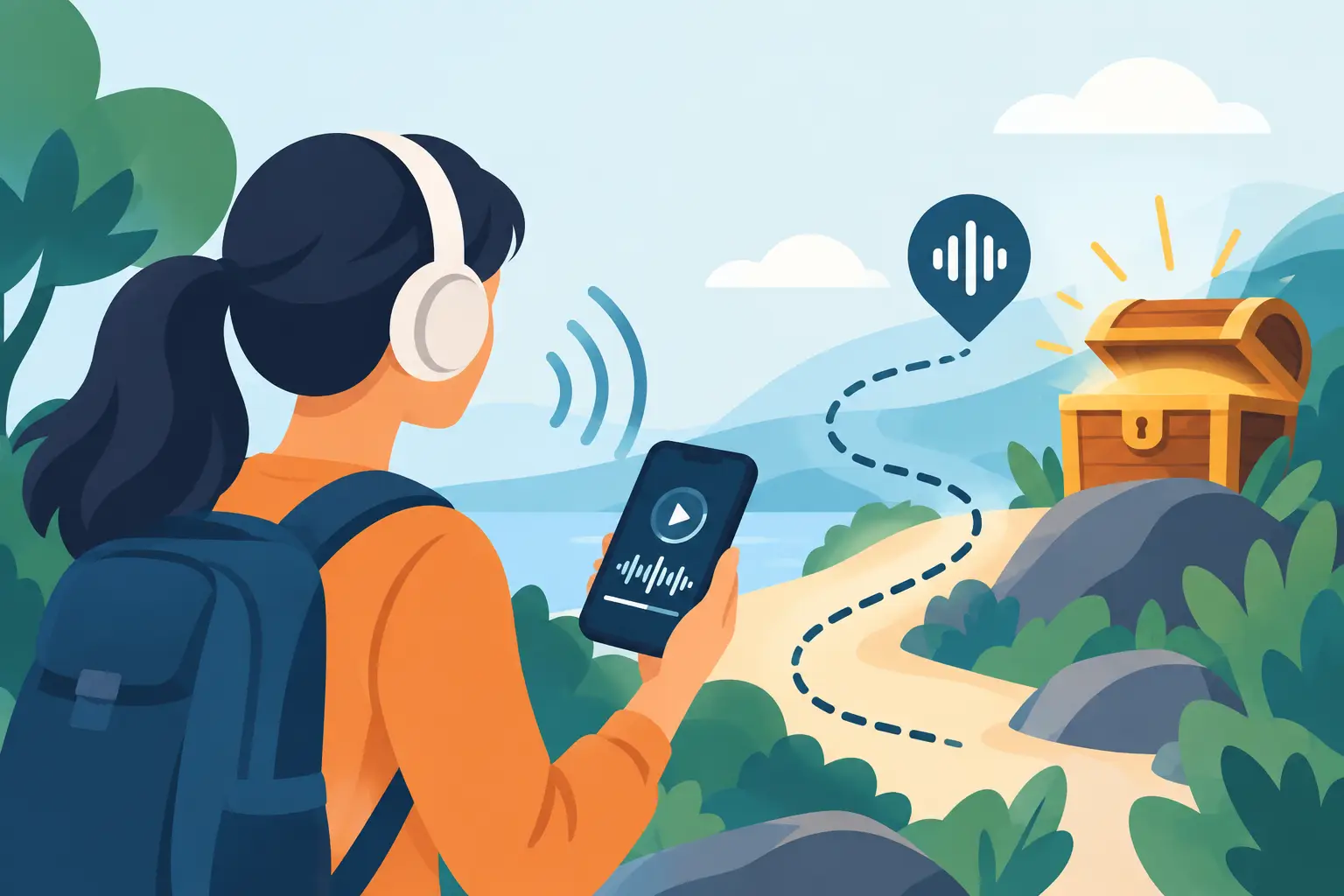
A child stops in front of a coat of arms, hears a voice pose a riddle and then leads their family to the next stop. This scene captures what makes an audio scavenger hunt so valuable: it turns a visit into an active experience without reducing heritage to a simple game. For a museum, historic site or tourist office, a well-designed route combines the pleasure of discovery, high-quality content and straightforward management.
Audio is particularly well suited to this form of interpretation. It lets visitors look around, keeps their hands free and can give a place a distinctive voice: a character's words, a soundscape, a resident's testimony or the recreated sounds of a workshop. A successful hunt, however, is not just a series of puzzles. It relies on a clear scenario, accessible clues and reliable technology on site.
Start with a clear interpretation goal
Before choosing the stops, define what participants should understand, feel or notice by the end of the route. Do you want them to discover the history of a neighborhood, make a complex monument easier to understand, showcase local know-how or encourage families to explore a historic center? This goal will guide the tone, level of difficulty and type of challenge.
An audio scavenger hunt does not need to cover an entire site. A route with six to ten well-designed stops is often more memorable than a very long itinerary. It might revolve around a historical mystery, a fictional character inspired by archival material or a contemporary mission: finding fragments of an inscription, preparing the symbolic opening of a monument or following the journey of a raw material through a territory.
The narrative thread gives visitors a reason to keep moving. It also prevents the puzzle from feeling bolted onto content that could just as easily have appeared on an information panel. Each clue should encourage visitors to observe the site, listen carefully or connect two pieces of information. If the answer can be found without paying attention to the surrounding heritage, the stop should be reworked.
Design an audio scavenger hunt that fits the site
A site survey is a design stage in its own right. Walk the route at different times and look at it through a visitor's eyes. Identify noisy areas, unsafe passages, physical obstacles, places with weak mobile coverage and locations that naturally lend themselves to listening.
Content triggers should support the experience. A QR code works well for a stop in front of an object, façade or starting panel: visitors choose when they are ready to listen. Geolocation is useful for guiding an outdoor walk, creating a surprise as visitors approach a point of interest or reducing the need for multiple physical signs. In a dense space, however, it needs careful calibration so that content is not triggered in the wrong place.
Offline mode deserves particular attention on rural routes, in gardens, along ramparts or inside buildings with thick walls. A game that depends entirely on an unreliable connection creates frustration just when visitors should be focusing on the site. Allowing them to download the content in advance makes the experience more reliable and helps welcome international visitors.
Finally, adapt the actual duration to the context of the visit. A family on holiday, a school group and a visitor passionate about history will not move at the same pace. For a general-audience format, forty-five minutes to an hour is usually enough to maintain engagement. It is better to offer one coherent main route, followed by optional content for visitors who want to explore further.
Write for the ear, not for a brochure
An audio script is not a label read aloud. Use short sentences, concrete vocabulary and directions that help visitors look around: “Look up at the central window”, “Listen to the chime behind you”, “Look for the engraved mark near the door”. One instruction per sequence is often enough.
For each stop, alternate three steps: capture attention, provide an element of the story, then suggest an action or ask a question. This structure avoids overly explanatory recordings and gives the route a natural rhythm. A one- to two-minute audio clip is usually sufficient. Longer passages are harder to follow, especially outdoors or with younger audiences.
Voice quality matters as much as the writing. A warm, clear performance adapted to the subject gives the story credibility. You may not need several actors, but a human voice, a clean recording and restrained sound design can substantially change how the content is perceived. Background sounds should never cover the words or become an artificial backdrop.
The hunt also benefits from deliberate pauses. After asking a question, leave a few seconds for visitors to search, observe and discuss. The smartphone should support the visit, not impose a continuous stream of information.
Guideius addresses every digital cultural mediation challenge
Create a multilingual smartphone audio guide that is easy to deploy, accessible and tailored to your museum, heritage site or destination.
Design inclusive and rewarding puzzles
A good riddle invites visitors to solve it without setting them up to fail. It should be solvable using elements found on site or heard in the audio, rather than prior knowledge available only to a few insiders. Observation questions, architectural details, sounds to identify and narrative choices often work better than abstract riddles.
Plan a graduated hint and, when necessary, a solution that keeps the rest of the route moving. The aim is to preserve the enjoyment of the investigation, not to sort visitors by age, language skills or familiarity with digital technology. This flexibility matters for families, intergenerational groups and occasional visitors.
Accessibility should be considered from the writing stage. A transcript of the audio content helps deaf or hard-of-hearing visitors, as well as people visiting in a noisy environment or still learning the language. Descriptions of essential visual elements, readable navigation, sufficient contrast and unambiguous instructions make the route more accessible in practical terms.
For visitors with reduced mobility, check that every stop is reachable. When a passage is not accessible, provide an alternative route that preserves the meaning of the game. Inclusion is not a layer added at the end of the project: it improves the experience for everyone.
Plan for simple, sustainable management
Designing a route does not end when it goes online. Opening hours, construction work, exhibition changes, new signage or a corrected recording may all require updates. The content should be quickly editable by the team, without depending on a technical provider every time.
A suitable interpretation solution lets teams manage languages, media, quizzes and triggers from a clear interface. With Guideius, organizations can publish a route on visitors' smartphones via QR code or GPS, including offline access, without buying or maintaining a fleet of audio-guide devices. This reduces the work involved in lending, charging, disinfecting and replacing equipment.
Usage data provides another useful source of insight. The number of route starts, the most-viewed stops, the completion rate and the languages selected help reveal real visitor behavior. These indicators do not replace qualitative feedback from visitors and front-of-house staff, but they can highlight a stop that is too long, a confusing riddle or a recurring drop-off.
Set a few evaluation criteria from the outset: Does the route attract the target families? Do visitors complete the mission? Do they understand the content? Can the team update the experience independently? This preparation makes adjustments easier and helps explain the investment to partners or the local authority.
Test with real visitors before opening
A technical test is not enough. Ask people who know neither the site nor the scenario to try the hunt: a family, a teenager, someone who is not comfortable using a smartphone and a person who needs accessibility features. Observe their hesitations without stepping in too quickly. They often reveal problems that the design team no longer notices.
Check the time needed to get started, whether the instructions are clear, the listening volume, the accuracy of the GPS zones and whether the QR codes scan reliably in real conditions. Test in the rain, with sunlight on the screen and when the site is busy. A cultural route has to work in real-life conditions, which are rarely ideal.
A successful audio scavenger hunt leaves visitors feeling that they have discovered something meaningful for themselves. That combination of autonomy, storytelling and attention to heritage is what turns a simple digital route into a genuine interpretation experience.
Would you like to apply these ideas to your site?
Guideius helps deploy multilingual audio tours with QR codes, GPS, offline mode, multimedia content and privacy-friendly analytics.